

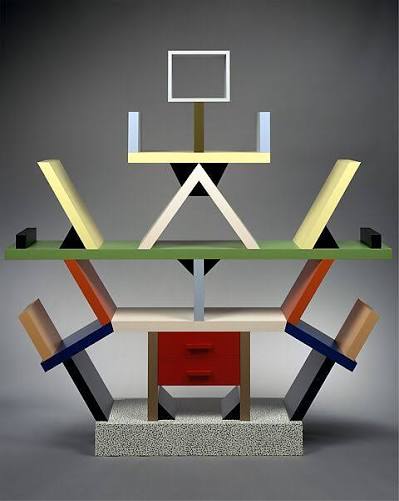
A bookcase that looks like it was assembled from leftover Lego and traffic cones just sold for £52,500 against a £5,000–£7,000 estimate — roughly ten times what Sotheby’s expected. That 1981 Ettore Sottsass “Carlton” room divider came from David Bowie’s private collection, and its sale is one small data point in a much larger reversal: a design movement design critics wanted nothing to do with in 1981 now anchors auction sessions that pull in seven figures, according to World Collectors Net’s coverage of the 2016 Sotheby’s sale.
The Night Milan Booed the Furniture
The Memphis Group didn’t ease into existence. It launched on September 18, 1981, at Milan’s Arc ’74 showroom, after Ettore Sottsass — already in his 60s and a respected veteran of Italian design — invited a group of younger architects to his apartment that December to plan a collective built on “geometric shapes, clashing colors and patterns, and anti-functional forms,” as London’s Design Museum describes it in its own account of the movement. Sottsass served as the collective’s creative nucleus, working alongside critic and partner Barbara Radice to shape a house style built on rule-breaking rather than refinement.
Not everyone was charmed. Fellow Italian designer Vico Magistretti dismissed the furniture outright, saying it “offers no possibility of development whatsoever,” per the Design Museum’s own record of the era’s reception. Designer Jasper Morrison later admitted the collection gave him “a kind of cold sweat” and “a feeling of shock and panic” the first time he saw it. The pieces were loud, plastic-laminated, and built to look cheap on purpose — a direct insult to the polished minimalism that had defined “good taste” in furniture design for a generation.
Function Was Never the Point
That was intentional. Sottsass and his collaborators weren’t trying to build furniture that disappeared into a room — they wanted furniture that interrupted it. Bookcases with no clear top or bottom, shelves at angles that made stacking books genuinely annoying, patterns lifted from 1950s Formica countertops blown up to an aggressive scale. Critics who judged Memphis by the standards of functional design were, in a sense, missing the point entirely: it was closer to sculpture that happened to hold books than furniture that happened to look interesting.
From Punchline to Provenance
The rehabilitation took decades, and it needed the right kind of owners. David Bowie was, by multiple accounts, a serious and early collector of Sottsass and the Memphis group — not a celebrity dabbling in a trend but someone who actually lived with the pieces. When Sotheby’s auctioned his design collection in November 2016 as part of the “Bowie/Collector – Part III: Post-Modernist Design” sale, the session brought in £1.387 million total, with the Carlton room divider and other lots blowing past their pre-sale estimates by a wide margin.
That kind of result changes how auction houses treat a category. A single session pulling seven figures for furniture that critics once refused to take seriously isn’t a fluke — it’s a market signal, and design houses have kept building dedicated Memphis sales ever since, from single-owner collections to themed evening auctions built entirely around the movement’s greatest hits.
What Actually Changed
The furniture itself never got better made or more functional; a Carlton bookcase is still an awkward place to store books. What changed was the distance between Memphis and the mainstream. Major design institutions have since staged dedicated retrospectives and folded Memphis pieces into their permanent holdings — the kind of institutional embrace that was unthinkable to the critics scoffing at Arc ’74 in 1981. Memphis’s bold patterns have resurfaced repeatedly since, including in Christian Dior’s 2011 haute couture collection, and the aesthetic still turns up around Milan Design Week most years.
None of that retroactively makes the movement’s aesthetic universally loved — plenty of people still find it genuinely ugly, and Sottsass would probably have taken that as a compliment. He wasn’t chasing consensus in 1981, and the collectors paying tens of thousands of dollars for his furniture today aren’t chasing it either; they’re paying for the specific, deliberate discomfort that made critics so uneasy in the first place.
But the fact that “genuinely ugly” and “sells for tens of thousands of dollars a piece, with entire single-owner sales clearing well into seven figures,” can now describe the same body of work says less about Memphis changing and more about how design taste gets rewritten by whoever’s willing to bid on it decades later.

Leave a Reply