

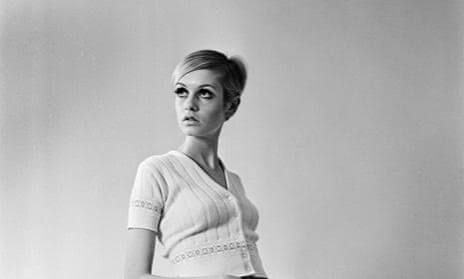
Ninety-one pounds. That was the entire physical fact of Leslie Hornby, a 16-year-old from London who stood five-foot-six with cropped hair and enormous gray eyes, when a single salon photograph turned her into the most talked-about face in fashion within a matter of weeks, according to details documented by the ASU FIDM Museum’s history of the original supermodel. Every previous beauty standard in postwar fashion had prized curves, polish, and adult glamour. Twiggy had none of that, on purpose, and the industry didn’t just accept the substitution — it restructured itself around her almost overnight.
A Salon Photo Nobody Expected to Matter
The image that started it all wasn’t shot for a magazine. Photographer Barry Lategan took a portrait of Hornby for the salon where her hair had just been cropped short, and fashion editor Deirdre McSharry happened to see it, according to Encyclopedia.com’s biography of Twiggy. McSharry ran the photo across a center spread in the Daily Express in February 1966, branding the teenager the “Cockney Kid” and, in the phrase that stuck permanently, “the Face of ’66.” She had left school within weeks to keep up with the bookings that followed. There was no gradual build, no years of catalogue work leading up to a breakthrough — one salon photo, run in one newspaper, was enough to make a sixteen-year-old the most requested face in British fashion inside a single news cycle.
Ninety-One Pounds, Global Headlines
What makes the story unusual isn’t just that a teenager got famous fast — it’s how explicitly the fashion press fixated on her physical specifics as the actual news. By January 4, 1967, Women’s Wear Daily was openly asking how this “slender young thing, completely unspoiled, unpretentious” had rocketed to the top of modeling in under a year, per the same ASU FIDM Museum account. Vogue went further two months later, describing her face on March 15, 1967, as one that seemed “conceived by a computer to match the requirements of the face of the sixties — bony, pale-skinned, big-eyed, vulnerable.” Society photographer Cecil Beaton, no stranger to conventional glamour himself, put the shift in explicitly class-conscious terms: “Today’s look comes from below. The working-class girl with money in her pocket can be as chic as the deb.”
The Mini-Skirt Needed a Body Like Hers
Twiggy’s rise didn’t happen in isolation from what was already shifting on London’s streets. Mary Quant had been pushing hemlines steadily upward through the early 1960s, but it was Twiggy’s frame that gave the look its defining image — the Victoria and Albert Museum’s account of Mary Quant’s career credits Twiggy’s “willowy figure” with helping “turn super-short hemlines into an international trend.” A style that had been building in boutiques for several years suddenly had a single, instantly recognizable face attached to it, and that face happened to belong to someone built entirely differently than the models who came before her. Mod fashion had always been about signaling youth over establishment polish — shorter hems, boxier silhouettes, a deliberate rejection of anything that read as ladylike in the old sense — and a teenager with a boy’s build and a child’s proportions embodied that rejection more completely than an adult model in the same clothes ever could.
A Brand Before ‘Personal Brand’ Existed
The industry moved fast to capitalize on what it had found. Twiggy signed a reported million-pound licensing deal for a clothing line called Twiggy Styles, which launched in May 1967, and her image was stamped across Yardley cosmetics packaging and a Twiggy-branded Mattel doll, according to the ASU FIDM Museum’s account. By August 1967 she was on the cover of American Vogue and, according to the same source, appeared on twelve magazine covers simultaneously — a level of media saturation built almost entirely on a look the previous decade would have considered a liability.
The Standard Didn’t Just Shift — It Inverted
What happened to Twiggy in 1966 wasn’t a gradual evolution of beauty ideals; it was a swap. The traits that would have kept a girl out of modeling a few years earlier — extreme thinness, an androgynous frame, a working-class accent instead of studied poise — became the exact traits the entire industry chased next. Fashion didn’t widen its definition of beautiful that year so much as replace one narrow definition with another, and it did it in the space of a single magazine spread.
That inversion is the part later retellings tend to flatten into a simple girl-power story. It wasn’t purely liberating — the same industry that had excluded anyone who didn’t fit the old glamour mold now excluded anyone who didn’t fit the new one, just as narrowly. What changed in 1966 wasn’t that fashion became more open. It was that everyone suddenly had to look like someone who, a year earlier, would have been told she was too thin for the job.

Leave a Reply