

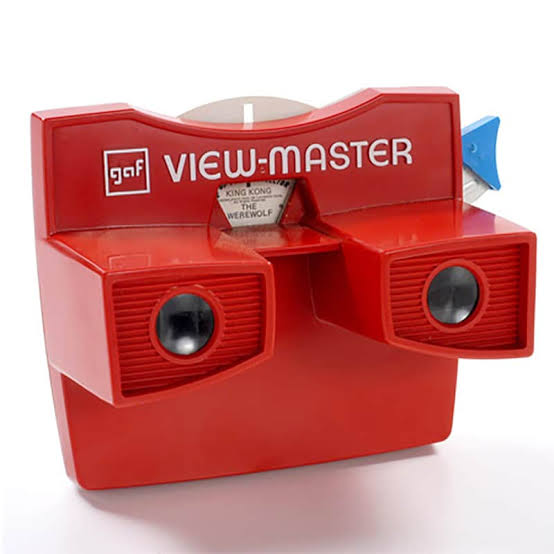
Two Kodak Bantam Specials, strapped together with a homemade rig, pointed at the inside of a limestone cave. That was the odd sight that stopped a postcard publisher named Harold Graves in his tracks at Oregon Caves National Monument in 1938, according to the Oregon Travel Information Council’s account of the encounter. By the time the two men finished dinner that same evening, they’d sketched out the idea that would become the View-Master, a toy that never would have existed if Graves hadn’t happened to be touring the same cave, on the same day, as a photographer testing out a strange double-camera contraption.
A Camera Built for a Problem Nobody Had Asked to Solve
William Gruber wasn’t a toy designer. He was a photographer and piano tuner from Portland with a fascination for stereoscopic imaging, the old parlor trick of viewing two slightly offset photographs simultaneously to trick the brain into perceiving depth. According to the Strong National Museum of Play’s object history, Gruber had built his own rig from two Kodak cameras mounted together specifically to capture stereo images on the newly available Kodachrome color film, and he’d carried it to Oregon Caves that day to photograph the cavern’s interior on paper-mounted 16mm reels. He wasn’t trying to build a product. He was chasing a technical curiosity, updating the same 19th-century parlor stereoscope that had once sat in millions of Victorian drawing rooms into something built around modern color film.
One Dinner, One Deal
Graves, who ran Sawyer’s Photographic Services and made his living publishing scenic postcards, recognized something in Gruber’s odd rig that Gruber himself may not have fully clocked: an entirely new category of photographic souvenir. The two men struck up a conversation on the spot, then sat down together for dinner at the Oregon Caves Chateau that night to talk through what a commercial version of Gruber’s viewer might look like. By the following morning, the pair had reached an agreement to develop it together, according to the Oregon Travel Information Council’s history of the invention, an astonishingly fast turnaround for a product that would go on to define a category of toy for the next eight decades.
A World’s Fair Debut, Aimed at Adults, Not Kids
The View-Master made its public debut at the 1939 New York World’s Fair, and for its first several years on the market, it was sold as a photography accessory and travel souvenir rather than a children’s toy. Early reels featured the Grand Canyon, Yosemite, Yellowstone, Hawaii, and European landmarks, distributed through camera shops, stationery stores, and gift counters at scenic attractions rather than toy aisles, according to History.com’s account of the product’s early marketing. By 1941, the viewer and its reels had reached more than 100,000 stores nationwide, an impressive distribution footprint for a device most Americans still associated with adult tourists rather than kids flipping through cartoon reels.
What the View-Master offered, before television had fully arrived in American living rooms, was something genuinely novel: a version of a photograph that felt like presence rather than a flat picture. Oregon Historical Society executive director Kerry Tymchuk has described the appeal in interviews as something closer to actually being somewhere rather than simply looking at an image of it, and that sense of dimensional immersion is exactly what separated the View-Master from every postcard rack it sat beside.
Mickey Mouse Turns a Novelty Into a Toy
The pivot from adult travel souvenir to genuine children’s toy came in 1951, when View-Master acquired a rival filmstrip company called Tru-Vue, and with it, the licensing rights to Disney characters. Suddenly kids could click through reels of Mickey Mouse, Cinderella, and Snow White rendered in vivid color, at a moment when most American households were still watching everything on black-and-white television sets, per History.com’s account of the acquisition. That single deal reoriented the entire product line toward children and turned a niche photography accessory into a fixture of American childhood, one that would pass through Sawyer’s, GAF, and eventually Mattel’s Fisher-Price division over the following decades, discontinuing its nature and travel reels only as recently as 2008 while keeping character-based reels alive well into the smartphone era.
None of that would exist without the specific coincidence that started it: one photographer testing an odd homemade camera rig, one postcard publisher curious enough to ask what he was doing, and one shared dinner table at a cave in southern Oregon where two strangers decided, almost on impulse, to go into business together. Toy origin stories often get smoothed over into tidy inevitability after the fact, but the View-Master really did begin as pure chance, the kind of meeting that could just as easily never have happened at all.

Leave a Reply