

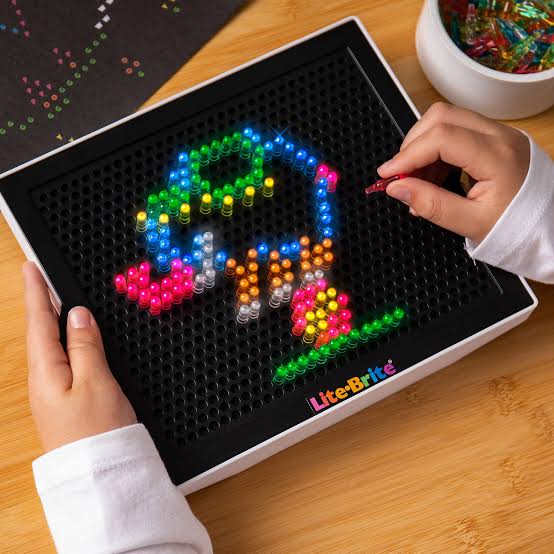
Lite-Brite doesn’t trace back to a toy company’s brainstorm session. It traces back to a Fifth Avenue sidewalk during the 1966 Toy Fair, where designer Burt Meyer stopped to look at a window display built from hundreds of colorful lights, according to The Strong National Museum of Play. He wanted to shrink that effect down into something a kid could hold. What he actually built — a single light bulb behind a grid of translucent colored pegs — got approved for production faster than almost any toy pitch in the company’s history.
A Window Display Rebuilt as a Toy
Meyer worked at Marvin Glass and Associates, the Chicago design firm behind a long list of era-defining toys, alongside colleagues Marvin Glass and Henry Stand. Per the Strong Museum of Play, Meyer’s idea was straightforward once he had it: a single light source and small pieces of translucent colored plastic that a child could push into holes on a panel, lighting up wherever they landed. He built a working version using plastic panels punched with holes, backed by opaque black paper so the bulb’s light would only escape through wherever a peg had been inserted.

Approved in Under an Hour
The toy went straight from prototype to production with almost none of the back-and-forth that usually stalls a new concept. Meyer pitched it to Merrill Hassenfeld of Hassenfeld Bros., the company known today as Hasbro, and Hassenfeld approved the deal in under an hour, according to the Strong Museum of Play. Hasbro brought Lite-Brite to market in 1967. The original set shipped with 400 plastic pegs across eight colors — green, blue, red, yellow, orange, pink, purple, and clear — along with paper templates for simple designs like boats, flags, and ducks that kids could trace by feel in a darkened room.
What made the toy work wasn’t complicated engineering — it was the fact that nobody had bothered to build it before. Turning off the lights and pushing colored pegs into a lit-up board was a genuinely new kind of play experience in a toy aisle still dominated by static plastic figures and wind-up mechanisms. The darkness itself became part of the design: a Lite-Brite creation only really showed off what it was once the rest of the room went black, which meant the toy came with a built-in reason to make it a nighttime ritual rather than an afternoon distraction.
A Toy That Kept Adapting
Lite-Brite’s basic mechanism barely changed for decades, but what you could make with it kept expanding. The template library grew to include alphabet and number sets, then eventually licensed character designs tied to whatever was popular at the moment, according to TIME’s own retrospective on the toy. Later versions folded in everything from Scooby-Doo to Darth Vader to My Little Pony to Mr. Potato Head, turning a fixed piece of 1960s hardware into a rotating showcase of whatever franchise a given decade cared about most.
Recognition Decades Later
TIME ranked Lite-Brite at No. 55 on its All-TIME 100 Greatest Toys list in 2011, placing it in the publication’s 1960s category among the decade’s most influential releases. The magazine’s own writeup leans into the toy’s messier side too, noting that alongside a genuine creative masterpiece, “there were at least a few of the pointy little pegs waiting to be stepped on” — a small, honest acknowledgment that the same design that made the toy magical in the dark also made it hazardous barefoot at 2 a.m.
The recognition didn’t stop with a magazine list. Lite-Brite was inducted into the National Toy Hall of Fame in 2022, according to Wikipedia’s entry on the toy — a formal institutional acknowledgment, more than five decades after that Fifth Avenue sidewalk moment, that a single light bulb and a box of translucent pegs had earned a permanent place alongside toys like the Slinky and the yo-yo in the record of American childhood.
What the Speed of the Pitch Actually Proves
Most toy origin stories get told as struggles — years of tinkering, rejected pitches, a company that almost passed. Lite-Brite’s story is the opposite, and that’s exactly what makes it worth remembering. A designer noticed something ordinary on a sidewalk, rebuilt it small enough to fit on a kitchen table, and had a green light within the hour. Sometimes the idea that lasts fifty-plus years isn’t the one that survives a fight. It’s the one that’s obviously right the moment someone finally sees it.

Leave a Reply