

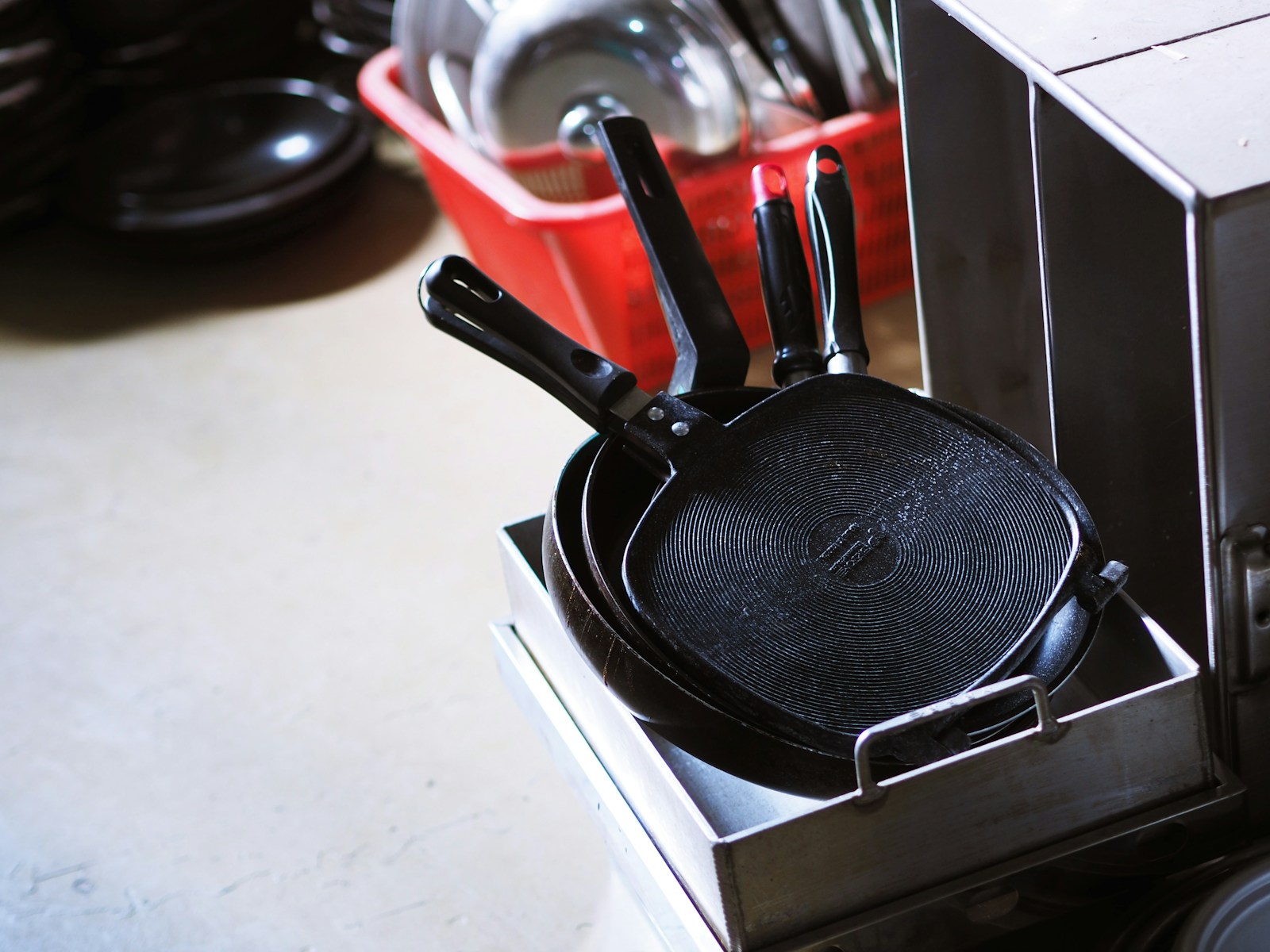
Ten thousand dollars. That is what a single ERIE-marked spider skillet fetched at a two-day cast iron auction in Indiana in August 2024, according to auction results tracked by Griswold Cookware. Most people who inherit a black skillet from a grandmother assume it is worth whatever a flea-market table charges — maybe twenty dollars if the seasoning looks decent. Sometimes that guess is right. But foundry marks stamped into the underside of Griswold Manufacturing Company cookware, cast in Erie, Pennsylvania, from the 1860s through 1957, can turn that twenty-dollar assumption into a four-figure surprise, and the difference lives in details most people scrub off with steel wool before they ever look closely.
The Logo Tells You When It Was Made
Griswold changed its markings several times over the decades, and each version works like a timestamp. Early pieces carry a large “ERIE” arched over a cross, dating to the late 1800s, while later cookware shows a smaller, more stylized logo reading “ERIE, PA,” according to collector identification guides that track Griswold’s foundry marks. Whether the phrase “Made in USA” appears underneath narrows the window even further, since that addition came later in the company’s run. Collectors also watch the handle: Griswold’s classic grip has a long, tapered “drop” with a reinforced rib underneath that comes to a fine point, a shape mass-market imitators rarely bothered to replicate exactly.
None of this is decoration. A skillet’s logo era is often the first filter a buyer applies before they even flip it over to check the pattern number, because certain eras correlate directly with certain price brackets at auction.
Pattern Numbers Are the Skillet’s Fingerprint
Underneath the size number, most Griswold pieces carry a second, smaller number: the pattern number, which told foundry workers exactly which mold to pull off the shelf. A size 10 skillet, for instance, generally corresponds to pattern number 716, while a size 0 corresponds to pattern number 562 and a size 14 to pattern number 718, per the sales data compiled in the Griswold Vintage Cast Iron Skillet Price List. That number is what separates a common size from an oddball one, and oddball sizes are where the real money tends to concentrate.
Consider the size 1 skillet, one of Griswold’s smallest and shortest-produced patterns. An example bearing pattern number 411 sold for $9,500 at that same August 2024 Indiana sale, according to Griswold Cookware’s auction recap. That is not a typo, and it is not an outlier driven by a bidding war between two collectors with more money than sense — small-size Griswold skillets are genuinely scarce because the foundry made far fewer of them than the mid-size workhorses that ended up on every stovetop in America.
What Actually Sells for Real Money
Rarity, not age alone, decides the price. At a February 2019 estate sale in Montgomery, Indiana, a large block logo “EPU” no. 13 skillet brought $2,200 and a matching no. 2 skillet with a heat ring brought $2,000, while a slant-logo “ERIE” no. 2 skillet sold twice in the same sale for $500 and $650, according to prices reported by Antique Trader’s coverage of the Dinky’s Auction Service sale. Dutch ovens performed even better: a no. 13 Dutch oven with its matching low-dome lid sold for $2,700, and a no. 12 pair brought $2,400 at the same event.
Compare that to what turns up at a typical Saturday flea market. A common, mid-century no. 8 skillet with worn or replaced markings, no matching lid, and no early logo will usually change hands for well under $50 — the reason most people’s cabinet find really is just a decent pan. The gap between that and a four-figure sale is not sentiment or a compelling backstory; it is a specific combination of an early or rare logo, a low-production pattern number, an intact heat ring or matching lid, and surface condition free of pitting or heavy rust.
Look Before You Scrub
The instinct to scour a rusty pan back to bare iron is understandable, but it is also how a five-figure identifier gets sanded into an anonymous smudge. Before doing anything else, flip the skillet over, photograph the full underside in good light, and match the logo style, size number, and pattern number against published references. Most skillets really will turn out to be ordinary — but the ones that aren’t tend to reward exactly the patience it takes to check first and clean second.

Leave a Reply