

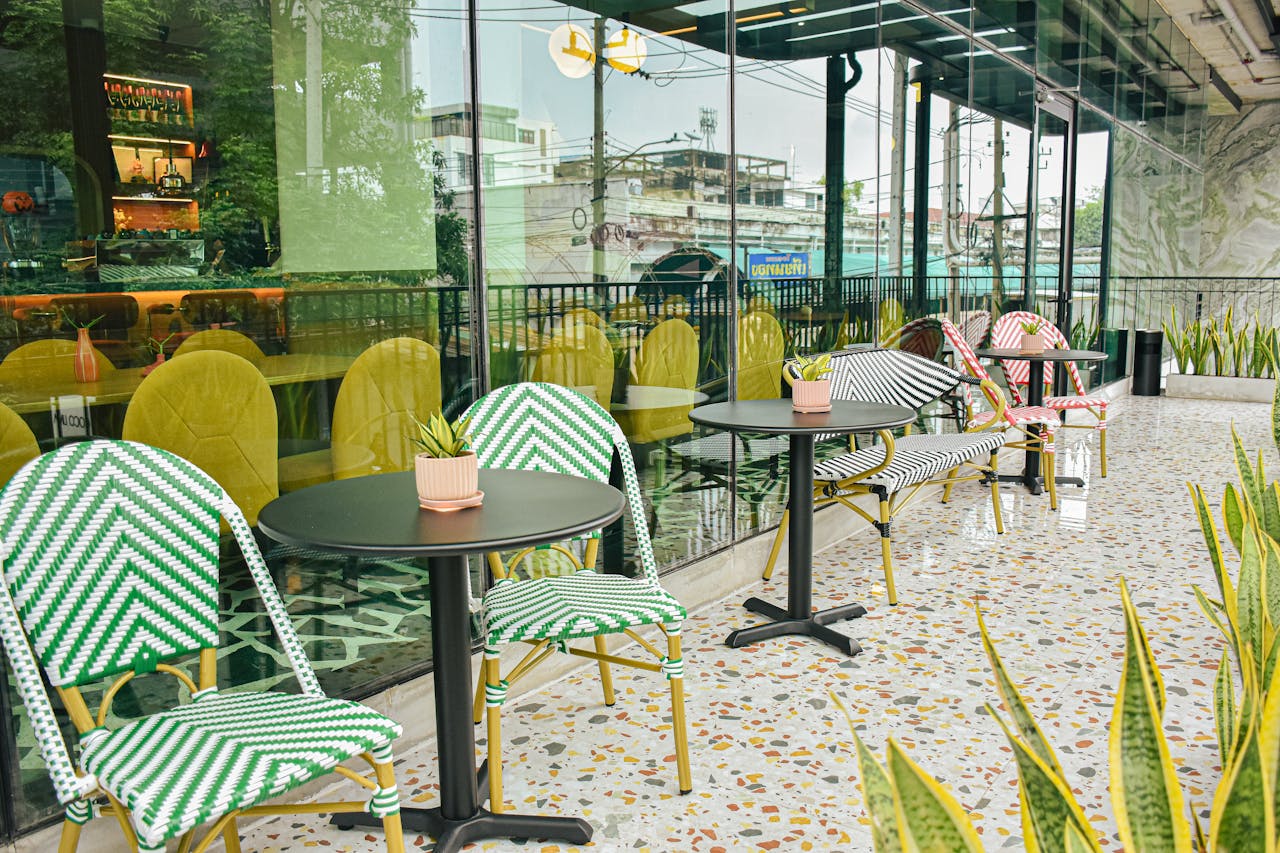
Terrazzo’s most famous American floor isn’t in a house at all. It’s the base of the Space Needle, poured in 1961 near the peak of the material’s midcentury run, according to the National Terrazzo and Mosaic Association’s own history. Three years later, architect Philip Johnson set a terrazzo map of Texaco’s highway network into the ground at the 1964 World’s Fair, and by 1965 Chicago’s McCormick Place had installed the first large-scale epoxy terrazzo floor ever built. Then, for most of the rest of the century, the material got covered up. Now it’s back in kitchens, bathrooms, and home décor, and design writers say this round looks nothing like the terrazzo you grew up walking on in your elementary school hallway.
A Trade Built on Chips of Stone
The National Terrazzo and Mosaic Contractors Association was founded in Chicago in 1923, and membership grew quickly enough over the next decade that the craft became standard in American schools, hospitals, and airports, according to the association’s own account of its history. Two inventions cemented that dominance: the electric grinder and the divider strip, both introduced in 1924, which let installers polish terrazzo to a seamless shine and section it into clean geometric fields instead of one uncontrolled slab. That combination is what turned a centuries-old Venetian technique for reusing scrap marble into a fixture of American design for the next four decades, well beyond the schools and hospitals where the association says it first took hold.
Somewhere Along the Way, It Got Buried
By the last quarter of the twentieth century, terrazzo had largely fallen out of residential fashion in the U.S. Most of what remained in older homes ended up hidden rather than admired, buried under new tile or ripped out entirely for laminate as tastes shifted toward softer, warmer surfaces underfoot. There’s no single documented turning point for that decline, but the pattern turns up again and again whenever a pre-1980s house gets gutted for a renovation and a slab of speckled stone shows up under the subfloor, usually still in decent shape after forty or fifty years of being walked on and ignored.
The Comeback Has a Different Look
The current version doesn’t resemble the flecked school-hallway floor you’re picturing. Dwell’s own material guide to the surface describes a resurgence that arrives “with a bit of a modern twist”: bigger, chunkier aggregate pieces, saturated colors instead of muted institutional neutrals, and a jump from flooring into furniture and home accessories, from side tables to soap dishes. Designer Max Lamb’s Marmoreal, produced by the material studio Dzek, is one of the pieces the guide credits with pulling terrazzo out of beige hallways and into gallery-worthy color. It’s less a revival of what got torn out in the ’90s and more a reinterpretation of it, the same way bell-bottoms came back with a different rise.

A Tile Company Bet Its Own House on It
Kate and Chad Balsis, co-founders of concrete and terrazzo tile manufacturer Concrete Collaborative, tested that bet on their own property. The couple renovated a roughly 2,400-square-foot, circa-1970s house in Dana Point, California, using their company’s own terrazzo and patterned-concrete tile lines throughout, Dwell reported. They ran pink terrazzo pavers along the front walkway and built the interior finishes around the original era of the house instead of gutting it down to the studs, treating the home’s original bones as a feature worth keeping rather than a problem to solve.
What It Actually Costs to Bring Back
Reviving the look isn’t cheap, and it was never really meant to be a splurge material in the first place. Precast terrazzo tile starts around $9 a square foot, poured cement terrazzo with labor included runs $15 to $25 a square foot, and elaborate custom patterns can climb past $35, according to This Old House. The tradeoff is longevity: installed correctly, terrazzo can last up to a century, though it requires professional installation, periodic resealing, and pH-neutral cleaners rather than whatever’s already sitting under your kitchen sink. Judged strictly by cost per year of use, it may be one of the more reasonable “trendy” floors you could put in.
Terrazzo didn’t get reinvented so much as it got rediscovered by a generation that never had to rip it out themselves. That’s usually how it goes with the materials your parents replaced: they don’t disappear so much as wait under the carpet, patient, until someone young enough mistakes them for something new.

Leave a Reply