

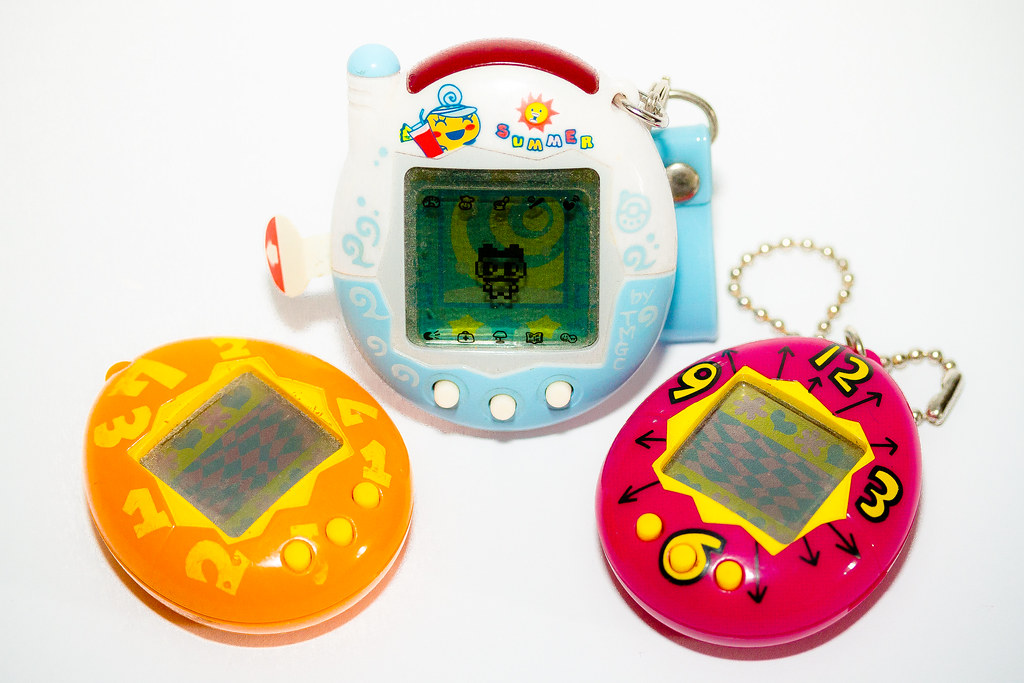
Bandai released the Tamagotchi in Japan in November 1996, and within the toy’s first year on the market roughly 20 million units had sold in Japan alone, with another 20 million moving in markets abroad — a pace of demand that reportedly had the company scrambling to produce around 3 million units a month just to keep shelves stocked. Thirty years later, the egg-shaped digital pet is getting a full anniversary run of exhibitions and product drops, marking one of the rare ’90s toy fads that never actually stopped selling.
An Egg, a Watch, and a Guilt Trip
The name itself was the whole pitch: “Tamagotchi” is a portmanteau of the Japanese word tamago (egg) and the English “watch,” according to Tokyo Weekender’s history of the toy, which credits Bandai employee Aki Maita, then 30 years old, as the toy’s creator. JAPAN HOUSE Los Angeles’s design retrospective on the toy credits the design firm WiZ and Bandai’s Takeichi Hongo as key collaborators on the concept, and frames the toy’s real innovation as less about the pixel-pet graphics than the emotional mechanism underneath them: a device that couldn’t be paused, so that neglecting it had real, visible consequences. The device shipped in a deliberately simple, egg-shaped plastic shell with a tiny monochrome LCD screen and three buttons — a minimal, low-cost design that made it easy to manufacture at the volumes Bandai suddenly needed once demand outstripped every internal sales projection within weeks of launch.
That always-on design is what separated it from every other handheld toy on the market. Tokyo Weekender’s reporting describes the effect bluntly — the toy offered “a sense of simulated responsibility,” and losing a neglected pet to a preventable digital death is remembered by an entire generation as a genuinely emotional event, not just a game-over screen. The same relentlessness that made the toy emotionally sticky also made it a classroom liability: the unmuted beeping that signaled a hungry or dirty virtual pet was loud and frequent enough that schools across the U.S. and Japan moved quickly to ban the devices from classrooms within the toy’s first year on shelves, turning it into contraband kids smuggled in anyway, tucked into pencil cases and hoodie pockets during the exact lessons it was most likely to start demanding attention.
Thirty Years of Refusing to Stay Retro
Unlike most mid-’90s toy crazes, Tamagotchi never fully receded into nostalgia-only territory. JAPAN HOUSE Los Angeles’s coverage notes Bandai has kept the product line commercially active for three decades, with current entries like Tamagotchi Paradise reportedly still selling out regularly rather than surviving purely on collector demand. The 30th-anniversary calendar has leaned into that continuity rather than treating the toy as a museum piece exclusively: Tokyo Weekender reports a “Dai Tamagotchi” exhibition ran at Tokyo’s Roppongi Museum from January 7 through February 2, 2026, alongside region-specific “Tama Destinations” console releases tied to the anniversary. That the anniversary calendar spans a physical museum show in Tokyo, region-locked hardware drops, and a still-active mainline product line all at once is itself unusual for a toy this old — most 1990s properties get one of those treatments, not all three simultaneously.
The exhibition framing matters here: Bandai is treating a handheld toy with the same institutional weight usually reserved for gaming consoles or fashion labels, a sign of how far the brand’s cultural standing has traveled since it was mostly known as a schoolyard distraction teachers tried to confiscate. It also set a template the toy industry has borrowed from repeatedly since — Nintendogs, Neopets, and a whole genre of mobile care-sim apps all run on some version of the same core mechanic Bandai patented first: an entity that needs you specifically, on a schedule you don’t control, whether that entity is pixelated or, decades later, rendered in full color on a smartphone screen.

Why a Digital Pet Outlasted Its Own Fad Cycle
Most ’90s toy phenomena — Beanie Babies, Furby, Pogs — became collector-market curiosities once the initial hype cycle burned out. Tamagotchi’s staying power comes down to the fact that its central mechanic, a small creature that depends entirely on you and punishes inattention, doesn’t actually age out the way a fad character or a trading-card gimmick does. Thirty years on, that’s still an unusually direct emotional hook for a piece of plastic that fits on a keychain, and it’s why Bandai can stage a museum retrospective for a toy that, unlike most of its 1996 shelf-mates, never really needed reviving in the first place.

Leave a Reply