


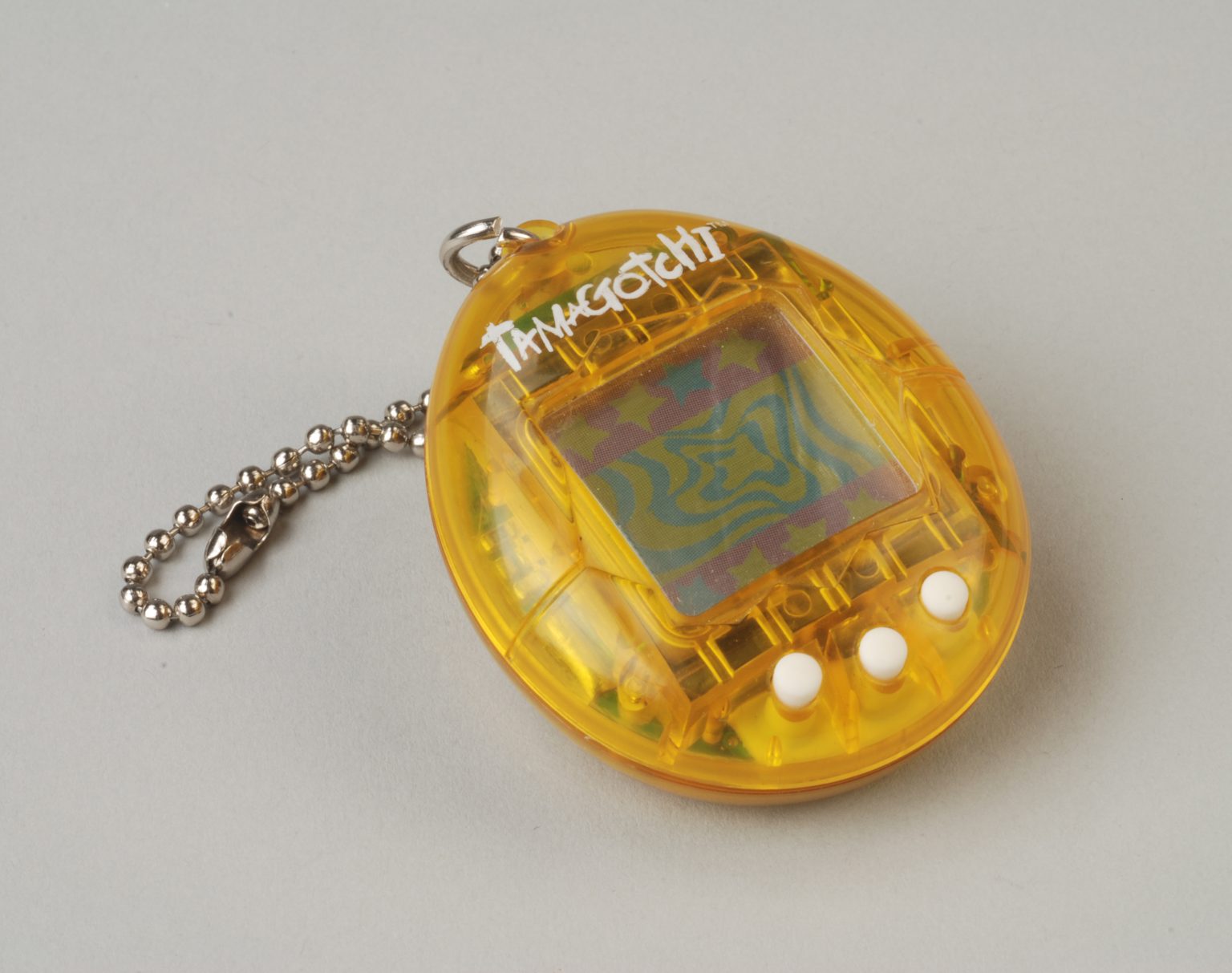
Thirty years ago this November, Bandai put a plastic egg on shelves in Japan that beeped, demanded feeding, and guilt-tripped an entire generation into obsessive caretaking. Tamagotchi launched on November 23, 1996, and moved 10 million units in Japan within its first eight months, according to Bandai Namco Holdings’ own investor newsletter. Cumulative worldwide shipments passed 100 million units by July 2025, the company reported, nearly three decades after a single virtual chick first hatched inside a keychain-sized shell. In between, schools confiscated it, executives treated it as a fad that would pass, and it kept selling anyway. Now Bandai is spending 2026 throwing the anniversary party that little egg earned.
The Egg That Got Banned Before It Got Big
The name is a mashup of “tamago,” Japanese for egg, and the English word “watch,” and the entire appeal of the toy was the anxiety of a schedule you could not ignore. Feed it, clean up after it, or watch it die, on a loop that did not pause for algebra class. Within about a week of Tamagotchi’s debut, Honolulu’s Iolani School had already banned the device, according to a June 1997 report in the Honolulu Star-Bulletin; students caught with one paid a $1 ransom to get it back, and repeat offenders lost it for two weeks. Punahou School lumped Tamagotchi in with Walkmans and handheld video games as contraband, and other Oahu schools followed once the toy started pulling attention away from class. The bans were never really about the plastic. They were about a device that had, for the first time, made kids answer to a schedule set by a screen instead of a bell.
From Infrared to Wi-Fi
Bandai never let the format sit still. In 2004 it added infrared communication so two Tamagotchis could interact directly, and that generation of devices alone moved another 5 million combined units, according to the company’s own account of its product history. A color LCD screen arrived in 2008, alongside an animated series that turned the pets into a real cartoon property instead of just a gadget. The biggest jump came in 2023, when Tamagotchi Uni launched as the brand’s first simultaneous global release, adding Wi-Fi connectivity to a device that had spent its entire life sealed inside a plastic shell. The momentum kept building into 2025: Tamagotchi Paradise hit shelves, and Bandai opened a dedicated Tamagotchi Factory retail concept in Tokyo’s Harajuku district.
A 30th Birthday With a Marketing Budget
Bandai Namco Toys & Collectibles America is not treating the anniversary like a quiet reissue. The company unveiled a full slate of anniversary products, limited-edition collectibles, and brand partnerships for 2026 — including a collaboration with case maker CASETiFY, a tie-in dining experience with Kura Sushi, and a takeover of MINISO’s Times Square storefront — as part of what it calls a national celebration, according to the company’s own announcement distributed via PR Newswire. “For 30 years, Tamagotchi has remained culturally relevant because it has grown alongside its fans,” said Tara Badie, senior director of toys at Bandai Namco Toys & Collectibles America, in that same release. The lineup also made its debut at the New York Toy Fair in February 2026, where the brand set up at the Jacob Javits Center with character appearances and merchandise timed to the milestone.
Nostalgia Did What Marketing Couldn’t
None of this works without the adults who grew up carrying one. Tamagotchi’s resurgence tracks with what toy-industry watchers call the “kidult” category — teens and grown adults buying nostalgia-driven toys, a segment the Japan Times described as a multibillion-dollar piece of the industry that has been reshaping how companies like Bandai plan their release calendars. It runs on the same instinct driving Y2K fashion racks and cassette-tape reissues: a specific hit of recognition that no algorithm can manufacture from scratch. The egg from 1996 has not gotten any less demanding, either — you can still let it die of neglect just as easily as you could in 1997. It just found a generation with its own income and a soft spot for exactly that kind of low-stakes chaos.
Tamagotchi’s second act is not really a toy story. It is proof of a pattern that keeps repeating across every category this site covers: a product does not need to evolve past its original idea to survive a few decades. It just needs to wait for the people who loved it the first time to grow up, get a paycheck, and buy it again — for themselves this time, not their parents.

Leave a Reply