

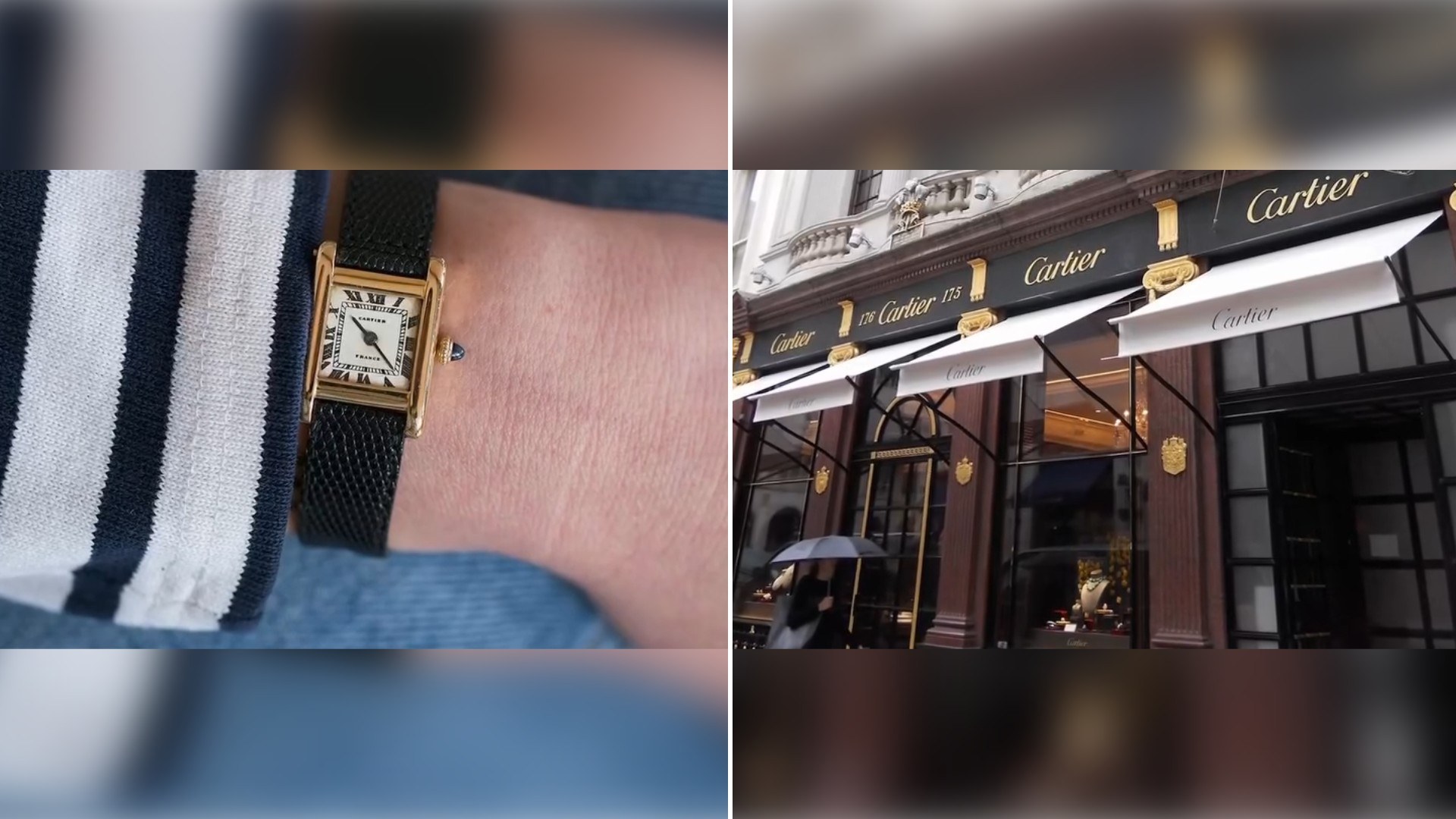
Some of the most compelling vintage-object stories online come not from the owners themselves but from storytellers who specialize in tracing an item’s history, and that is exactly the format @financialteapodcast works in, narrating over a montage of a vintage watch and archival black-and-white photographs. Worth noting from the outset: the account is a third-party storytelling and podcast page built around narrating celebrity and pop-culture history, not the watch’s actual owner or someone with firsthand access to the object, so the provenance claims below are best understood as the story being told rather than independently verified fact.
According to the story shared by the account, a vintage Cartier watch was inherited within the extended Kennedy and Radziwill family circle, reportedly passed down before eventually being sold at auction and, according to the telling, resurfacing years later in Kim Kardashian’s possession. The narration leans heavily on the watch’s supposed journey between high-profile owners across several decades, using that arc to carry the emotional weight of the piece.
Object-provenance storytelling has become its own popular genre within pop-culture-history content, often blending genuinely documented auction records with more loosely sourced family lore, and the results can be difficult for casual viewers to fully fact-check in real time. Stories involving prominent families like the Kennedys and high-profile figures like Kardashian understandably draw outsized attention, but that popularity is exactly why claims like these deserve a healthy dose of skepticism until confirmed through an auction house record, an estate document, or another independently verifiable source.
None of that undercuts why a story like this resonates. A single object supposedly moving between multiple famous households over decades taps into a fascination collectors have long held with provenance generally, the idea that an item’s value and meaning are shaped as much by who touched it before you as by its craftsmanship alone.
That fascination with provenance is not unique to celebrity storytelling; it runs through nearly every serious collecting category, from vintage furniture to rare books to fine watches. A Cartier piece is already a significant object purely on the strength of its craftsmanship and brand history, but a documented or claimed chain of ownership through notable hands adds an entirely separate layer of value, one that has nothing to do with materials or manufacture and everything to do with story. That second layer is often what separates a merely nice vintage piece from one that commands genuine attention at auction.
It is worth unpacking, too, why this particular kind of provenance narrative is so hard to verify from the outside. Family heirlooms often pass through private sales, informal gifts, or estate settlements that never generate the kind of public paper trail a formal auction does, meaning even a genuinely accurate family history can be functionally unprovable to anyone without direct access to the family’s own records. A viewer is left, essentially, trusting the storyteller’s research and sourcing, which is exactly why an account’s track record and transparency about its sourcing matters so much in this genre.
There is also a meaningful difference worth drawing between this kind of third-party narration and a documented museum or auction house provenance record, which typically requires physical evidence at each step, a bill of sale, an insurance appraisal, a photograph with clear dating. A podcast-style narration can reference those same kinds of sources without actually showing them on screen, leaving the viewer to take the account’s word for the underlying research rather than seeing the paper trail directly. That gap between citing sources and showing them is worth keeping in mind whenever this genre of content crosses from entertaining storytelling into something presented as settled historical fact.
The montage format itself, archival photographs layered with narration over a shot of the object in question, has become a recognizable visual shorthand for this kind of content, borrowing techniques from documentary filmmaking to lend a sense of historical weight to a story that may or may not hold up to the same rigor an actual documentary would apply. That borrowed visual authority is worth watching for specifically, since a well-produced montage can make a loosely sourced claim feel far more credible than its underlying evidence actually supports.
For readers drawn to this kind of story, it is worth enjoying as exactly what it is: an engaging piece of pop-culture-history narration built around a compelling object, rather than a documented, sourced account of the watch’s ownership.
There is also something worth saying about why watches specifically lend themselves so well to this kind of multi-generational provenance storytelling. Unlike clothing, which wears out, or jewelry, which is sometimes melted down or reset, a well-made mechanical watch can genuinely function for decades, even generations, passing from owner to owner in working condition the entire time. That durability makes a watch a uniquely plausible vessel for exactly the kind of decades-spanning ownership chain being described here, whether or not this specific account holds up to scrutiny.
It is also worth noting how this genre of content interacts with the broader public fascination with the Kennedy family specifically, a fascination that has generated its own enormous body of documented history alongside a steady stream of looser, harder-to-verify anecdotes and family lore. Object-provenance stories tied to the family tend to travel especially far online precisely because that appetite for Kennedy-adjacent history is already so well established, giving any claim involving the family a kind of built-in audience regardless of how solidly it has actually been sourced.
Whatever the watch’s actual journey turns out to have been, the enduring appeal of a story like this one says less about any particular family or celebrity and more about how much collectors, and audiences generally, want their objects to come with a story worth telling.

Leave a Reply