

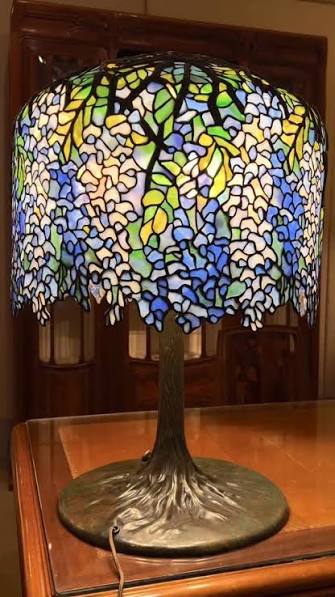
One Tiffany Studios Wisteria lamp, its shade built from more than 1,000 individually cut pieces of mottled opalescent glass, sold at Sotheby’s for $1.5 million, a price that says more about hand-cut glasswork’s staying power than any decorating trend report could. Louis Comfort Tiffany began producing these mosaic-style lamps around 1895, and the workshop’s most celebrated design, the cascading wisteria pattern, was designed in 1900 and produced for over three decades. That kind of glowing, jewel-toned glasswork was common enough in American living rooms by the 1970s that it became background furniture rather than a showpiece. Interior designers are now specifying it again, and they are doing so for reasons that have little to do with nostalgia for a grandparent’s side table.
The Woman Behind the Most Famous Design
Tiffany’s name is on the lamps, but the Wisteria design and many of the studio’s other botanical patterns came from Clara Driscoll, who led the company’s Women’s Glass Cutting Department, a team that became known internally as the “Tiffany Girls.” Driscoll originally designed the Wisteria lamp in 1900, according to a history published by the Cleveland Museum of Art, and her department was responsible for selecting and cutting much of the glass that made the studio’s naturalistic patterns possible. Her contribution went largely uncredited for decades, surfacing publicly only after later research connected her name to specific surviving designs. The pieces attributed to her department now anchor major museum collections, a level of institutional recognition that took far longer to arrive than the lamps themselves took to become popular in the first place.
Why Designers Are Reaching for Them Again
Arlie Sulka, owner of the New York gallery Lillian Nassau LLC, which has specialized in Tiffany glass since 1945, told Homes & Gardens that renewed interest tracks with a broader cultural discomfort around automation. “As some parts of society are turning towards automation, AI, screens, etc., there are those who yearn for objects made meticulously by hand,” she said. Nadia Watts, a Colorado-based interior designer who is also Louis Comfort Tiffany’s great-great-granddaughter, offered a related read in the same piece, describing the appeal as “a desire for depth and sensory richness” and “a direct connection to the natural world” that flat, uniformly lit rooms can’t provide.
A Reaction Against Screens and Flat Light
What both women are describing, in different language, is a rejection of the evenly lit, low-texture rooms that dominated the previous decade of interior design. A single stained-glass lamp changes how light behaves in a room rather than just where it comes from, scattering color instead of producing one uniform glow, which is precisely the quality that made these pieces common in the 1970s and then unfashionable once brighter, simpler lighting took over in the decades after. Homes & Gardens frames the current wave as part of a larger move toward “maximal, handcrafted exuberance,” positioning hand-cut glass as a deliberate counterpoint to minimalist, AI-assisted design rather than a simple return to an old look. That framing matters because it separates this revival from a purely sentimental one. The pitch has nothing to do with efficiency; an LED panel will always outperform hand-cut glass on brightness per dollar. What a mass-produced shade cannot fake, no matter how closely it copies the color palette, is texture, the small irregularities of hand-cut glass, and visible evidence that a person assembled the thing piece by piece.
From Church Windows to the Living Room
Stained glass didn’t start in living rooms, and its move there is itself a story about craftsmanship outliving its original purpose. The technique Tiffany’s studio refined had been used for centuries in religious architecture, and his innovation was largely technical: a proprietary process for producing opalescent glass with color and texture built directly into the material rather than painted on top of it, which is what let the Wisteria and its sister designs achieve the layered, naturalistic color the Cleveland Museum of Art credits to Driscoll’s department. That same glass, sitting on a side table instead of filling a cathedral window, is what current designers are describing when they talk about depth and warmth that a flat lampshade cannot replicate.
A century-old technique built for churches ended up defining a decade of American living rooms, fell out of fashion, and is now being specified again by people who could light a room any way they wanted and chose the one that scatters color instead.

Leave a Reply