


A single one-quart casserole dish, printed with four-leaf clovers and hearts, drew 119 bids on eBay and ran the price to $22,100 before the auction fell apart.
The pattern is called Lucky in Love, Corning never sold it to the public, and depending on which Pyrex collector you ask, it’s either the rarest piece of American kitchenware ever made or a rumor that took forty years to get a price tag.
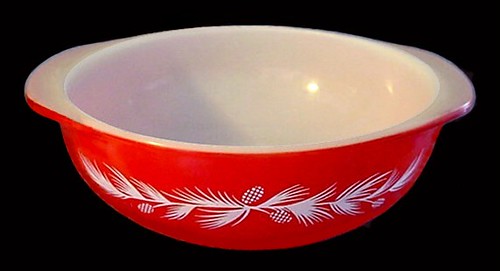
Quality control rejected the run before it ever reached store shelves. The dish also carried an opal-white lid design that Corning wouldn’t put into regular production again for another 13 years, which means the rejected test run was, in a strange way, ahead of its own product line.
The Corning Museum of Glass still holds the original test bowl in its permanent collection; almost nothing else survived, because there was nothing else to survive — the pattern was never manufactured for sale.
For decades, that was basically the whole story: a bowl collectors had seen in reference books and never in person, traded in whispers at estate sales and swap meets. Some doubted it existed outside of factory rumor, since a batch that small could plausibly have been destroyed entirely before it ever left the plant. Then examples started surfacing, and the prices started proving the rumor right.
A Price That Kept Climbing
A Lucky in Love dish sold for around $4,000 in 2015. Two years later, Goodwill of Western New York put one up on its own online auction platform, shopgoodwill.com, and watched it close at $5,994 — at the time, the highest bid the charity’s site had ever recorded, according to Goodwill’s own account of the sale. The listing pulled in roughly 19,000 views and 60 bidders, numbers a secondhand casserole dish has no business generating, and the sale was notable enough to get written up in a print antiques trade magazine that same month.
Then, in July 2022, a listing on eBay blew past all of it. Bidding climbed to $22,100 across 119 bids, a number multiple collectors flagged as the highest ever offered for a single piece of Pyrex. The auction had real drama behind it, too: according to reporting from Hunker, a TikTok user who documents Pyrex sales tracked the listing in real time and revealed that an earlier bidder had briefly offered roughly $45,000 before getting cold feet and withdrawing, fueling speculation among collectors that a museum, or even a celebrity homemaker, might be quietly bidding. When the dust settled at $22,100, the winning bidder walked that offer back too, telling the seller it had been placed “by mistake.” The dish went back on the market. The $22,100 figure still stands as the number collectors point to when they talk about what Lucky in Love is worth, cold feet and all.
What’s Sitting in Your Grandmother’s Cabinet
You don’t need a Lucky in Love to have something worth checking. Vintage Pyrex from the 1950s through the 1970s gets donated to thrift stores and Goodwill bins constantly, usually because whoever’s clearing out the cabinet has no idea a specific pattern, run, or color variant can be worth real money to the right buyer. Most of it isn’t. A common Butterprint or Gooseberry bowl in decent shape might fetch $20 or $30 online, not thousands. The difference gets sorted out these days in online collector communities that have gotten remarkably good at spotting a rare glaze or a discontinued color from a single blurry photo.
But the gap between “donate it without a second thought” and “photograph it before you let it go” often comes down to a pattern name most people have never heard of — a promotional test run, a short production window, a printing flaw that should have been a defect and became a feature. Lucky in Love is the extreme case: a bowl that was never supposed to leave the factory, now worth more than most people’s cars. It’s also a reminder that the boring beige box of hand-me-down kitchenware in the basement deserves a five-minute search before it heads to the donation pile, because somewhere out there, a Corning reject from 1959 just keeps proving the collectors right.

Leave a Reply