

James Wright was in his sixties, working in a General Electric research lab in New Haven, Connecticut, when he mixed boric acid into silicone oil in 1943 and produced a substance that was, by every measure the U.S. government actually cared about, a complete failure.
photo credit: pexels
The country was in the middle of World War II, and Japan’s advance across Southeast Asia had cut off the rubber plantations that supplied most of America’s natural rubber. Tires, gaskets, hoses, boots — an enormous share of wartime industry ran on rubber, and suddenly there wasn’t nearly enough of it. The federal government leaned on chemical companies to find a synthetic substitute, and GE, which had employed the Scottish-born Wright for roughly 35 years across its Schenectady and New Haven labs, put him on the case. His approach was to try swapping silicon into rubber’s carbon-based chemistry, chasing the same stretch and bounce with a different atomic backbone.
What came out of the test tube instead was strange in ways that had nothing to do with tires. The stuff stretched like taffy, bounced noticeably higher than a rubber ball, and could be pressed onto a comic strip or newspaper page to lift the ink clean off the paper. Struck hard and fast, it shattered like glass. Left alone, it slowly puddled and flowed like a very patient liquid. It was, by the Strong National Museum of Play’s own description, “a solid liquid” — genuinely useful for almost nothing GE’s engineers could think of, and definitely not a rubber substitute the War Production Board could put in a jeep tire. GE circulated samples to engineers around the world hoping someone would find an application. Nobody did, and the compound sat around as a curious dead end for the better part of a decade, filed away as an interesting failure by a company that had far more pressing wartime priorities than a toy that wouldn’t exist as a category for another seven years.
Wright himself never got rich off any of it. He’d been a career industrial chemist rather than an entrepreneur, and by the time Hodgson turned the compound into a retail phenomenon, Wright had no ownership stake in what it became — the eventual GE patent and the rights Hodgson negotiated separated the inventor almost entirely from the product’s runaway commercial life. He died in 1959, less than a decade into Silly Putty’s rise, having spent the vast majority of his 35 years at GE working on problems that never got anywhere near a toy shelf.
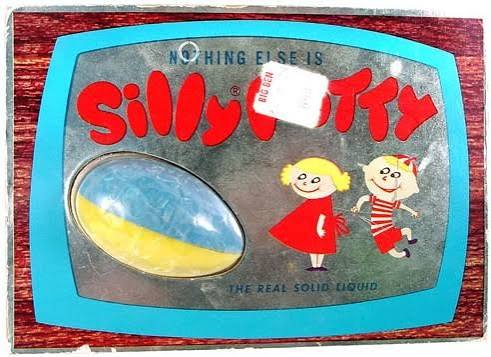
The pivot came from a toy-store owner and marketing consultant named Peter Hodgson, who spotted the bouncing, ink-lifting oddity at a party and recognized something the chemists hadn’t: it was fun. Already $12,000 in debt from other ventures, Hodgson borrowed $147 to buy a batch of the material from GE, which had found no commercial use for it and was happy to let it go, then split it into one-ounce blobs and packaged each one inside a plastic egg — cheap to produce and perfectly timed for Easter. He listed it in his catalog first as “Nutty Putty” before settling on the name that stuck.
The real explosion happened almost by accident, too. A 1950 piece about the novelty ran in The New Yorker, and within three days Hodgson’s tiny operation had racked up orders for a quarter million eggs. The business nearly died anyway: when the Korean War broke out in 1951, the government rationed silicone as a strategic material, and Hodgson’s supply dried up for roughly a year before restrictions eased and production resumed. He kept pushing the product toward a younger audience, and in 1957 he ran Silly Putty’s first television commercial during a broadcast of The Howdy Doody Show, a move that shifted the putty’s core buyers from novelty-seeking adults to children between about six and twelve — the audience it’s kept ever since.
Silly Putty has never really slowed down since that pivot. It was named to the National Toy Hall of Fame in 2001, a quarter century after Hodgson’s own death in 1976, colored and glow-in-the-dark variants followed in the early 1990s, and the little plastic egg has by now sold in the hundreds of millions worldwide, according to the same GE-adjacent origin story the Strong museum still tells to visitors today.
What’s easy to miss, looking at a toy chest staple that costs about a dollar, is how directly it traces back to a failed defense contract nobody talks about anymore. The rubber shortage that started it all ended decades ago. The compound built to solve it never once got used for that purpose. And the thing that came out of the wreckage outlived the war, the shortage, and just about every rubber substitute that actually worked as intended.

Leave a Reply