

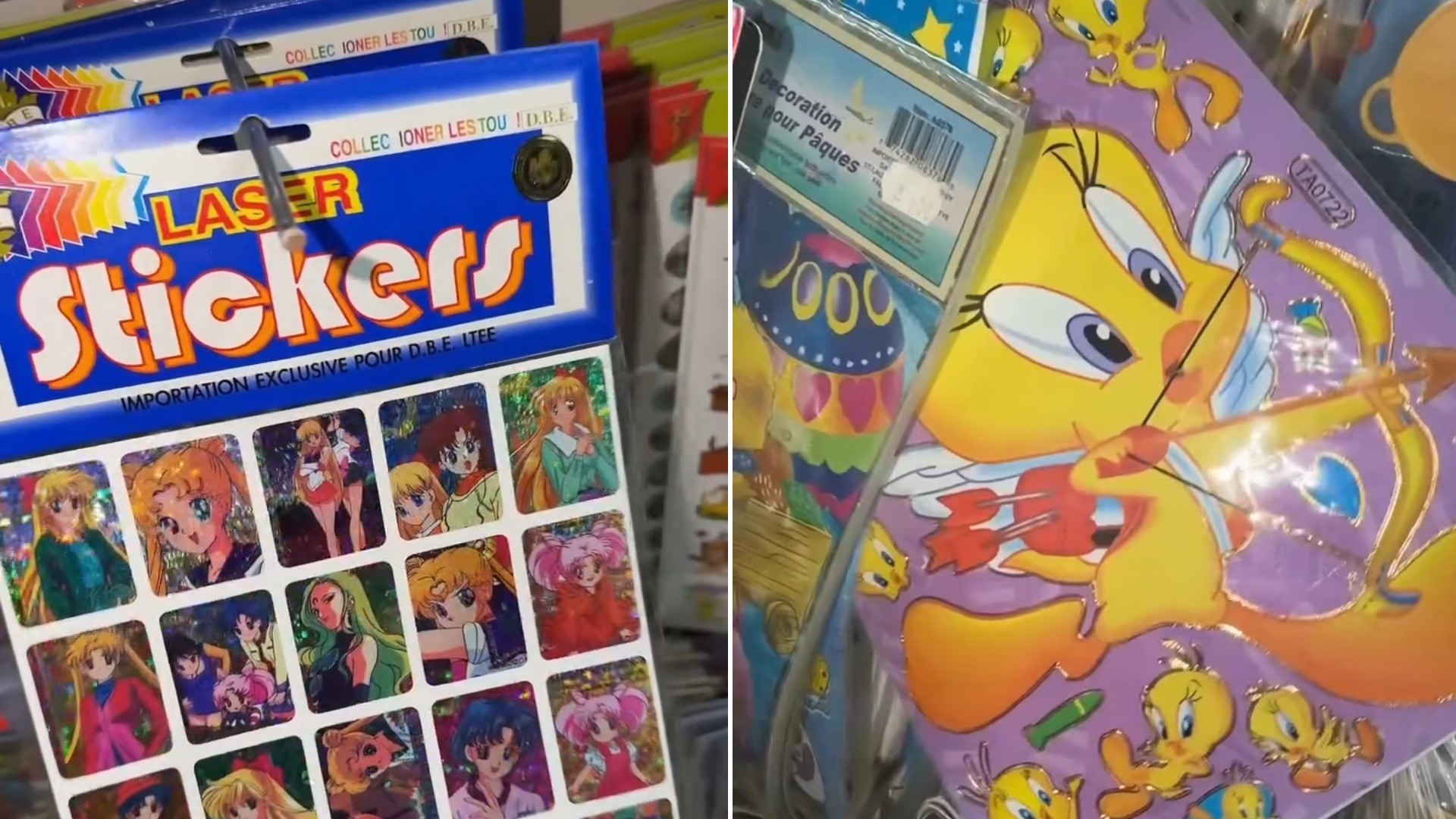
Deadstock stores occupy a very specific niche within secondhand shopping, and @swaggheaven gives viewers a proper guided tour of one in a first-person walkthrough video, highlighting old merchandise that has sat, never sold, still sealed in its original packaging for decades. The tour format lets the video linger on individual finds rather than rushing through a general haul, and one discovery in particular stands out: a set of original 1990s Sailor Moon stickers, untouched since the era that produced them.
The creator’s reaction to that specific find borders on a genuine love letter, treating the stickers less like an ordinary shopping pickup and more like a small piece of preserved anime history stumbled upon by accident. That framing fits the deadstock format perfectly, since everything in a store like this one exists precisely because it never got the chance to be used or loved the first time around.
Deadstock, merchandise manufactured but never sold, occupies an increasingly appreciated corner of vintage retail, valued specifically because it offers something even well-preserved secondhand items rarely can: a completely untouched, unused condition frozen at the exact moment of manufacture. For collectors of 90s anime merchandise specifically, that distinction matters enormously, since so much Sailor Moon merchandise from the era was produced for a young audience that used, wore out, or eventually discarded their original pieces.
Finding a sealed set that skipped that entire life cycle entirely offers a rare kind of time capsule, a piece of 90s anime nostalgia in exactly the condition it left the factory rather than the condition decades of use would have left it in.
The tour format itself deserves credit for how well it suits deadstock shopping specifically, compared to a typical haul video that jumps straight to a pile of purchases. Walking through the shop in real time, shelf by shelf, lets viewers experience the same slow build of anticipation the shopper felt, and it gives smaller, easily overlooked items like a sealed sticker set the kind of dedicated attention they would never get in a quick edited montage of a bigger haul.
Sailor Moon specifically occupies a special place within 90s nostalgia broadly, having been one of the defining anime franchises to reach a wide audience outside Japan during its original run, and merchandise from that era carries a specific weight for the generation that grew up watching it. A sealed sticker set is a small object individually, but it represents a much larger wave of merchandise, toys, apparel, school supplies, that flooded stores during the franchise’s peak popularity, most of which has long since been used up, lost, or thrown away.
Deadstock stores also serve an important, somewhat overlooked function within the broader secondhand economy, effectively acting as accidental archives for retail history. Items end up there not because anyone deliberately set out to preserve them but simply because they never sold the first time around, sitting in a warehouse or back room until eventually resurfacing decades later as a genuine collectible rather than the unwanted overstock they originally were.
There is also something worth noting about how sealed packaging itself becomes part of the appeal for this category of collector. An opened sticker set, even in excellent condition, immediately loses the specific kind of value a sealed one carries, since the seal itself is proof that nothing has been touched, used, or altered since the day it was produced. That distinction, sealed versus merely well-preserved, matters enormously to collectors chasing the most complete, untouched version of a nostalgic object.
There is also something worth saying about how deadstock stores in general challenge a common assumption about vintage shopping, that older automatically means more worn or used. A shop dedicated specifically to unsold inventory flips that assumption entirely, offering exactly the opposite experience from a typical thrift store browse, where condition varies wildly and pristine examples are the rare exception rather than the rule. For a collector who values condition above almost everything else, that shift in odds alone makes a dedicated deadstock store worth seeking out.
The specificity of this particular find also says something about why first-person walkthrough tours have become such a popular content format in secondhand shopping generally. Viewers get to experience the store almost as if they were browsing it themselves, scanning the same shelves in the same order, which makes a standout discovery like the sealed stickers feel like something the audience found together with the creator rather than something simply reported back to them after the fact.
It is also worth noting that a find like this one tends to carry an added emotional charge for anyone who owned, used, and eventually lost track of the same merchandise as a child. Seeing an unopened set of exactly the stickers that might have covered a childhood notebook decades ago, still perfectly intact, offers a strange kind of closure, a chance to possess the object in its ideal, uncreased form rather than the well-loved but worn-out version memory usually holds onto.
Anime merchandise from the 90s has also become a genuinely active collecting category in its own right over the past several years, with renewed interest in the era’s biggest franchises driving demand for exactly the kind of small, easily overlooked ephemera, stickers, trading cards, stationery, that once felt disposable but now reads as a meaningful artifact of the period. A sealed set found by chance in a deadstock store sits right at the center of that renewed appetite.
For fans of this era of anime merchandise, a tour like this one is a good reminder that deadstock stores remain one of the more overlooked sources for genuinely untouched vintage finds, well worth seeking out for anyone hoping to add something truly pristine to a themed collection.

Leave a Reply