

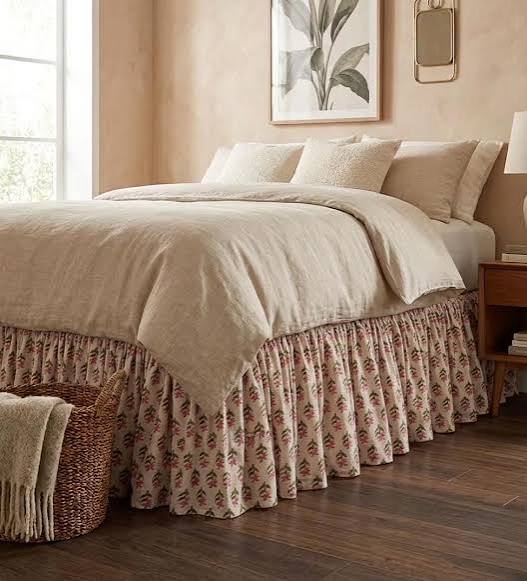
The bed skirt as most people picture it didn’t exist much before the 1930s. Mattress and box-spring construction changed, and what had been a purely functional dust barrier between mattress and floor slowly turned into something homeowners styled on purpose. By the 1940s, matching bedspread-and-skirt sets were common enough to be considered practically standard in American bedrooms, and the same soft, gathered logic eventually spread off the bed frame entirely, wrapping around sofas and wing chairs in nearly every style of house for the next several decades. Now it’s back on showroom floors, minus the word “dust.”

From Dust Barrier to Decorating Statement
Textile historians tracing the object’s origins generally agree the earliest bed skirts served a genuinely unglamorous job: keeping dust and allergens from circulating between an exposed box spring and the floor once cotton-and-coil mattresses replaced older feather-filled designs. That practical origin explains the original name, dust ruffle, a term that stuck around well into the mid-20th century even after the decorative version had mostly taken over from the functional one. Popular fabrics of the era included chiffon, cotton, wool, and satin, and the terminology itself eventually shifted, with “bed skirt” edging out “dust ruffle” in common use by the 1970s and 1980s as the decorative function fully eclipsed the practical one.
The Look Migrated Off the Bed
Once ruffled, gathered fabric skirting became a normal part of bedroom decorating, it didn’t stay confined to beds for long. The same soft-edged, fabric-wrapped silhouette showed up on armchairs, sofas, ottomans, and vanity benches throughout mid-century American homes, particularly in more traditional or cottage-leaning interiors where a hard wooden chair leg would have looked out of step with everything else in the room. A floor-length skirt on an upholstered chair did double duty: it softened the furniture’s outline the same way a bedspread softened a bed frame, and it quietly hid whatever got shoved underneath for storage, from board games to out-of-season shoes.
Design Coverage Is Calling It a Comeback
That mid-century silhouette is showing up again in current design coverage, and not as a one-off callback. Interior designers quoted across recent design coverage describe skirted furniture as having genuinely returned to active rotation after years of minimalist, hard-edged furniture dominating showroom floors, with one New York-based designer pointing to a broader shift away from stripped-down mid-century modern pieces toward reimagined traditional silhouettes. Retailers have followed the same signal: pieces like Anthropologie’s Lorelei Madeline accent chair and Birch Lane’s Maggie Ruffle Armchair, which lets its wooden tapered legs peek out through the ruching instead of disappearing beneath it, are being sold specifically as statement pieces built around the ruffle, front and center on the product page rather than buried in the fine print.
Designers working with the trend today are treating it with more intention than the original mass-market version ever got. Coverage of current skirted-furniture projects distinguishes between crisp, box-pleated skirts, which read as more modern and tailored, and fuller, billowier gathered ruffles, which lean into the whimsical, overtly vintage end of the look. Fabric choice matters just as much this time around: recommendations lean toward saturated solid colors in textured materials like linen or velvet rather than the busy floral prints that dominated the style’s original mid-century run, a small but deliberate distancing from the fussier version of the look that some homeowners still associate with an older relative’s formal sitting room.
Practicality Never Actually Left the Equation
The functional argument for skirted furniture has aged surprisingly well, too. A floor-length skirt still hides a chair or sofa’s legs and whatever’s stored beneath it, the same trick that made the style useful on beds nearly a century ago, and it remains one of the cheaper ways to visually soften a room full of straight lines and hard edges without replacing a single piece of furniture underneath the fabric. Skirt length has become its own design decision rather than a default, with shorter styles that expose tapered wooden legs now offered alongside the traditional floor-sweeping version for homeowners who want the softness without fully concealing the furniture’s structure.
Furniture trends tend to move in one direction until they don’t, and skirted pieces spent a long stretch written off as dated the moment mid-century modern’s clean lines took over. What’s happening now is a fabric detail that solved real, unglamorous problems in the 1940s finding a fresh audience that’s simply tired of rooms where every chair looks like it came from the same showroom.

Leave a Reply