

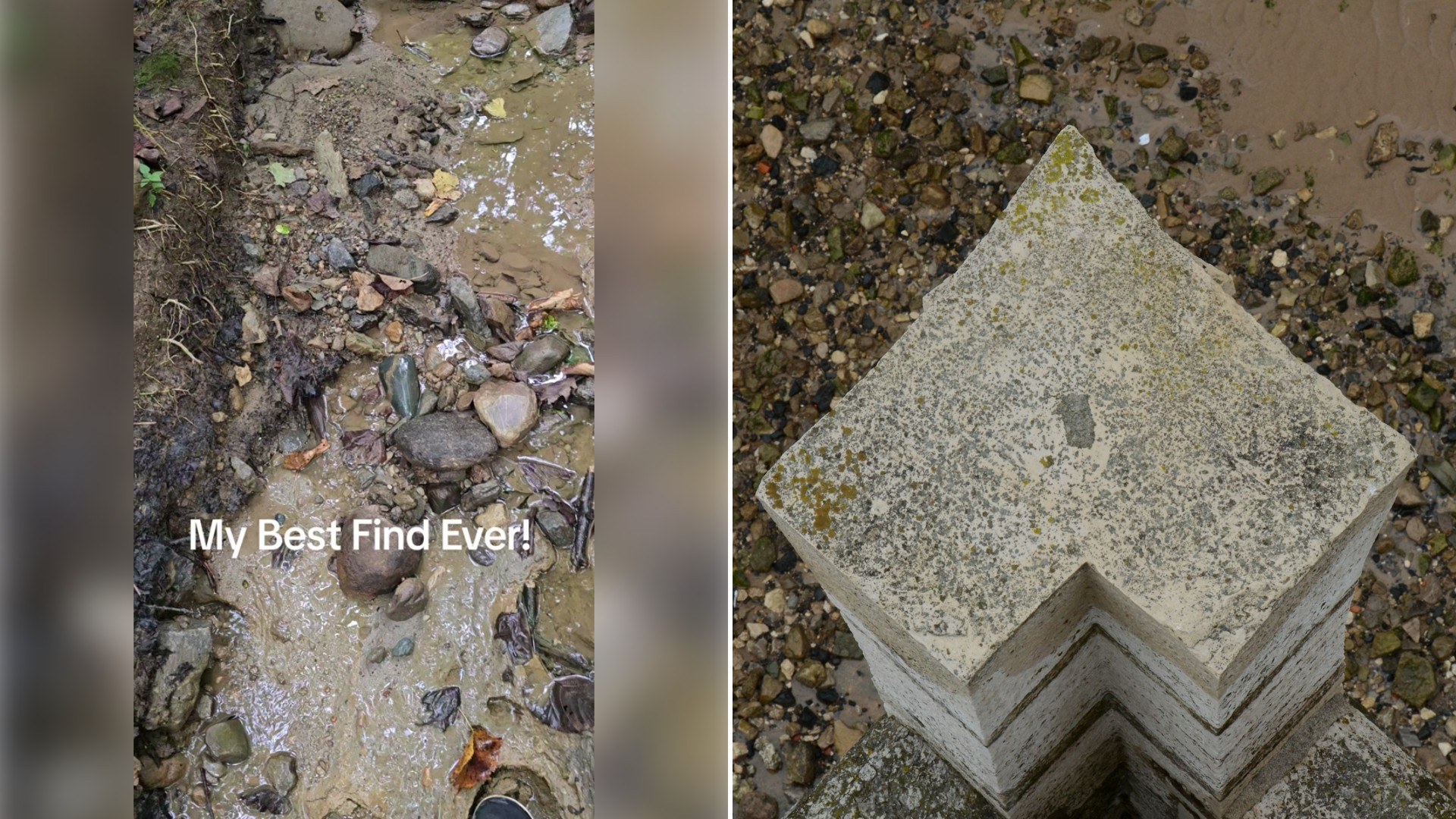
Amateur relic hunting rewards patience and a willingness to get genuinely dirty for the chance at something extraordinary, and @1tennvolfan gets both in a single afternoon, wading into a muddy creek bed and reaching down to pull out a smooth, clearly worked stone tool. The caption identifies the piece as an Adena-culture adze, dating back to roughly 800 BC, and his reaction, genuine, unfiltered excitement, makes clear he understands exactly what he is holding.
He calls it the best find of his entire relic hunting life, a claim that carries real weight given how rare it is for amateur hunters to stumble onto an artifact with this kind of documented age and cultural attribution rather than a more common, harder-to-date stone fragment.
Finding genuine artifacts from Indigenous cultures like the Adena, an early mound-building culture in what is now the eastern United States, understandably captures public fascination, since these are not simply old objects but pieces of a much deeper, specific human history embedded in the ground. Worth flagging clearly for readers: the legal landscape around collecting such artifacts is genuinely complicated and varies significantly by location. Removing artifacts found on federal or state-protected land, or on tribal land, is generally illegal under laws designed specifically to protect archaeological and cultural heritage sites, while finds made on private land with the landowner’s permission typically fall under different, more permissive rules.
Anyone drawn to this hobby after watching a video like this one should take that legal distinction seriously before searching anywhere themselves, since the excitement of a find like this one depends entirely on where it was made and under what circumstances, details a short clip alone cannot fully confirm.
Relic hunting as a hobby occupies an unusual middle ground between casual outdoor recreation and something closer to amateur archaeology, and creek beds specifically have long been favored search locations among hunters for a straightforward reason: moving water naturally erodes soil and shifts sediment over years and decades, gradually exposing objects that would otherwise stay buried indefinitely. A worked stone tool that might sit hidden for generations under undisturbed ground can end up sitting in plain sight along a creek bank purely because of that slow, ongoing natural excavation process, which is exactly the kind of lucky timing this find seems to reflect.
An adze specifically is a woodworking tool, historically used for shaping and smoothing wood in ways broadly similar to how a modern hand plane or adze-style axe functions today, and finding one attributed to the Adena culture connects a single afternoon of muddy searching to a documented, named civilization with its own distinct material culture and mound-building traditions. That specificity, a named culture and an approximate date, is part of what elevates a find like this beyond a generic old rock and into something genuinely historically significant, at least as significant as an amateur, undocumented find in the field can reasonably be considered without formal expert verification.
The emotional intensity of the reaction in the video also reflects something true about how differently relic hunting rewards patience compared to other collecting hobbies built around a store shelf or a resale market. There is no guarantee built into a creek bed the way there is a guarantee built into a trading card pack; a relic hunter can search for years without finding anything remotely comparable to a documented ancient tool, which makes a genuine, well-attributed find like this one feel less like luck and more like the payoff of accumulated persistence finally landing all at once.
It is also worth noting how content like this plays an important, if informal, educational role for viewers who might otherwise know very little about pre-colonial Indigenous history in their own region. A short video capturing genuine excitement over an Adena artifact can prompt curious viewers to look up the culture themselves, learning at least a little about mound-building societies and their material culture in a way a dry textbook reference rarely manages to achieve on its own.
There is also a responsibility angle worth expanding on here, since the enthusiasm this kind of video generates can sometimes outpace viewers’ awareness of the legal and ethical framework surrounding artifact collecting. Laws protecting archaeological sites exist specifically because uncontrolled digging and removal, even when well intentioned, can destroy context that professional archaeologists rely on to actually understand how, when, and by whom an object was used, information that is permanently lost the moment an artifact gets pulled from the ground without proper documentation. A hobbyist excited by a video like this one owes it to the hobby, and to the history itself, to research the specific laws in their own area before ever setting out to search themselves.
There is also something worth saying about why creek and riverbed hunting specifically has developed such a devoted following within the broader relic hunting community, distinct from surface hunting in open fields or metal detecting on old homestead sites. Water-worn finds tend to arrive already partially cleaned by the current itself, and the constant, slow turnover of exposed sediment means a spot searched thoroughly one season can genuinely turn up something new the next, after enough rain and current movement has shifted the streambed once again. That renewability gives creek hunting a different rhythm than other search methods, rewarding hunters willing to return to the same familiar stretch of water again and again rather than constantly chasing new, unexplored ground.
For responsible relic hunters, the enduring appeal of the hobby is real, a genuine connection to deep human history that most other collecting categories simply cannot offer, but that appeal comes with a real obligation to understand and respect the laws protecting the ground it comes from.

Leave a Reply