

Not every restoration starts with dust and neglect. Some start with someone else’s well-meaning mistake.
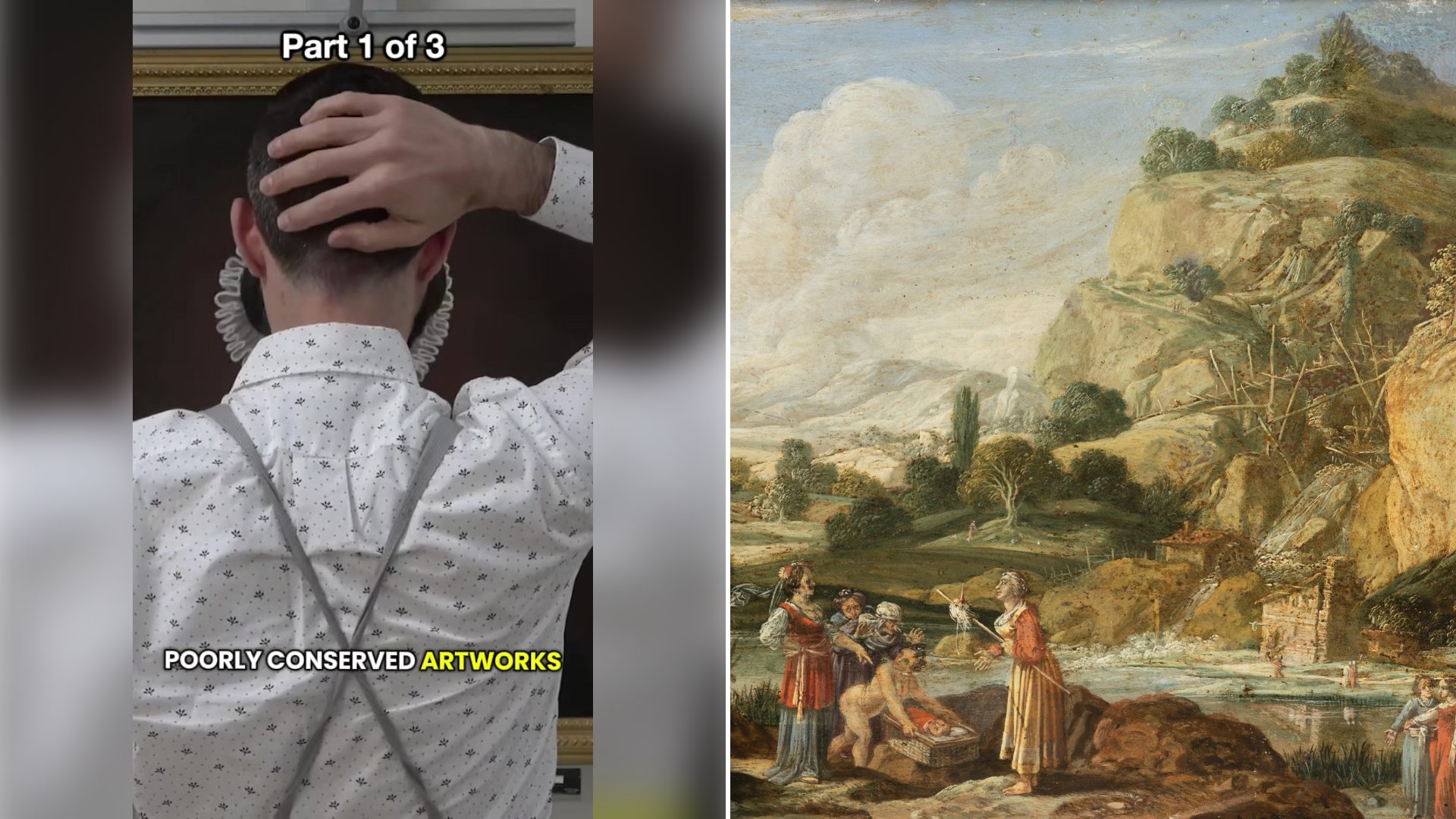
A professional art conservator’s studio video opens with an oil portrait of a woman in lace attire, mounted on an easel under bright studio lighting. Close-up shots linger on flat, muddy brushwork and visible cracking across the canvas, the telltale signs of previous amateur restoration work rather than age alone. “Poorly conserved artworks often land in our studio for rehabilitation,” the conservator explains in voiceover. “Though well intending, oftentimes amateur attempts at conserving artworks have disastrous results. Such was the case for this portrait. Overpainted and poorly handled.” On-screen text marks the video as “Part 1 of 3,” signaling the kind of multi-stage restoration professional conservators often document in full rather than compressing into a single before-and-after cut.
The process that follows is methodical by design, not for dramatic effect. First, the conservator detaches the painting from its frame, carefully pulling staples and nails to separate the stretcher bars, saving both the frame and the stretcher for reuse later. Then comes the harder, slower work: peeling away old canvas reinforcement strips and scraping off hardened, non-conservation-grade adhesive left behind by whoever handled the piece previously. “Unfortunately, this was not a conservation grade adhesive, so it requires manual work to remove the residue,” he notes, describing the kind of shortcut that creates exactly the mess his studio now has to undo by hand.
The most visually striking stretch of the video comes last, as the conservator tests a series of solvents, cleaners, and gels to find a mixture safe for the painting before using solvent-soaked swabs to lift the overpaint itself. Section by section, the muddy, opaque layer rolls away under the cotton swab, first across the background, then the sitter’s lace veil, revealing delicate original brushwork and colors that had been flattened into a near-caricature by the heavy-handed overpainting. “As this overpaint comes up, we can start to see more of the artist’s original work, more of the delicacy of their brushwork and the original colours,” he says, visibly satisfied as the woman’s expression re-emerges from underneath decades of someone else’s bad intervention.
Amateur overpainting is a genuinely common problem in the world of inherited and secondhand artwork. Well-meaning owners, or restorers without formal training, often use whatever paint and adhesive is on hand to patch damage or touch up fading, with no regard for reversibility, the principle that separates professional art conservation from simple repair. A conservator’s job in cases like this one isn’t just cleaning; it’s carefully reversing someone else’s irreversible-feeling decision, solvent by solvent, without damaging the original paint layer underneath. This video stops short of a full reveal, closing with the canvas lifted toward a lining table for the next phase, but the transformation already visible in the swab work makes clear why conservators find pieces like this one worth the painstaking process.
@baumgartner.restoration
More from Vinyl and Velvet
- Thrifter Who Has Checked the Art Section of Every Secondhand Store for Years Finally Scores Four Framed Patrick Nagel Prints in One Go Through Facebook Marketplace
- Volunteer Gravestone Cleaner Asked Viewers Who Joseph Lampkin Was, Then Cleaned His 1871 Headstone and Revealed the Railroad Dump Car Accident That Killed Him at 17
- Safe Technician Empties a Hidden Safe He Says a Family Found Two Months After Losing Their Sister and Pulls Out Coin Collection Books, a Pouch of Rolled Coins and a Revolver Booklet

Leave a Reply