

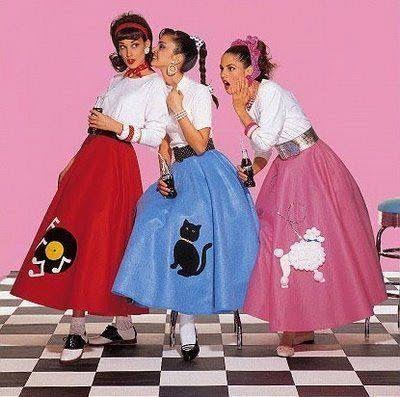
Juli Lynne Charlot couldn’t sew a seam when she invented the single most recognizable skirt of the 1950s. She was an out-of-work singer with no formal training in garment construction, so for a 1947 Hollywood Christmas party she cut a plain circle of white felt, punched a hole in the middle for a waistband, and appliquéd on a few Christmas trees — a shortcut, not a design statement, according to her documented account of that first skirt. Felt doesn’t fray, so it needed no hem and no seams at all. That single practical detail, not a runway decision by anyone with fashion credentials, is the actual origin of the poodle skirt.
A Party Favor That Turned Into a Business
Charlot wasn’t trying to launch a fashion movement — she needed a skirt for one specific party and had almost no budget for it. She improvised the entire garment with felt, scissors, and her brother’s slide rule to measure the circle, and the result was accidental enough that she was reportedly surprised when a Beverly Hills boutique asked her for three more after seeing it, which then sold out almost immediately, per the same reporting on her career. There was no design brief, no fabric sourcing plan, and no intention of starting a trend — just a workable solution to having nothing appropriate to wear.
The Poodle Wasn’t Even Charlot’s First Idea
Once the Christmas-tree skirts sold out, store owners pushed Charlot toward a repeatable, year-round design, and dogs were her first instinct — not poodles specifically, but dachshunds, worked into skirts with a narrative about three dogs with distinct personalities stitched into the felt. It was the store owners themselves who steered her toward poodles instead, a decision that turned out to be the more commercially durable one: fluffy, instantly recognizable in silhouette even from across a dance floor, and carrying a whiff of French sophistication that a dachshund silhouette simply didn’t have, according to documented fashion history of the garment. Charlot built her original skirts around storytelling — she reportedly wanted each design to work as a conversation starter, which is part of why appliqué rather than print became the dominant technique.
Why Felt, Specifically, Made It a Mass Trend
The material choice that solved Charlot’s personal sewing problem is exactly what let the design spread so fast among teenagers who had no more sewing training than she did. Because felt doesn’t fray, anyone could cut a circle skirt and glue or stitch on a simple appliqué without hemming a single edge — a low enough skill floor that it became one of fashion history’s clearest examples of a garment teenagers could genuinely make themselves rather than simply buy, which fashion historians credit as central to its status as arguably the first true teenage fashion trend. That do-it-yourself accessibility, paired with how well a full felt circle skirt flared out on a dance floor, made it the default look for sock hops and diner outings well before any department store had fully caught on.
From a Mortgaged Diamond Ring to Bergdorf Goodman
The commercial scale-up wasn’t smooth. After a Bullock’s department store executive placed a bulk order and gave the skirts prominent window displays on Wilshire Boulevard, Charlot’s small manufacturing operation still struggled to make payroll, and her mother reportedly mortgaged her own diamond ring more than once to keep the business running in its earliest months. That precarious start gave way quickly to orders from Neiman Marcus and Bergdorf Goodman, and by 1952 the trend had grown large enough to support dedicated mail-order poodle-skirt catalogs. What began as one improvised felt circle for a party nobody remembers the guest list of became the visual shorthand for an entire decade of American teenage culture — not because anyone designed it that way, but because it was cheap, forgiving, and genuinely easy to make your own.
It’s a genuinely rare origin story in fashion: a look this iconic usually gets credited to a studio, a design house, or a marketing campaign chasing a trend that already existed. The poodle skirt’s real backstory is closer to the opposite — an out-of-work singer solving a wardrobe emergency with the cheapest fabric she could cut without a sewing machine, and a decade of teenagers finding that same shortcut irresistible.

Leave a Reply