

In November 1971, a chrome-flecked cabinet shaped like something out of a Jetsons fever dream started eating quarters in a bowling alley near Sunnyvale, California. It wasn’t Pong. Pong didn’t exist yet. The machine was called Computer Space, and it beat the game everyone actually remembers to market by a full year, then quietly lost the fight for the history books anyway.
The men behind it were Nolan Bushnell and Ted Dabney, two engineers moonlighting as “Syzygy Engineering” while holding day jobs at a company called Ampex. Bushnell had spent his college summers running a midway arcade at Utah’s Lagoon amusement park, and he’d fallen hard for Spacewar!, the 1962 two-player dogfight game a few MIT students had built to run on a room-sized DEC PDP-1. Bushnell’s idea was blunt: shrink that experience down, wire it into a coin box, and sell it to bars. He and Dabney built a working prototype, then licensed it to an established coin-op manufacturer, Nutting Associates, which had previously scored a hit with a trivia cabinet called Computer Quiz.
photo credit: Google
Nutting expected another Computer Quiz-sized smash. What it got instead was a game that split its audience right down the middle. Near college campuses, where players were patient enough to parse Computer Space’s two rotation thrusters, a fire button, and a hyperspace-style thrust control, it did fine. In the working-class taverns where most coin-op machines actually lived, it flopped, because the rules were simply too much to absorb between rounds of pool. Roughly 1,300 to 1,500 units sold, bringing in a little over a million dollars, which counted as a disappointment by Nutting’s math and a real commercial video game by anyone else’s. Historians generally credit it as the first arcade video game and the first video game ever sold commercially, though Computer Space did have a rival: a Stanford-built machine called Galaxy Game ran essentially the same year, but it depended on a $20,000 mainframe tethered to the cabinet, which made it a curiosity rather than a product.
What made Computer Space a genuine product rather than a lab experiment was also what made it strange to look at from a modern angle. There was no microprocessor inside it, because no commercially available microprocessor existed yet in 1971. According to the Computer History Museum’s own timeline of the era, the entire game ran on discrete logic circuits — individual transistor-level chips wired together to produce motion, collision detection, and scorekeeping, with no RAM or ROM anywhere in the cabinet. Every rule of the game was, in effect, hard-wired into the machine’s circuit board rather than stored as software. The futuristic, curved fiberglass shell hid what amounted to a fairly primitive analog brain doing a convincing impression of a computer.
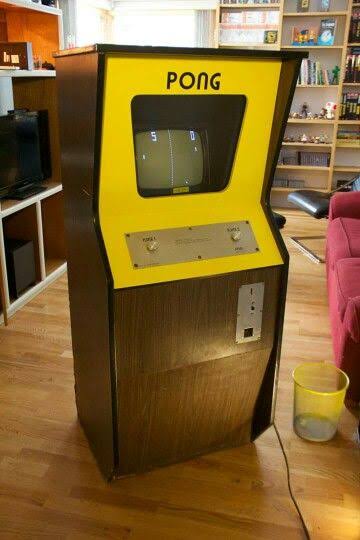
Bushnell and Dabney left Nutting in June 1972 and incorporated their own outfit under a new name: Atari. Their first release, a stripped-down tennis simulation called Pong, did what Computer Space never managed — it required no instructions at all, and it became the game that actually launched the arcade industry into the cultural mainstream. Computer Space, meanwhile, drifted into a stranger kind of fame. A single white cabinet turns up in the background of the 1973 Charlton Heston film Soylent Green, which historians point to as the first video game ever to appear on screen in a Hollywood movie — and a Computer Space cabinet shows up again two years later in the beach-town arcade scenes of Jaws, quietly cementing it as one of the more unlikely recurring extras in 1970s cinema.
That obscurity is exactly what’s made surviving units so valuable now. In August 2026, Shiny Entertainment founder and longtime game industry figure David Perry put his own two-player Computer Space cabinet, a rarer 1973 green-sparkle variant with dual joysticks, up for sale through RR Auction, as part of a sale titled Steve Jobs & the Computer Revolution: The Apple 50th Anniversary Auction Part Two. Perry, who said he was simply running out of room in his home arcade, described his machine bluntly: “It’s probably the rarest arcade game in existence, found in museums.” Bidding opened at $6,748 with auctioneers projecting a final price north of $200,000 by the time the sale closed on August 20 — a number that starts to make sense once you know a more common single-player Computer Space sold for $69,000 back in 2024.
What makes the story land isn’t just the price tag, though. It’s the fact that the game everyone thinks of as the birth of the arcade wasn’t first at all — it was the polished, simplified successor to a stranger, harder machine that a couple of engineers built because they were obsessed with a spaceship game running on a university mainframe. Computer Space demanded patience and instructions in an industry that would go on to reward neither. Pong figured that out and got the mythology. Computer Space got the discrete logic, the cameo in two movies, and, eventually, the auction house.

Leave a Reply