

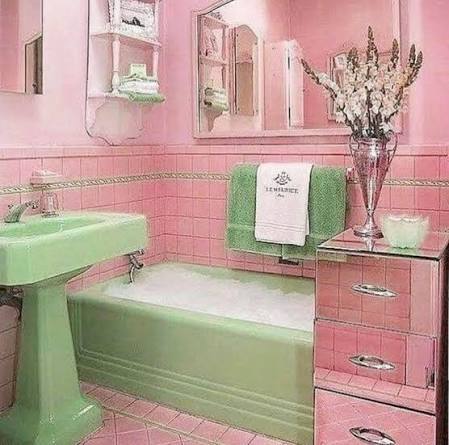
An estimated 10 million pink bathrooms went into American homes during the postwar tile boom, a figure that puts pink well ahead of every other pastel competing for wall space in the era’s ceramic tile catalogs. Mint green had real staying power of its own. It just never caught up.
A Palette Built for a Housing Boom
The pastel bathroom explosion followed directly from the postwar housing boom. Between 1946 and 1966, the United States built roughly 20 million new homes, and tile manufacturers responded to that construction wave by dramatically expanding their color catalogs. Historical archive research into the era puts the scale of that expansion in concrete terms: by the early 1950s, the industry was producing more than 200 shades of wall tile and nearly 100 colors for flooring, a staggering range compared to the mostly white bathrooms of prior decades. Pink, mint green, baby blue, and soft yellow all competed for space in those catalogs, often sold as coordinated sets so a homeowner could match tile, tub, sink, and even the soap dish in a single pastel family.
Mint Green’s Genuine Appeal
Mint, or seafoam, green wasn’t a runner-up by accident. Tile industry retrospectives on the decade describe the color’s appeal as rooted in its fresh, clean feel — a shade that read as hygienic and modern in a way that fit naturally with a bathroom’s function, without the more overtly decorative, feminine-coded associations that came to define pink. Mint green paired easily with black accent tile and chrome fixtures, giving it a slightly more restrained, almost clinical elegance that some homeowners preferred over pink’s softer, warmer tone. It held a genuinely strong share of the market throughout the decade and remains, alongside pink, one of the two colors most instantly associated with midcentury bathrooms today.
Pink Had a First Lady on Its Side
Pink’s advantage came down to a combination of marketing momentum and a genuinely famous booster. When Mamie Eisenhower moved into the White House in 1953, she decorated extensively in pink — both in her private White House quarters and later at the Eisenhowers’ Gettysburg home — to the point that the press nicknamed her “First Lady Pink” and the specific shade became known nationally as Mamie Pink. That level of visibility, from the country’s most photographed household, gave tile and fixture manufacturers a powerful marketing hook that mint green never had an equivalent for. Pink wasn’t just a pastel option anymore; it was aspirational, tied directly to the most prominent home in the country.
The Number That Settles It
The clearest evidence of pink’s edge is the installation count itself. Industry reporting citing HGTV’s research puts the figure at roughly 10 million pink bathrooms installed during the postwar tile boom, a scale that no other single pastel color reached in the same period. Mint green, blue, and yellow all had loyal followings and remained common enough that they’re still recognizable design signatures of the decade, but none matched pink’s sheer market penetration. Pink wasn’t simply popular — it was, by a wide margin, the bathroom color of the 1950s.
Why the Rivalry Still Matters
The pink-versus-mint contest wasn’t really a fair fight once Mamie Eisenhower entered the picture, but that’s precisely what makes the story interesting: a bathroom tile color’s fortunes got tied to presidential-level celebrity culture in a way that’s almost unimaginable today. Mint green earned its staying power on aesthetic merit alone, quietly holding its ground as the reasonable, understated alternative. Pink won because it had both genuine design appeal and the most famous homemaker in America putting it in front of millions of readers and viewers. Sixty-plus years later, both colors read as equally “vintage,” but only one of them actually dominated when the tile was going into the ground.

Leave a Reply