

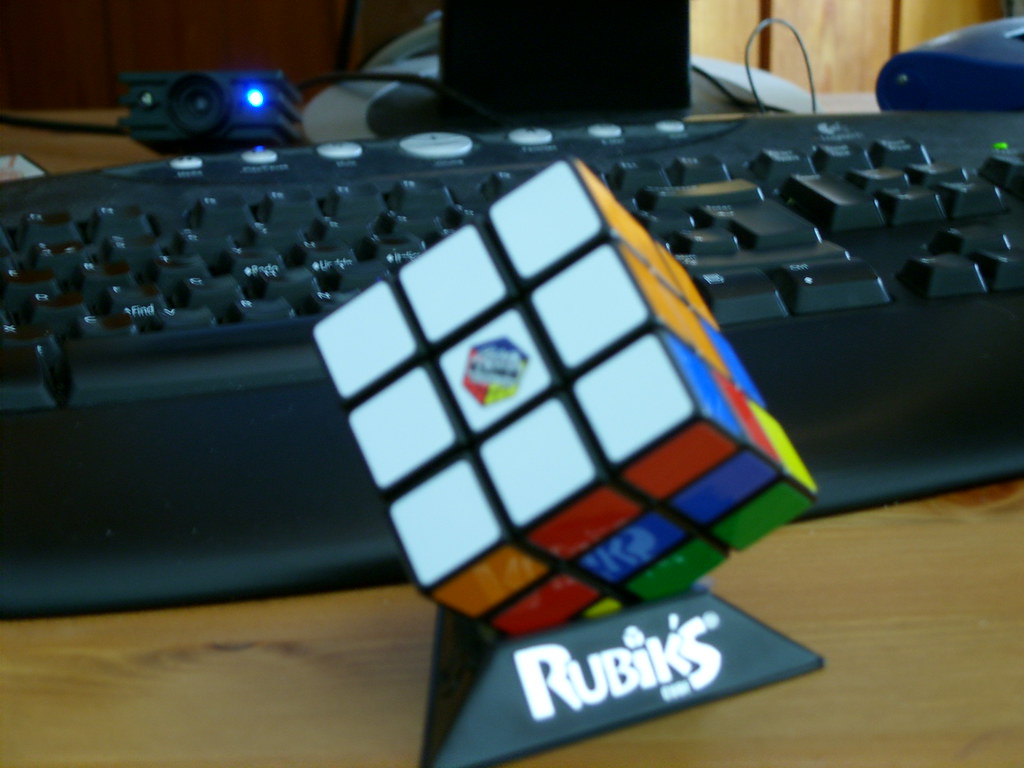
Thirty-seven years after it hit American toy shelves, a pocket-sized plastic puzzle pulled in $250 million in a single year. That’s not a typo, and it’s not a fluke: according to the Rubik’s Cube’s own official history, 2017 marked a genuine record year for the toy, and business reporting on the figure pegs it as a 45% jump over the year before — the cube’s strongest performance since the original 1980s craze. A puzzle invented as a teaching tool, not a toy, somehow keeps out-earning products with a fraction of its age.
An Accident That Took a Month to Solve
Ernő Rubik built the cube in 1974 as a Hungarian architecture professor trying to explain three-dimensional movement to his students, not as a commercial product, according to Rubik’s own history page. He patented the mechanism in 1975 under the name “Magic Cube.” It reportedly took Rubik himself a full month to solve his own invention the first time — a detail both CNBC’s reporting and the brand’s own materials repeat, because it’s the whole story in miniature: a thing so simple to hold and so hard to crack that it accidentally became one of the best-selling toys ever made.
The puzzle made its way to international toy fairs in London, Paris, New York, and Nuremberg in 1979, and it was officially renamed Rubik’s Cube for its 1980 debut in American stores. That single year — a Hungarian classroom tool becoming a household name across the Atlantic — set off a craze that peaked with the first World Championship in Budapest in 1982, where the winning solve took 22.95 seconds.
What made the 1980 debut land so hard wasn’t just clever marketing — it was math nobody could quite wrap their head around. The cube has more than 43 quintillion possible configurations, per the official history, yet exactly one of them is “solved.” That gap between astronomical possibility and a single correct answer is what turned a simple injection-molded object into a genuine cultural obsession, one that sold tens of millions of units within just a few years of its American debut.
The Long Middle: Fading, Then Not
Most toy fads follow the same arc: peak, decline, novelty-shelf afterlife. The Rubik’s Cube followed a stranger one. It dipped after the ’80s craze cooled, then found new relevance decade after decade — a cameo in 2008’s Wall-E, an educational push through the “You Can Do the Cube” program the same year, a resurgence tied to speedcubing communities that turned solving times into a genuine competitive sport.
By 2017, that slow-burn relevance turned into the biggest sales year the toy had ever posted. Reporting on the $250 million figure points to a specific convergence: the cube became a fidget toy for a generation glued to open-plan offices, a status symbol for the tech and coding culture that dominated hiring headlines, and a physical alternative to phone-screen boredom that cost less than a video game. A cameo in a Taylor Swift music video that same era didn’t hurt either.
The speedcubing scene did some of the heaviest lifting. What started as a niche competitive hobby after that first 1982 championship eventually produced solve times that sound fictional: current world-record holder Max Park has solved the cube in 3.13 seconds, according to CNBC’s reporting — a number that turns a toy Ernő Rubik needed a month to crack into a spectator sport measured in fractions of a second. Competitions, YouTube tutorials, and online communities built almost entirely around one object kept the brand culturally present in years when no single news cycle was pushing it.
What Nostalgia Actually Buys
The record year wasn’t nostalgia in the usual sense — most of the people buying cubes in 2017 weren’t rebuying their own childhood toy, they were discovering a decades-old object for the first time through a very modern lens: something tactile, screen-free, and satisfying in an era that had almost none of those. CNBC’s coverage of the puzzle’s 50th anniversary notes it still commands roughly 42% of the entire brain-teaser category under current owner Spin Master, which bought the brand in 2021 and has since released heat-reactive and color-shifting versions without touching the core mechanism.
That’s the throughline worth sitting with: a toy engineered to teach geometry outlasted the fads that were supposed to replace it by refusing to change the one thing that made it work. Forty-plus years and one $250 million year later, the Rubik’s Cube isn’t a relic being rediscovered — it’s proof that some ideas don’t age out, they just wait for the culture to need them again.

Leave a Reply