

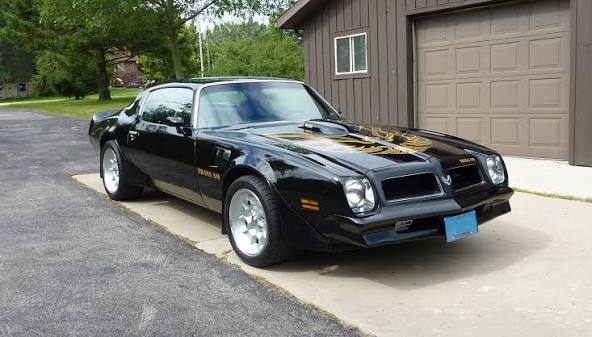
Pontiac gained 25,000 extra Trans Am sales in a single year because of one movie, and decades later the star’s own personal copy of that same car sold at auction for $495,000. Those two numbers, four decades apart, are really the same story: a low-selling muscle car that Detroit was quietly worried about turned into the most requested silhouette in America because Burt Reynolds jumped it over a canal on a movie screen, according to Hagerty’s own account of the film’s automotive fallout.
A Car GM Almost Didn’t Bother Making
By the mid-1970s the Trans Am wasn’t Pontiac’s crown jewel so much as its stubborn survivor — a performance nameplate limping through an era of fuel crises and shrinking horsepower that had killed off flashier rivals already. Smokey and the Bandit director Hal Needham needed a hero car for his 1977 chase comedy and GM supplied five Trans Ams for the production, banking on exposure rather than a guaranteed hit. Filming started in August 1976, just ahead of the model-year changeover, so the crew quietly modified the cars’ graphics and headlights to match the upcoming 1978 specs — meaning audiences were technically watching next year’s Pontiac before it existed on a dealer lot.
The shoot chewed through its fleet fast. One car got fitted with a 700-horsepower engine for the film’s signature bridge jump, and by the time production wrapped, only a single Trans Am was still in working order. Needham later put it plainly: “sales just soared after the film’s release,” and the studio’s gamble on free product placement turned into one of the most effective unpaid car commercials in Hollywood history.
From Loaner to Legacy: The Car Burt Kept
The Trans Am that eventually sold for nearly half a million dollars wasn’t a movie car at all — it never touched the film’s chase sequences. It was a thank-you gift from Pontiac to Reynolds for putting the nameplate back on the map, and by his own account it was the only 1977 Trans Am he personally owned, according to Robb Report’s coverage of the sale. Reynolds barely drove it, held onto it until 2014, and the second owner who bought it from him gave the car a meticulous restoration in 2015 — one careful enough to preserve the hand-painted “Bandit” lettering and the scuff marks his own cowboy boots had worn into the driver’s sill plate over the years.
That combination of documented celebrity ownership and untouched physical history is exactly what pushed the price so high. When Barrett-Jackson brought the car to its Scottsdale auction on February 1, 2022, it went for $495,000 — a number with essentially nothing to do with the car’s factory specs and everything to do with provenance. The lot came with Reynolds’s autographed glovebox, an engraved dedication plate on the driver’s door, his signed autobiography, a vintage Trans Am jacket and a copy of the film itself, turning the sale into as much an estate artifact as a car deal.
The restoration itself tells its own quiet story about what collectors were actually paying for. A less careful buyer might have stripped the car back to showroom-fresh condition, sanding away every imperfection in pursuit of a “better” result. Instead, the second owner treated Reynolds’s wear pattern as part of the vehicle’s specification sheet — as load-bearing as the 6.6-liter V-8 under the hood. That’s an unusual instinct in the collector-car world, where flawless restorations often command a premium over honest, lived-in originals. Here, the opposite was true: the imperfections were the provenance.
A Sequel Nobody Doubted
By the time the follow-up film went into production, GM’s hesitation had evaporated entirely. Where the original shoot got five borrowed Trans Ams on a hopeful bet, the sequel’s production received ten Trans Ams and 55 Bonnevilles without a second thought, Needham noted — the clearest evidence that the studio’s gamble had paid off in showroom traffic, not just box office. A car company that once treated a chase-comedy loan as a risk was, within a couple of years, treating it as standard marketing spend.
The mechanical numbers on Reynolds’s actual car were never the point, either. At 185 horsepower and 320 lb-ft of torque out of a 6.6-liter V-8, paired with a three-speed automatic, it was a comfortable cruiser more than a genuine street brawler — nothing close to the numbers the fictional Bandit’s car implied on screen. Buyers weren’t bidding on horsepower. They were bidding on a black-and-gold shape that an entire generation had already decided, before ever sitting in one, was the coolest car in America.
What connects the 25,000-unit sales bump and the six-figure auction result is the same underlying fact: a car’s value, whether measured in 1978 dealership traffic or 2022 hammer price, was never really about the Trans Am’s engineering. It was about who was driving it on screen, and later, whose actual boots left the scuff marks.

Leave a Reply