

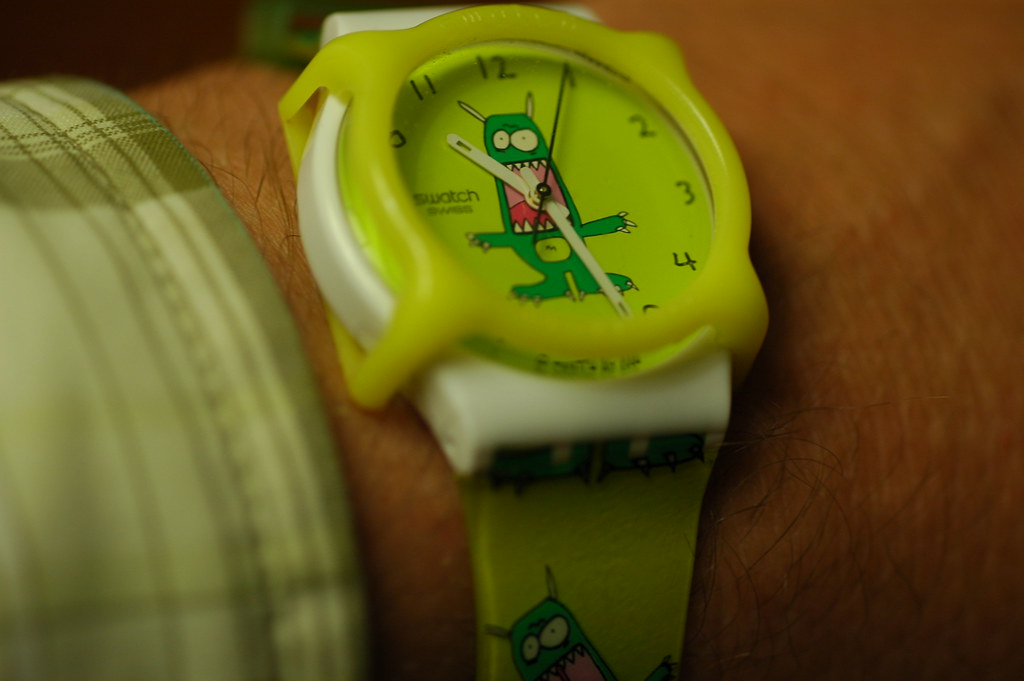

Swiss watchmaking employment had collapsed from 90,000 workers to 30,000, a loss of roughly 60,000 jobs, by the time a plastic watch called Swatch launched at a Zurich press conference on March 1, 1983, according to Neue Zürcher Zeitung’s account of the launch. One year later, the millionth Swatch had already rolled off the line, per the same report. An industry that Japanese quartz manufacturers had spent a decade quietly gutting found its comeback in a watch that cost less than dinner.
An Industry That Had Already Lost the Argument
The crisis Swatch walked into wasn’t subtle. Cheaper, more accurate quartz movements out of Japan had spent the 1970s and early 1980s eating the mid-range and budget segments Swiss manufacturers depended on for volume, and the job losses that followed made regular headlines about layoffs, short-time work, and shuttered plants, as NZZ describes it. Switzerland’s advantage had always been mechanical craftsmanship, and craftsmanship doesn’t matter much to a customer who just wants a watch that keeps accurate time for ten dollars.
The fix that eventually worked wasn’t a better mechanical movement. It was accepting that Switzerland needed to compete on the same electronic terms as its competitors, while adding something quartz watches from Japan weren’t offering: personality. Swatch built its case around fewer components, radically simplified assembly, and a plastic case that let the whole watch be manufactured and sold for a fraction of what a traditional Swiss watch cost, all while keeping final assembly in Switzerland.
That last detail mattered more than it might seem. Keeping production domestic meant the jobs a cheap plastic watch generated actually landed in the same country that had just watched tens of thousands of manufacturing positions disappear. It wasn’t a rescue plan built on nostalgia for how things used to be done. It was a rescue plan built on doing things differently enough that the old competitive math no longer applied.
A Million Watches Before the First Anniversary
The commercial response validated the bet almost immediately. Reaching a million units sold within a single year, as NZZ reports, wasn’t just a strong debut, it was proof that a Swiss-made watch could compete directly in the price bracket that had been bleeding the industry dry. Colorful, disposable-feeling, and cheap enough to own several at once, Swatch reframed the watch from a single lifetime purchase into something closer to a fashion accessory you might swap out with your outfit.

That reframing turned out to matter more than the technology underneath it. Limited runs and artist collaborations became part of the pitch almost from the start, giving Swatch a built-in mechanism for manufactured scarcity that a purely utilitarian quartz watch never had. The 1983 “Jellyfish,” an early transparent-cased model made in a limited run of only 200 pieces, is one of the earliest examples of that strategy, and it’s exactly the kind of piece that would later turn into serious money at auction.
From Five-Dollar Fashion to Five-Figure Auctions
The collector’s market arrived faster than anyone likely expected for a mass-produced plastic watch. NZZ notes that Sotheby’s held its first dedicated Swatch auction in Geneva in 1986, barely three years after launch, and that by the height of Swatch mania at the end of the 1990s, individual rare models were changing hands for as much as CHF 60,000, according to SWI swissinfo.ch’s coverage of a later Swatch auction.
The scale of that secondary market only grew from there. In April 2015, Sotheby’s Hong Kong sold a private collection of 5,800 Swatch timepieces, assembled over 25 years, for $6 million, per swissinfo.ch. Later that same year, a Geneva sale of the Schmid & Müller collection, 1,000 original watches and 380 prototypes that had spent years sitting in an attic in Neuchâtel, brought in CHF 1.3 million.
What started as an emergency measure to save Swiss manufacturing jobs quietly became one of the more unlikely collector categories in the watch world, sitting on auction house calendars alongside vintage Rolex and Patek Philippe lots. That’s a strange trajectory for a product originally pitched as disposable fashion rather than an heirloom, and it says something about how collector value actually forms. It rarely comes from an object being expensive to begin with. It comes from an object being loved widely enough, early enough, that scarcity eventually catches up to demand on its own.
A watch designed to be disposable turned out to be worth keeping, and the industry it rescued never really needed saving twice.

Leave a Reply