

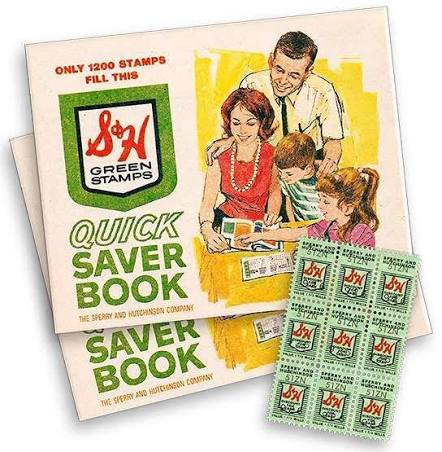
By 1964, the Sperry & Hutchinson Company was printing 32 million catalogs a year and moving more than a billion stamps a week, according to Journal of Antiques’ history of the brand. The mechanism was almost embarrassingly simple: buy groceries, collect stamps, lick them into a booklet, trade full booklets for merchandise. An estimated 80 percent of American households were doing exactly that through the 1960s and 1970s, per the same account. Somewhere between the checkout line and the delivery truck, a grocery-store loyalty gimmick quietly became one of the country’s biggest furniture suppliers — one that never once called itself that.
The Math Behind the Sticky Pages
S&H Green Stamps traced back to 1896, when Thomas Sperry and Shelley Byron Hutchinson built a rewards system on top of an idea another Milwaukee department store had already floated, and opened their first redemption center in Bridgeport, Connecticut, the following year, according to Journal of Antiques. The rules stayed consistent for decades: one stamp per ten cents spent, pasted into a 24-page collector’s book at 50 points a page, for 1,200 points per completed booklet.
Shoppers then walked those booklets into a local Green Stamps redemption store or mailed off an order from the company’s mail-order catalog. At its peak the operation was staggering in scale — Antique Trader reports that S&H was printing roughly three times as many stamps as the U.S. Postal Service, while Journal of Antiques puts annual catalog distribution at 32 million copies and savers-book distribution above 140 million a year.
From Stamp Book to Sofa
The catalog itself is where the “loyalty program” framing breaks down, because the merchandise wasn’t limited to toasters and steak knives. Pages ran deep into home furnishings — china, linens, clock radios, furniture, and branded housewares from names like GE, Pyrex, Corningware, Libbey, and Seiko, per Journal of Antiques. Some editions even offered redeemable classes in cooking, bridge, and interior design, treating the catalog less like a rewards menu and more like a household-outfitting service that happened to run on adhesive paper instead of a paycheck.
Local redemption centers reinforced the same idea in physical form — they were built and merchandised like small department stores, with furniture and appliances staged on showroom floors so a family could see exactly what a stack of full booklets was actually worth before they committed a single stamp to it. That showroom model did more to normalize the exchange than any catalog page could, because it let stamp-collecting feel less like a chore and more like layaway you’d already paid for.
The company leaned into that role hard enough to buy its way deeper into it. Between 1969 and 1971, Sperry & Hutchinson acquired four separate furniture manufacturers, consolidating them into a furniture division headquartered in Richmond, Virginia by 1974 and rebranded as S&H Furniture in High Point, North Carolina by 1976, according to the Smithsonian’s National Museum of American History archival records, which also hold a surviving 1963 S&H Green Stamps booklet documenting how deeply the program had woven itself into ordinary household purchasing by that point. That furniture arm was eventually sold off to its own executives and investors in 1981, becoming LADD Furniture — a company that, in a roundabout way, owes its existence to a coupon.
Why the Program Ran Out of Sticking Power
The same catalog economy that built living rooms eventually undercut itself. The 1970s energy crisis and the recessions that followed squeezed retailers’ willingness to keep handing out stamps at the old rate, and reward values shrank accordingly — shoppers found themselves needing more books for merchandise that was barely discounted off retail price, a downward spiral Antique Trader traces directly to the program’s late-1980s and 1990s fade. The stamps hung on in diminished form for years afterward, but the mass-participation era — the one where a family could plausibly stamp its way to a new couch — was already over.
What’s left now is mostly ephemera: loose booklets, stray catalog pages, the occasional intact redemption center sign, all of it collectible precisely because so much of it got used up doing exactly what it was designed to do. The real legacy sits quietly in half of America’s mid-century living rooms and dens, in furniture nobody remembers as a “reward” because it just looks, now, like furniture — proof that a loyalty program can outlast its own name by disappearing completely into the furniture itself.

Leave a Reply