

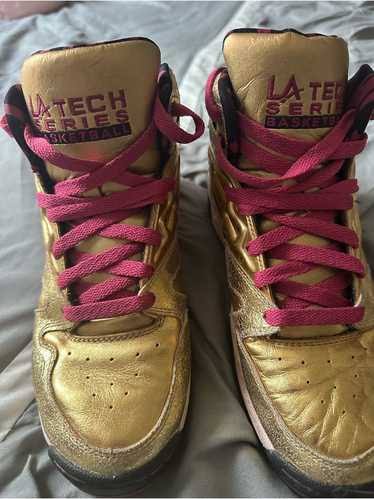
Third Place Behind Nike and Reebok
In 1990, L.A. Gear pulled in $818.8 million in sales and held 11.8 percent of the U.S. athletic shoe market, good enough for third place, ahead of every brand except Nike and Reebok. Founder Robert Greenberg, who’d started the company as a roller-skate outfit before pivoting into sneakers, told the press at the height of it: “We’ve taken the number three position now. Our brand is growing and consumer confidence is gaining every day.” Eight years later, the company he built filed for Chapter 11 bankruptcy protection. That’s not a slow fade. That’s a full collapse inside a single decade, from a brand practically issued at birth to every kid on a given block to a filing in federal court.
The Climb Was Just as Fast as the Fall
L.A. Gear’s rise had the same velocity as its collapse, just running the opposite direction. The company entered the athletic shoe category in 1985 with a single canvas workout shoe aimed at fashion-conscious women, and sales jumped from roughly $200,000 at the start of that year to $1.8 million by its end. After going public in 1986, growth compounded fast: sales climbed another 200 percent that year and doubled again in 1987, on the way to the 1990 peak. It’s the kind of curve that makes a leadership team feel invincible right up until the year it inverts.
The Product That Actually Earned the Closet Space
L.A. Gear didn’t win teenagers over with subtlety. The brand built its identity on chunky-soled, brightly colored high-tops and the LA Lights line, sneakers with tiny bulbs embedded in the sole that flashed with every step, which sold more than 5 million kids’ pairs a year at its peak. A Paula Abdul-branded women’s line became one of the best-selling shoe collections of the early ’90s on its own. This wasn’t a niche athletic brand; it was mainstream enough that going public in 1986 and riding a growth curve that doubled sales year over year felt, for a stretch, inevitable rather than lucky.
The Wrong Bet, Made Loudly
The unraveling started with an expansion into men’s performance shoes that the company’s fashion-driven, teen-first identity was never built to support, compounded by a costly celebrity endorsement push, including a widely reported Michael Jackson deal, that didn’t translate into sales. The company posted a $66.2 million loss in 1991, its first of several consecutive losing years. Trefoil Capital Investors stepped in with a $100 million injection in exchange for a 34 percent stake, a rescue that bought time but not a turnaround. Greenberg resigned as CEO in early 1992 as market share slid from that 1990 high of 11.8 percent toward single digits. By fiscal 1995, the company reported a $51.4 million loss on $296.6 million in sales, more than half its 1990 revenue simply gone, with market share down to 3 percent.
Chapter 11, Then Ten Employees
L.A. Gear filed for Chapter 11 bankruptcy protection in January 1998, sales having eroded to roughly $125 million the year before, a fraction of its 1990 peak. The company emerged from bankruptcy later that same year in a form its founders would barely recognize: a private licensing operation with a staff of just ten people, no longer manufacturing anything itself, simply renting out its name to other companies to put on shoes, apparel, and accessories. Greenberg didn’t leave the industry, though. He went on to found Skechers, the company that arguably inherited the exact market L.A. Gear had lost.
What Actually Killed It
L.A. Gear’s collapse wasn’t a case of changing tastes catching a brand flat-footed over a generation. It happened in real time, inside less than a decade, because a company that had built its entire identity on being the flashy, fashion-forward alternative to Nike and Reebok tried to out-perform the actual performance brands instead of doubling down on what had made teenagers choose it in the first place. The lesson didn’t need forty years of hindsight to land. It was obvious within about eight fiscal quarters, and the empty shelf space at the mall told the rest of the story on its own. Nostalgia has since been kind to the brand’s old catalog, with original LA Lights and chunky ’90s high-tops now trading as collector pieces among people who wore the originals as kids, but the company that made them spent 1998 in bankruptcy court, not on a victory lap.

Leave a Reply