

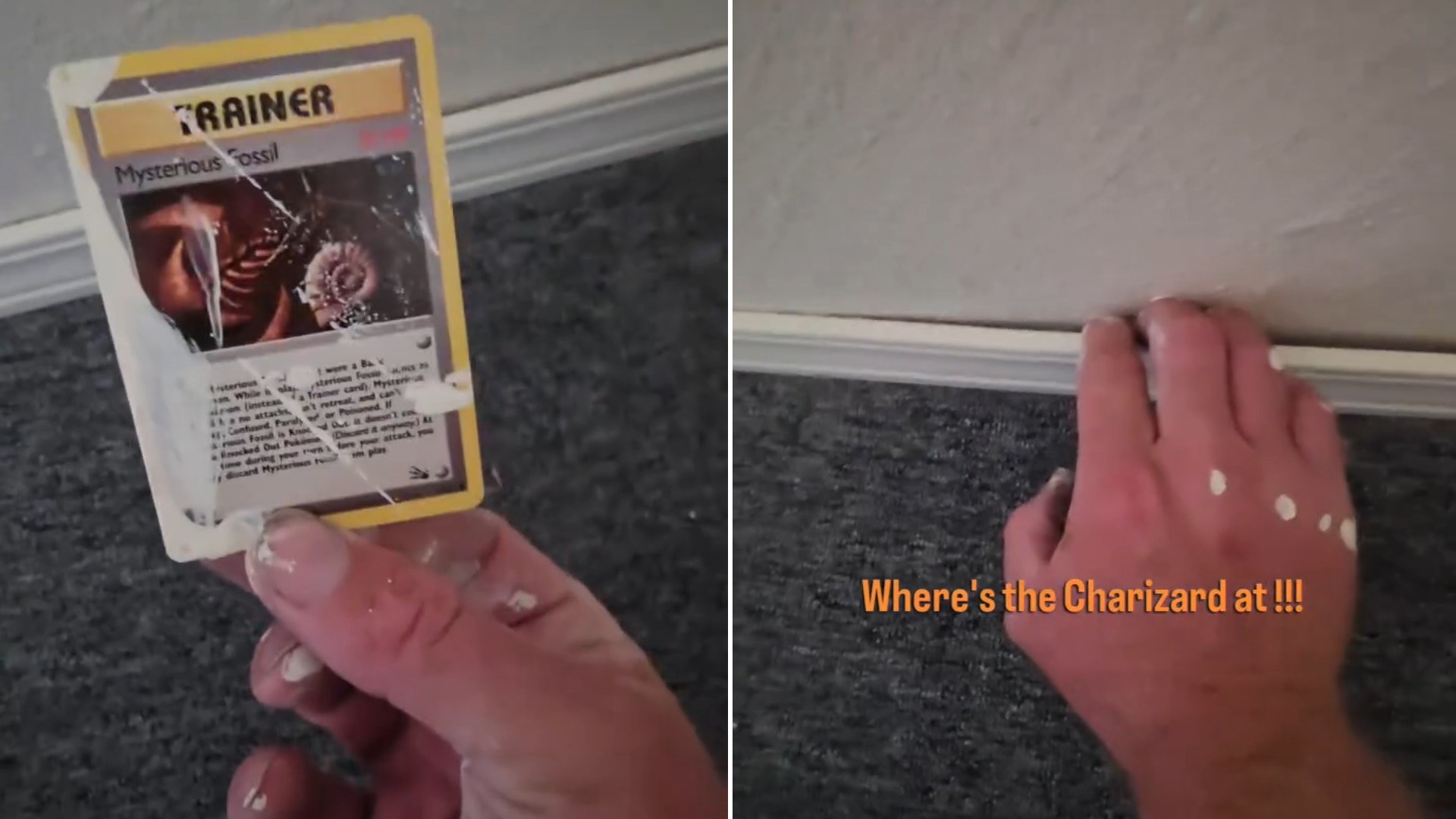
Home renovation projects have a way of turning up things nobody was expecting to find, and for creator @rem__state, a simple repainting job became something closer to a scavenger hunt. What started as a routine coat of paint along a room’s baseboard trim turned into an unexpected discovery when the brush caught the edge of something that clearly didn’t belong there: the corner of a Pokemon card, wedged tightly behind the trim as if it had been placed there on purpose.
Curiosity got the better of the moment, and rather than simply painting over it and moving on, the trim got pried back to see what else might be hiding behind it. What emerged wasn’t just one stray card but several, tucked into the gap between the baseboard and the wall in what looked less like an accident and more like a previous owner’s makeshift solution to a very specific carpentry problem: using old cards as cheap, disposable shims to level out an uneven board.
View this post on Instagram
It’s a strange kind of collision between two very different value systems. To whoever installed that trim years or even decades ago, those cards were essentially worthless scrap paper, the kind of thing you’d grab off a kid’s bedroom floor if you needed something thin and sturdy to wedge under a board and didn’t want to waste a proper shim. To the collector community today, depending on condition, rarity, and which cards actually turned up, that same stack could represent real value, the kind of accidental discovery that collectors dream about finding at an estate sale, let alone inside their own walls.
That contrast is really the heart of why this story caught fire the way it did. Pokemon cards occupy a strange place in collectible culture: dismissed for years as kids’ ephemera, the kind of thing tossed in a junk drawer or donated to a yard sale box without a second thought, and then, decades later, suddenly commanding serious money in the resale market as the generation that grew up trading them in schoolyards grew into adults with disposable income and a lot of nostalgia. A card that someone once considered so disposable it could be used as construction material is now, in many cases, worth actively hunting down.
The post ending with a direct question to the audience, asking whether anyone else has found something rare hiding behind their own walls, wasn’t just a clever way to drive engagement. It tapped into something real. Older homes accumulate decades of small human decisions inside their structure that nobody thinks about until a renovation forces the issue: newspapers used as insulation, old letters stuffed into wall cavities, forgotten tools left behind by previous contractors. A house is, in a very literal sense, a time capsule that gets built up one layer at a time, and most of what’s inside it stays hidden until someone finally opens the wall back up.
For anyone who has ever taken on a home improvement project themselves, there’s an obvious takeaway here worth sitting with: slow down before painting over, patching, or demolishing anything in an older home, especially around trim, baseboards, and other spots where gaps or shims tend to get used. It costs nothing extra to peek behind a loose board before sealing it back up, and the odds of finding something interesting, even if it’s not literally a stack of collectible cards, are higher than most people assume. Old homes hold onto their history in strange, unglamorous places, and trim work is one of the most overlooked.
There’s also a broader collecting lesson tucked into this story, one that applies well beyond Pokemon cards specifically. Value is almost never fixed. What one generation treats as trash, the next can treat as treasure, and the gap between those two judgments can be enormous depending on timing, nostalgia, and scarcity. Baseball cards, vintage toys, old comic books, even certain pieces of furniture have all followed the same arc: written off as clutter for years before someone rediscovers them and the market catches up all at once. Stories like this one are a small, satisfying reminder that it’s worth taking a second look at things before assuming they’re worthless, whether they’re sitting in a drawer, a storage bin, or, apparently, wedged behind a baseboard where nobody thought to check.
There’s also a practical side to this story worth pausing on for anyone in the middle of their own renovation. Trim work, baseboards, and door casings are exactly the spots where past homeowners and contractors historically tucked small items out of sight, whether to solve a leveling problem quickly, to hide something intentionally, or simply because a gap behind a board was the most convenient place to stash something that needed to disappear at the time. Knowing that pattern ahead of time changes how a homeowner might approach a demolition or repaint, turning what would otherwise be a routine task into a moment worth slowing down for, just in case.
The reaction this kind of discovery generates online also says something about collective curiosity that goes beyond any one collectible category. People love a mystery with a tangible object at the center of it, something they can imagine finding themselves rather than just reading about secondhand. A stack of cards behind a baseboard checks every box: it’s unexpected, it’s personal to whoever finds it, and it invites everyone watching to wonder what might be sitting behind their own walls, which is exactly the kind of question that keeps a video circulating long after the initial discovery.

Leave a Reply