

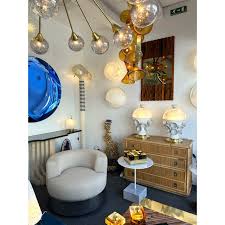
Twenty-eight percent of interior designers sourced a Murano-glass pendant light for a client project this year, more than any other named vintage lighting piece tracked in 1stDibs’ ninth annual trade survey of 468 design professionals. Behind it: Venini-style mushroom lamps at 10 percent and Louis Poulsen’s PH Artichoke lamp at 9 percent. These aren’t vague style categories — they’re specific, nameable objects, mostly Italian and Scandinavian in origin, mostly from the 1950s through the 1970s, that designers are competing to get their hands on for actual client homes right now.
The Specific Pieces Winning
Murano glass — hand-blown on the Venetian island of the same name since the 13th century, though its mid-century lighting boom came much later — took the top spot in 1stDibs’ lighting data by a wide margin. The Venini-style mushroom lamp, a rounded glass dome shape popularized by the Murano firm Venini starting in the 1950s and 60s, and the Louis Poulsen PH Artichoke — the tiered, spherical light designed by Poul Henningsen in 1958 and still in production today — rounded out the top named pieces, according to the same survey. Outside lighting, the report also flagged the De Sede DS-600 “Snake” sofa — the Swiss-made, infinitely reconfigurable modular leather sofa from 1972 — and Afra and Tobia Scarpa’s Soriana seating as furniture pieces gaining real traction with designers this year.
Why These Specific Objects, Not Just “Vintage Lighting”
What separates this list from a generic “designers love mid-century lighting” trend piece is the specificity: these are pieces with a maker, a decade, and a design pedigree attached, which matters for how they get sourced and priced. A Murano pendant isn’t interchangeable glass — the hand-blown, often hand-signed nature of the work means no two pieces are identical, which is part of the appeal for designers building a room meant to look collected rather than ordered from a catalog. The PH Artichoke, meanwhile, is a design object with a continuous production history, so “vintage” examples compete directly against pieces still being manufactured — a dynamic that keeps demand and resale prices for genuine older units unusually stable.
What Makes Each One Work in a Room
A Murano pendant tends to function as a room’s single sculptural moment — most designers hang one or a small cluster over a dining table or entry rather than using them for general room lighting, letting the glass color and shape do the visual work against a simpler backdrop. Mushroom lamps, by contrast, are typically table or floor pieces, and their rounded dome shape pairs unusually well with the curved-furniture and scalloped-tile trends showing up elsewhere in 2026 design data — the same soft geometry, just in lighting form. The PH Artichoke is the boldest of the three: its stacked, layered shade was engineered specifically to hide the bulb from every angle while still throwing warm, glare-free light, which is why it still reads as a genuinely useful design solution rather than just a decorative shape more than sixty years after Henningsen designed it.
Sourcing and Care Notes
Because Murano glass is hand-worked, provenance matters more than with mass-manufactured lighting — designers and collectors typically look for maker’s marks, documented provenance, or dealer expertise before paying premium prices, since reproductions have followed the trend upward too. Mushroom lamps and Artichoke lamps, being more standardized manufactured designs, are easier to authenticate but also easier to find well-made contemporary reissues of, which means the choice between an original vintage piece and a licensed reissue often comes down to budget and patience rather than availability.
The Bigger Picture
That designers are naming specific pieces down to the manufacturer and decade — rather than just checking a “vintage lighting” box — suggests the current wave of retro sourcing has moved past surface-level nostalgia into something closer to connoisseurship. It’s the same shift happening with vintage furniture and antiques more broadly this year: less about decorating in a decade, and more about hunting down the individual objects that decade actually got right.

Leave a Reply