

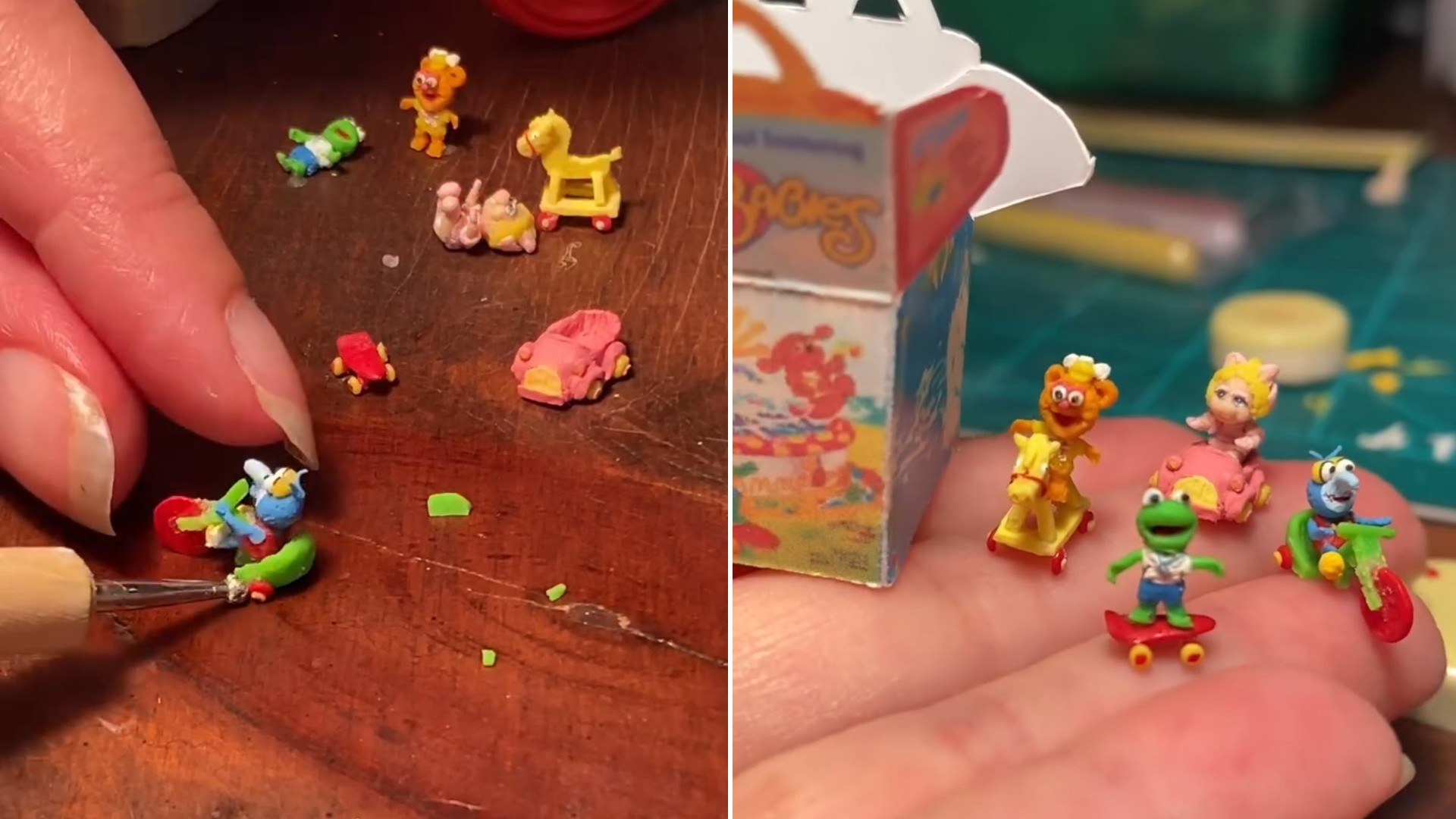
There is a particular kind of patience that miniature artists carry, and it shows in every frame of the latest project from @sotinyandtreasured. Working entirely under a macro lens, the creator set out to recreate an entire generation’s favorite Saturday morning cast in a scale so small that each figure could sit comfortably in the palm of a hand. The subject this time was Muppet Babies, the beloved 1980s cartoon that turned Kermit, Miss Piggy, Fozzie, and the rest of Jim Henson’s characters into toddlers with oversized imaginations, and the result is a tiny nursery of nostalgia rendered in painstaking detail.
What makes the project stand out is not just the size of the pieces but the standard the creator held herself to while making them. Every single Muppet Baby figure had to be hand-painted from a blank miniature base, and every prop built to match it in scale, down to details only visible when the camera pushes in close. Rather than settle for a fixed, permanent display, she insisted that each character remain removable from its tiny scene, a small decision that added enormous difficulty to an already demanding process, since a glued down figure is forgiving and a freestanding one is not.
View this post on Instagram
That insistence on removability meant every base had to be weighted and balanced just right, every joint or footprint calibrated so the piece would stand on its own without support. Viewers watching the video see the process unfold in stages: a bare miniature form gradually gains its color, its personality, its unmistakable cartoon identity, until a version of Gonzo or Miss Piggy no bigger than a fingertip is looking back at the camera. As the final pieces are set into place inside their palm-sized display, the classic Muppet Babies theme song plays, closing the video with the same nostalgic swell that once opened every Saturday morning episode for an entire generation of viewers.
It is easy to underestimate how much technical skill goes into work at this scale until you try to imagine painting eyelashes or shoelaces smaller than a grain of rice. Miniature artists in this space typically work with tools borrowed from other precision crafts, fine detail brushes meant for model trains or dollhouse restoration, loupes or digital magnification to catch mistakes invisible to the naked eye, and steady hands that have to work in short bursts to avoid the kind of tremor that would ruin an afternoon’s progress on a single centimeter of paint.
The appeal of this kind of content goes beyond admiration for a steady hand. Nostalgic properties like Muppet Babies occupy a specific emotional real estate for millennial and Gen X audiences, a show that many watched before they could read, absorbed more through color and voice than plot. Seeing it rebuilt in miniature does something a full sized collectible cannot: it turns a half-remembered childhood morning into an object you could hold in one hand, small enough to feel private and precious rather than mass produced.
For anyone newly curious about miniature art as a hobby, the barrier to entry is lower than the finished pieces suggest. Polymer clay, acrylic paint sets designed for fine detail work, and inexpensive magnifying lamps are widely available and affordable, and most serious miniaturists started with far rougher first attempts than anything shown in a finished reel. The learning curve rewards patience over natural talent; painting a single face over and over on practice pieces the size of a pea teaches a level of hand control that transfers to almost every other detail-oriented craft, from jewelry making to model building.
There is also a growing secondary market for this kind of nostalgic miniature work, with collectors seeking out custom commissions of the characters and settings that defined their own childhoods, whether that is a cartoon like Muppet Babies, a favorite sitcom set, or a beloved toy line. That demand has turned what used to be a niche corner of the crafting world into something closer to a small creative economy, where an artist’s willingness to sweat the smallest details, like insisting a two-centimeter Muppet Baby be removable rather than glued in place, becomes the very thing that sets serious work apart from a quick hobby project.
It is also worth remembering that projects like this one rarely happen in a single sitting. A palm-sized diorama with several removable, hand-painted figures typically represents many hours spread across days or weeks, since paint needs time to cure properly between layers and a rushed session is usually the fastest way to ruin painstaking earlier work. That drawn-out timeline is part of why finished miniature scenes feel so rewarding to watch assembled in a single video; the compressed footage hides just how much slow, deliberate effort actually went into getting every last detail right before the theme song ever started playing.
There is a reason this kind of craft keeps finding new audiences well outside the traditional miniatures community: it photographs and films beautifully in a way that translates instantly, even to viewers who have never picked up a paintbrush. A finished piece speaks for itself the moment it is framed correctly under a macro lens, which is part of why videos built around this kind of work tend to travel so far past the small, dedicated circle of people who actually make miniatures for a living or as a serious hobby.

Leave a Reply