

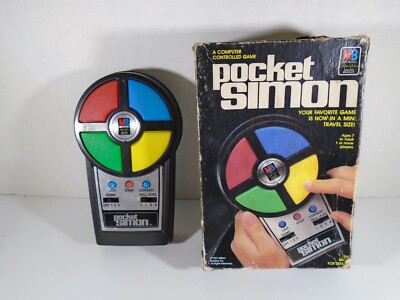
Simon almost didn’t need to exist as a new invention at all, because Atari had already built the core idea and released it — and it flopped. The 1974 arcade cabinet Touch Me “found itself competing for attention in arcades with the latest pinball machines and video games of the day; it was not very successful,” according to Wikipedia’s entry on the game. Ralph Baer looked at that failed cabinet in 1976 and saw a genuinely good idea buried under a genuinely bad execution. What he built from that observation became one of the best-selling electronic toys in American history.
A Blunt Review of Someone Else’s Product
Baer and his design partner Howard Morrison encountered Touch Me at a 1976 trade show, and Baer’s assessment of it was immediate and unsparing, according to the Smithsonian Institution’s own object record. He called it “nice gameplay. Terrible execution. Visually boring. Miserable, rasping sounds.” That’s not the review of someone dismissing an idea — it’s the review of someone identifying exactly which parts of a concept were worth saving and which parts needed to be thrown out entirely. Wikipedia’s account of Touch Me is even more direct about why Baer had an opening: Atari’s cabinet used four identically colored circular buttons and simply never caught on with arcade audiences already spoiled for choice.
Rebuilding the Idea From Scratch
Baer’s team didn’t just repackage Touch Me — they rebuilt its core mechanic around color, sound, and physical design choices arcades had skipped entirely. According to the Smithsonian, Baer picked the game’s four musical tones by consulting his children’s encyclopedia, deliberately choosing notes playable on a bugle so the sequence would sound genuinely pleasant rather than the “rasping” tones he’d criticized in the original. Programmer Lenny Cope handled the software, with Charles Kapps writing much of the underlying assembly code, per Wikipedia’s account of the game’s development. The prototype went through Milton Bradley under the working title “Follow Me” before the company renamed it Simon ahead of release — a name that made the game’s whole premise legible at a glance, since it played like a mechanized version of the childhood game Simon Says, just without another human being required to run it.
A Launch Built for Attention
Milton Bradley didn’t roll Simon out quietly. The game debuted in 1978 at Studio 54, the New York nightclub synonymous with excess and spectacle, with a four-foot model of the game hanging directly over the dance floor, according to the Smithsonian Magazine. It launched at a retail price of $24.95. The timing helped too — that same year, Steven Spielberg’s Close Encounters of the Third Kind featured a spaceship whose light-and-tone communication sequence bore an unmistakable resemblance to Simon’s own gameplay, giving the toy a pop-culture tailwind nobody at Milton Bradley had to pay for.
The nightclub launch wasn’t just a stunt for its own sake, either. Studio 54 in 1978 was one of the most photographed rooms in America, and putting a children’s electronic toy inside that specific setting signaled something deliberate about who Milton Bradley thought would actually buy Simon: not just kids, but the same adults who spent their evenings there, looking for a novelty gadget worth showing off at a party. That positioning helped Simon cross over into a genuinely adult market in a way most electronic toys of the era never managed.
Baer Made Sure Nobody Could Say He Hid the Source
Rather than obscure where the idea came from, Baer did the opposite. Per the Smithsonian’s object record, he meticulously documented Simon’s direct lineage from Touch Me in his own patent application — a notably transparent move from a man who had already been through prior patent disputes over video game prototypes with Atari. That patent, U.S. 4,207,087 for a “microcomputer controlled game,” was granted in 1980, and Simon went on to become one of the top-selling toys of the 1978 holiday season, according to Wikipedia’s account.
What the Flop-to-Hit Pipeline Actually Shows
Baer, later honored with the National Medal of Technology in 2006 and remembered as “the Father of the Video Game” per the Smithsonian, didn’t need a brand-new idea to build one of the most recognizable toys of the century. He needed a failed one that nobody else had bothered to fix. Simon’s real origin story isn’t a flash of pure invention — it’s a case study in taking something the market had already rejected once, being specific about exactly why it failed, and being disciplined enough to fix only that.

Leave a Reply