

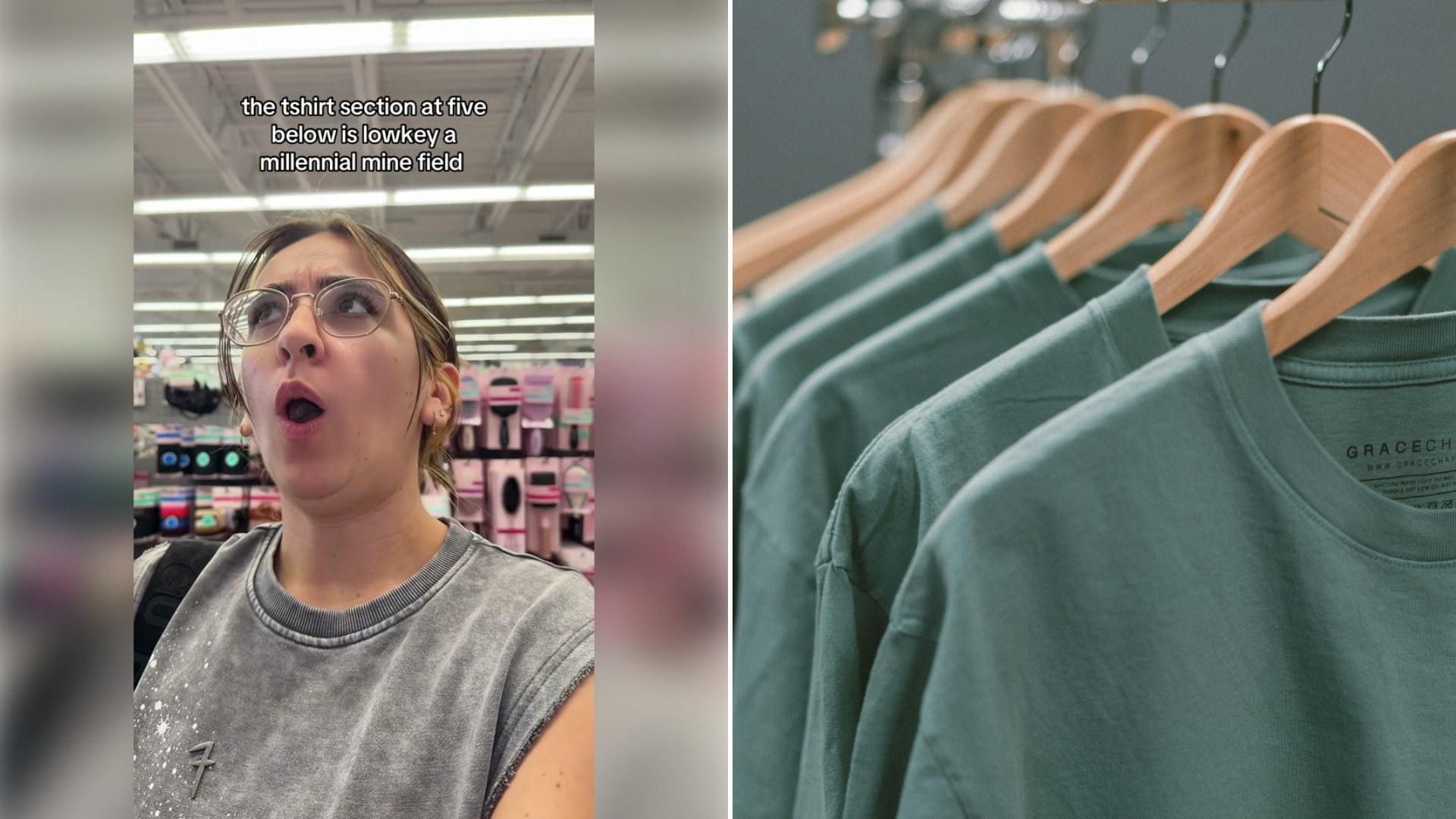
Nostalgia bait has a way of showing up in the last place anyone expects it, and @acooz31 finds exactly that browsing the t-shirt section of discount retailer Five Below. Visibly shocked, she discovers graphic tees featuring early-2000s pop culture references she grew up with, tucked into what is technically the kids section rather than anywhere an adult shopper would normally think to look.
Joking that the section is a millennial minefield of nostalgia bait, she admits it took real willpower not to buy the very last one on the rack. That specific tension, recognizing exactly why a product was designed to target her age group and still nearly giving in anyway, is what gives the video its comedic honesty.
Discount and budget retailers have increasingly leaned into Y2K-era pop culture nostalgia as a licensing strategy, recognizing that millennials now have real disposable income and a strong emotional pull toward the specific pop culture references of their childhood and teenage years. Placing that merchandise in the kids section specifically plays into the layered nostalgia of the moment, since the shirts are styled and sized like the ones this generation actually wore the first time around.
That deliberate targeting is part of a broader pattern across retail more generally, where brands have gotten increasingly sophisticated about recognizing which decade’s references will hit hardest with which shoppers, often placing that merchandise in unexpected corners of a store specifically to trigger this kind of surprised, deeply nostalgic reaction.
The specific choice to shop in a children’s section as an adult already carries a small, self-aware bit of comedy before any nostalgic shirt even enters the picture, since it inverts the usual assumption about who a store section is meant for. That inversion is exactly what makes the eventual discovery land so effectively; the shopper is not looking for nostalgia when she finds it, she is simply browsing casually, which makes the surprise of spotting something so specifically targeted at her own childhood feel less like clever marketing and more like an unexpected personal ambush.
Y2K nostalgia specifically has proven to be one of the most durable and commercially reliable waves of retro appeal in recent retail history, driven by a generation now old enough to have genuine purchasing power and a real emotional investment in reclaiming pieces of their own childhood. Early 2000s pop culture references, in particular, carry a specific kind of charge, tied not just to general decade nostalgia but to very precise memories of specific shows, characters, and cultural moments that millennials experienced firsthand rather than through hand-me-down family stories the way earlier decades sometimes get transmitted.
Retail licensing strategy has also grown noticeably more granular over the past several years, moving well past broad decade-based nostalgia marketing into far more specific, deeply referential graphic choices designed to trigger recognition in a narrow, well-defined age bracket rather than nostalgia in general. A shirt referencing a specific early-2000s pop culture touchstone is a far more targeted bet than a generic retro-styled design, and the fact that discount retailers are willing to make that kind of specific bet says something about how confident brands have become in millennial nostalgia as a genuinely reliable sales driver rather than a passing trend.
There is also something worth noting about the particular kind of guilt or hesitation captured in this video, the awareness that buying into nostalgia marketing is, on some level, buying into a deliberately engineered emotional trigger, while still genuinely wanting the item anyway. That self-aware tension has become its own recognizable comedic beat across nostalgia-shopping content broadly, letting viewers laugh along at their own susceptibility rather than pretending to be above it entirely.
The kids section placement specifically also reflects something practical about sizing and styling trends, since many of the graphic tee silhouettes popular in the early 2000s, boxy cuts, smaller proportions, and playful, oversized graphics, map surprisingly well onto modern kids clothing sizing and styling conventions. That overlap is not purely a marketing coincidence; it reflects a genuine convergence between what a retailer’s kids section already stocks and what an adult shopper chasing a specific throwback aesthetic actually wants to buy.
There is also a broader point worth making about how discount retail specifically has become an unlikely but fertile ground for nostalgic finds of all kinds, not just graphic tees. Because these stores rotate inventory quickly and stock closeouts, licensed overstock, and opportunistic buys from a wide range of suppliers, they often end up carrying a far more eclectic, less curated mix of merchandise than a mainstream retailer with a tightly controlled buying strategy. That unpredictability is exactly what makes browsing a store like Five Below feel more like a treasure hunt than a routine shopping trip, since the inventory on any given visit can differ meaningfully from what was there the last time.
The video also captures something true about how shoppers often talk themselves out of, and then back into, a nostalgia purchase within the span of a single store visit. The instinct to resist an impulse buy, especially one clearly engineered to appeal to a specific emotional weak spot, competes directly against the genuine pull of reclaiming a small, tangible piece of a specific childhood memory. That internal back-and-forth, played out here in real time on camera, is instantly relatable to anyone who has ever talked themselves in and out of a purchase standing in a store aisle.
For fellow millennial shoppers, this video doubles as both a warning and a recommendation: check the kids section on your next discount store run, since the nostalgia bait waiting there is apparently more effective than anyone expects it to be.

Leave a Reply