

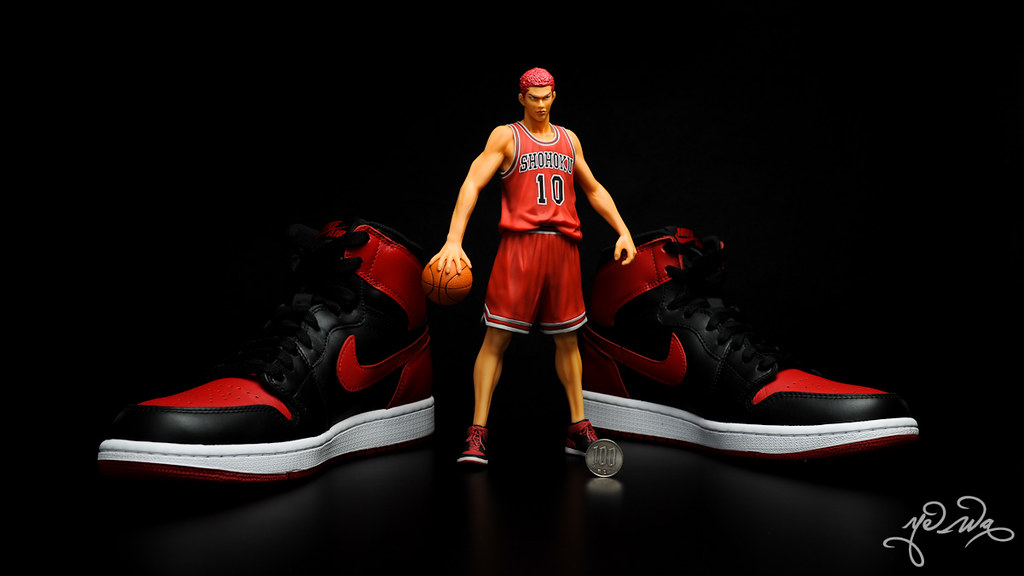
$560,000. $1.472 million. $2.238 million. $8 million. Each of those numbers set a new world auction record for sneakers, and every single one of them belonged to Michael Jordan.
No other athlete’s shoes have ever come close to that streak, and the gap between the first record and the most recent one — four years, roughly fourteen times the price — says more about the sneaker market than any single sale could.
It started in May 2020, when a pair of 1985 Air Jordan 1 Highs in Chicago Bulls colors sold at Sotheby’s for $560,000, timed to coincide with the finale of ESPN’s “The Last Dance.” The pair was game-worn, signed in black marker — unusual for Jordan — and mismatched, a size 13 on the left foot and a 13.5 on the right, exactly the kind of quirky, human detail that collectors chase.
It broke the previous sneaker record of $437,500, set the year before by a pair of 1972 Nike “Moon Shoes” that predated Jordan entirely. Nike had handed Jordan his own signature shoe line in 1984, an unprecedented arrangement for a rookie at the time, and by 2020 that decision was paying off in an auction room instead of a shoe store.
Sotheby’s own director of sneakers, Brahm Wachter, framed it plainly at the time: the sale showed “not only the incredible appeal of Michael Jordan as one of the most recognizable and legendary athletes of all time, but also that sneaker collecting is truly a global and growing market.” Eighteen months later, the market proved him right in a way even Sotheby’s probably didn’t expect.
Breaking Its Own Record, Again and Again
In December 2021, a pair of 1984 Nike Air Ships — not even branded Jordan, since Nike hadn’t launched the signature line yet — sold at Sotheby’s for $1.472 million. Designed by Bruce Kilgore and worn during Jordan’s fifth-ever NBA game as a rookie, the red-and-white pair became the first sneakers in history to cross the $1 million mark at a public auction. A shoe made before Jordan had a shoe deal outsold shoes that carried his own name. Notably, that record only counted public sales — months earlier, a pair of Kanye West’s Nike Air Yeezy prototypes had changed hands in a Sotheby’s-brokered private sale for $1.8 million, but because it wasn’t an open auction, it never carried the official title Jordan’s pairs kept claiming.
Then came April 2023, when a black-and-red pair of Air Jordan 13s worn in Game 2 of the 1998 NBA Finals against the Utah Jazz sold at Sotheby’s for $2.238 million. Sotheby’s noted these were the only complete, photo-matched pair from any of Jordan’s six Finals appearances ever authenticated by the sports authentication firm MeiGray Group — the same firm that has spent years cross-referencing broadcast footage frame by frame to match individual scuff marks and lace patterns on game-worn gear back to specific plays. That kind of forensic verification didn’t really exist for most memorabilia a generation ago, and it now routinely adds six figures to a winning bid.
Six Shoes, No Pairs, $8 Million
The most recent record isn’t even a pair. In February 2024, Sotheby’s sold what it called “The Dynasty Collection” — six individual sneakers, one from each of Jordan’s championship-clinching Finals games in 1991, 1992, 1993, 1996, 1997 and 1998 — as a single lot for $8 million. They exist as single shoes rather than pairs because Jordan reportedly gave one sneaker from each title to former Chicago Bulls public relations executive Tim Hallam, who held onto them for decades before consigning the set — a quiet, decades-long act of hoarding that turned out to be worth more than most professional athletes earn in a career.
Line them up and you get an oddly precise chart of a market maturing in real time: an autographed pair validated mostly by provenance and nostalgia in 2020, a technically unbranded rookie-year shoe breaking the seven-figure barrier a year later, a forensically photo-matched Finals pair doubling that in 2023, and finally a half-dozen single shoes — no mates, no boxes, just documented history — pulling in eight figures. You don’t need to know sneakers to see the pattern. Somewhere along the way, buyers stopped paying for shoes and started paying for verified minutes of Michael Jordan’s career, and the price has followed the stakes of the game the shoes were worn in — right up to a collection that represents six separate championship-clinching nights, sold together as essentially a decade of dynasty compressed into a single Sotheby’s lot.

Leave a Reply