

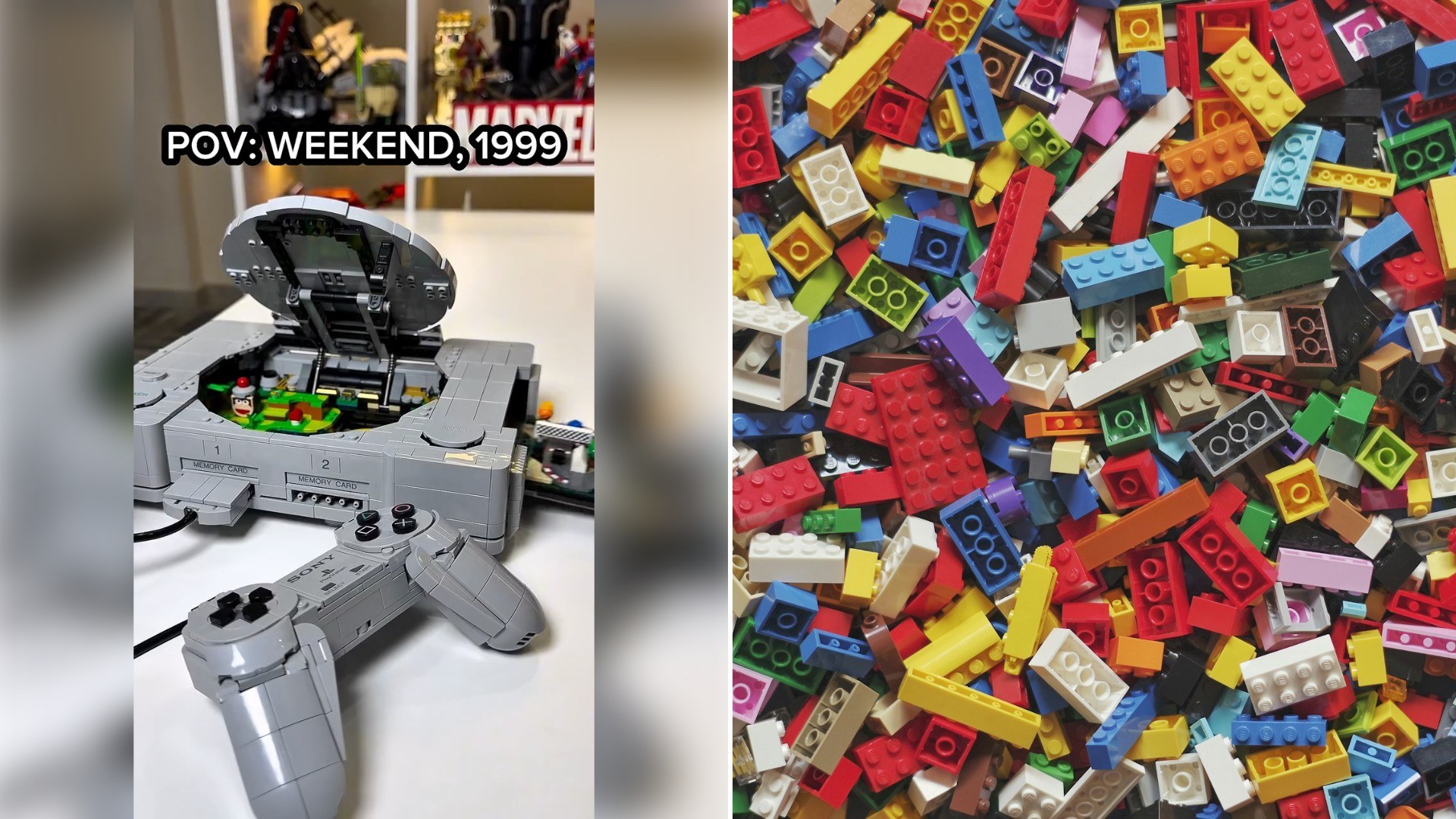
Brick-built nostalgia rarely gets more specific than recreating the exact console that defined a childhood living room, and that is exactly what @thebrickpharaoh pulls off with a fully detailed Lego build of the original 1990s Sony PlayStation. The set includes modular game inserts that swap in and out like real discs, and when the creator plugs a cable into the build, the console’s iconic startup chime and mechanical clicking sounds play right alongside it.
That sound design detail is what elevates the build from an impressive static model into something genuinely immersive. The caption notes the set was gifted by the LEGO Group, and the whole piece is framed around recreating the specific feeling of a 1999 weekend gaming session, down to sensory details that most console tributes never bother to include.
Lego’s licensed adult-collector lineup has grown significantly over the past decade, increasingly leaning into exactly this kind of hyper-specific, nostalgia-driven nod to gaming and entertainment history rather than the kid-focused sets the brand built its early reputation on. A build like the original PlayStation sits at the intersection of two collecting communities at once, appealing equally to Lego enthusiasts drawn to the engineering challenge and to retro gaming collectors drawn to the console itself.
The original PlayStation, released in the mid-1990s and a fixture of countless households by the late nineties, occupies a particularly strong place in gaming nostalgia precisely because of sensory details like its startup chime, a sound immediately recognizable to an entire generation even decades later. Recreating that sound alongside a physical model taps into memory in a way that a display piece alone could never quite manage.
What makes this kind of build especially impressive from an engineering standpoint is the challenge of translating something originally designed with curved plastic edges and smooth, injection-molded surfaces into the blocky, modular language of Lego bricks. Getting proportions and details recognizable within that constraint takes real design skill, and the fact that a viewer can immediately identify the console at a glance, despite the fundamentally different building material, says a lot about how carefully the build was planned before a single brick was placed.
The swappable game insert mechanism deserves particular credit too, since it replicates one of the most tactile, memorable parts of owning an actual PlayStation: physically removing one disc and sliding another into its place before booting up a different game. That small ritual, repeated countless times by anyone who owned the console during its heyday, is exactly the kind of muscle memory that a static display model could never recreate, and building it into a Lego version turns the piece from a static tribute into something closer to an interactive memory box.
Gifted builds from LEGO itself, as this one was, also point to how seriously the brand now takes this specific nostalgia market. Rather than treating adult collectors as an afterthought to its core children’s audience, Lego has increasingly invested in exactly the kind of licensed, detail-obsessed sets that reward builders who grew up with the original objects being recreated, a strategy that depends heavily on creators willing to document builds like this one in enough loving detail to make the nostalgia land for a wider audience online.
There is also something worth noting about how gaming nostalgia specifically differs from other categories of retro collecting. A vintage record or a piece of vintage clothing can often still be used exactly as originally intended decades later, but original gaming hardware frequently degrades, fails, or simply becomes impractical to hook up to modern displays. A detailed recreation like this one offers a workaround to that problem, letting the specific sensory signature of an era, its startup sound above all, live on in a form that does not depend on finding and maintaining decades-old electronics.
For fans of either hobby, this build is a reminder of how far detail-oriented nostalgia content has come, no longer satisfied with simply looking like the original object but increasingly focused on recreating the full sensory experience that made it memorable in the first place.
It is also interesting to consider how this kind of build fits into the much older tradition of scale-model hobbies generally, going back long before Lego ever entered the picture. Model trains, model cars, and miniature architecture have always drawn a specific kind of enthusiast willing to spend enormous time and care replicating something full-sized down to its smallest details. What is new here is the specific object being honored, a piece of consumer electronics rather than a vehicle or building, and the specific tool being used to honor it, interlocking plastic bricks rather than balsa wood or die-cast metal. The underlying impulse, though, the desire to physically recreate something beloved at a smaller scale, connects this build to a hobby lineage stretching back generations.
There is also a community dimension worth mentioning, since builds like this one rarely exist in isolation. Online spaces dedicated to custom and licensed Lego builds have grown into genuine hubs where builders trade techniques, share part lists, and push each other toward increasingly ambitious recreations of the objects that defined their own childhoods. A build this detailed did not happen in a vacuum; it happened within a community that has spent years collectively figuring out how to translate nostalgia into brick form with ever-greater precision.
Whatever comes next from this particular builder, the bar has clearly been set: a good nostalgia build these days needs to do more than just look right, it needs to sound right too.

Leave a Reply