

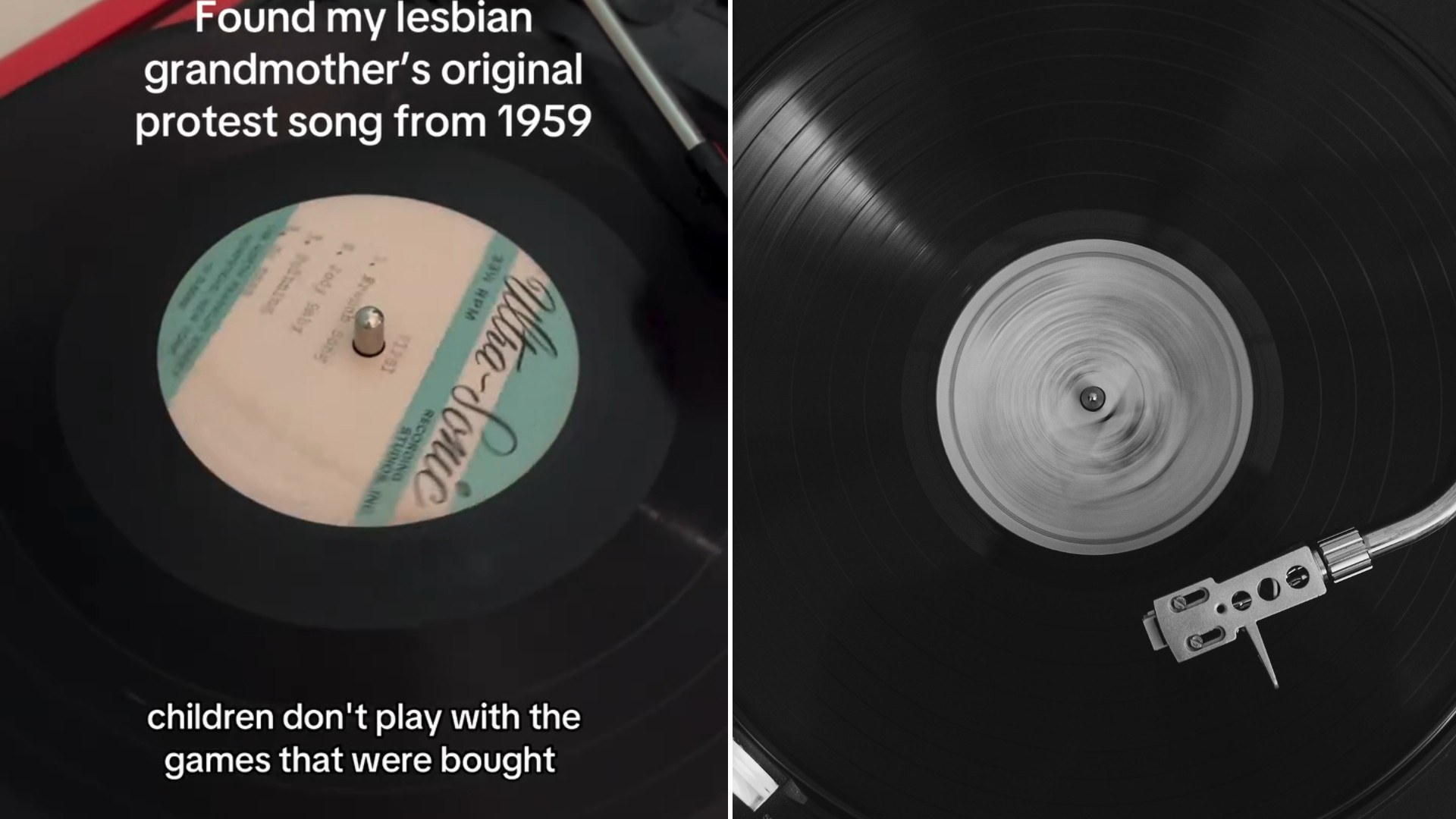
Some family heirlooms sit quietly in a drawer for decades before anyone thinks to actually play them, and that’s exactly the story behind a video from creator @julespaymer, who set a decades-old vinyl record spinning on a turntable and let it play in full for her audience. The record itself is a self-pressed protest song recorded by her own grandmother back in 1959, and rather than simply describing the moment, she let the actual music do the talking, layering the lyrics on screen as text overlay so viewers could follow along with every word as the song unfolded.
The caption calling her grandmother a blueprint says a great deal in very few words. It reframes what could have been a simple piece of family memorabilia into something closer to a personal origin story, a direct line connecting one woman’s convictions in 1959 to the values and voice of her granddaughter decades later. Self-pressed records from that era were never mass-produced or widely distributed; they were typically made in small batches, often as a way for independent voices to get their message onto a physical format when mainstream record labels either weren’t interested or weren’t accessible to them. A protest song pressed this way in 1959 represents a genuinely rare kind of artifact, both musically and historically.
View this post on Instagram
There’s an important context worth understanding about what it took to record and press a protest song independently in 1959. It required real conviction and real resources, at a moment when the infrastructure for independent music production was far more limited than it is today. Someone recording and pressing their own record back then wasn’t simply making a hobby project; they were making a deliberate choice to get a message onto a permanent, physical format, one that could be played, shared, and passed down, rather than letting the message exist only as a spoken idea or a piece of writing that could more easily be forgotten or lost.
That’s precisely what makes this story resonate so strongly decades later. The record survived. It stayed intact, stored carefully enough by family members across multiple generations, until eventually a granddaughter, presumably born long after her grandmother recorded it, was able to place the needle down and hear that exact voice again, singing exactly what she chose to sing in 1959. The caption calling her grandmother a blueprint captures the specific power of that moment: hearing not just a story about an ancestor’s values, but the ancestor’s own literal voice and words, preserved in a format that required real effort to make and even more effort to protect over the following decades.
Family heirlooms carry a particular emotional weight that mass-produced items simply can’t replicate, and music specifically occupies a unique category within that broader idea. A photograph shows what an ancestor looked like. A letter shows how they wrote. But a recording, especially one where the words appear as lyrics rather than simply background music, allows a listener to hear exactly what an ancestor believed strongly enough to put on a record, in their own voice, with their own specific phrasing and delivery. That’s a level of direct connection across generations that very few family artifacts can offer, and it’s exactly why moments like this tend to move so many people who watch, regardless of whether they have any personal connection to the specific family or the specific protest cause involved.
For anyone with old family recordings, letters, or other personal artifacts tucked away in storage, there’s a genuine value in taking the time to properly preserve and, ideally, digitize them before they’re lost to time, damage, or simple neglect. Vinyl records in particular degrade with repeated play and improper storage, and a record surviving in playable condition for over sixty years is genuinely fortunate rather than guaranteed. Taking the extra step to transfer an old recording to a digital format, or even simply storing it properly going forward, can be the difference between a family’s history staying accessible for future generations or quietly disappearing the moment the physical object finally gives out.
There’s also something worth reflecting on regarding how quickly personal history can slip away without anyone intending it to. A record like this could easily have been discarded decades ago by someone who didn’t understand its significance, or simply lost in a move, a flood, or a cleanout. That it survived long enough to reach a generation that could finally appreciate its full context is, in its own way, a small piece of luck worth being grateful for, and a quiet reminder to ask older family members what stories, recordings, or objects they might be holding onto before those opportunities disappear for good.
There’s also something worth sitting with about how technology has changed the way personal history gets preserved across generations. A self-pressed record in 1959 was one of relatively few ways an ordinary person could permanently capture their own voice in a format meant to last. Today nearly everyone carries a device that can record and share instantly, which adds a layer of appreciation for just how deliberate and rare an act of self-recording once was, back when it required real effort and real conviction.
Playing a record like this one publicly, decades after it was made, also does something the original recording likely never anticipated: it lets a message meant for one time and place reach a completely different audience, on a completely different platform, generations later than its creator could have imagined.

Leave a Reply