

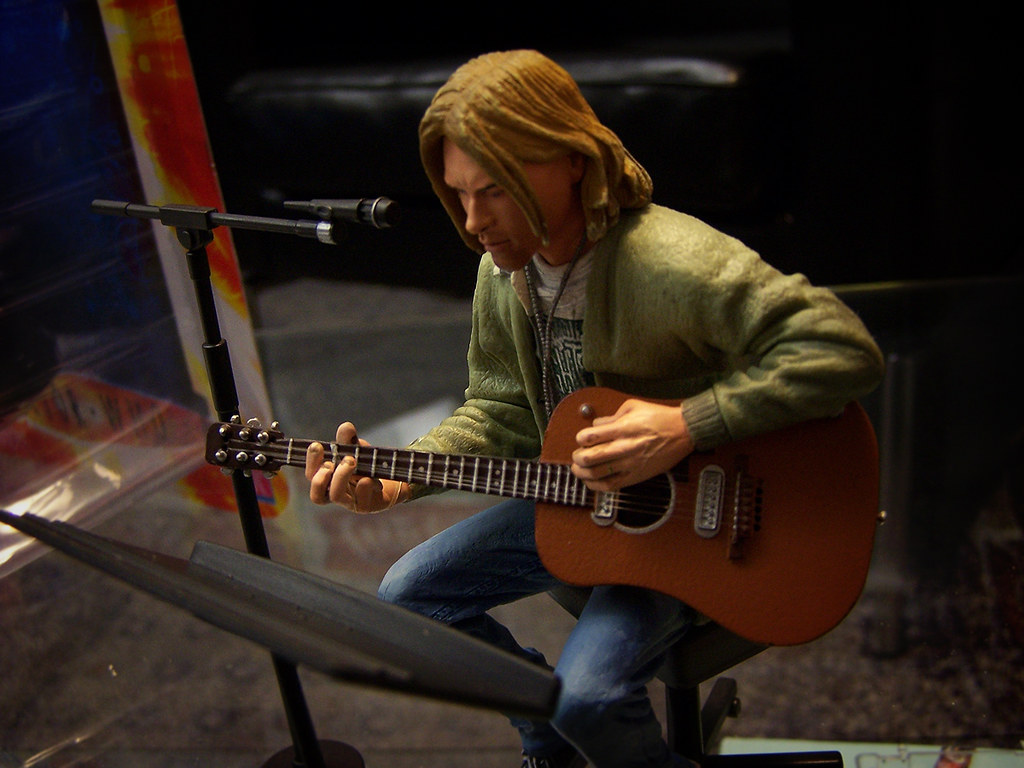
$6,010,000. That’s the hammer price a single acoustic guitar fetched at Julien’s Auctions in Beverly Hills on June 20, 2020 — a 1959 Martin D-18E that Kurt Cobain played during Nirvana’s now-legendary MTV Unplugged in New York taping. The sale, documented on Julien’s own auction listing, made it the most expensive guitar ever sold at auction at the time, and it held that title for nearly six years.
A Model Nobody Expected to Matter
The Martin D-18E wasn’t a flashy or particularly rare instrument when Martin built it. Fewer than 300 were produced across the model’s short production run, and it was never one of the brand’s marquee designs — a solid, plain-finished dreadnought with an added pickup, nothing close to the ornate showpieces that usually anchor big guitar auctions. Cobain reportedly bought it specifically to use for Nirvana’s stripped-down MTV set, and he played it through the entire 1993 performance, including the show-closing cover of Lead Belly’s “Where Did You Sleep Last Night” that became one of the defining moments of his career.
From Sound Stage to Auction Block
That single televised performance, taped on November 18, 1993, and released commercially after Cobain’s death the following year, is what turned an unremarkable Martin into one of the most sought-after instruments in rock history. MTV’s Unplugged series had already produced iconic sets from other artists, but Nirvana’s episode is routinely singled out as the format’s high-water mark, largely because of how far it strayed from the band’s usual sound — no distortion, no screaming, just Cobain’s voice and this one guitar carrying most of the set. Rolling Stone’s coverage of the sale noted that the guitar came to auction with documentation tracing it directly back to that night, the kind of unbroken provenance that collectors pay a premium for precisely because it’s so rare in music memorabilia, where guitars change hands, get modified, and lose their paper trail constantly.

Not the Only Cobain Item Chasing Records
The Martin D-18E wasn’t an isolated case. Cobain memorabilia has repeatedly outperformed expectations at auction over the past decade: his olive cardigan from that same Unplugged set, complete with a cigarette burn, sold for more than $300,000 in 2019, and a Fender Mustang guitar he smashed on stage in 1990 later sold for close to $600,000, roughly ten times its pre-sale estimate. None of those numbers come close to the Martin, but together they show a pattern — Cobain-owned objects tied to a specific, documented performance consistently pull far more than generic band memorabilia, because buyers are paying for a moment they can point to, not just a name.
Breaking the Previous Record
Before this sale, the benchmark for guitar auctions belonged to David Gilmour, whose black Fender Stratocaster — used across decades of Pink Floyd recordings — sold for $3.975 million in 2019. Cobain’s Martin didn’t just edge past that number; it beat it by more than $2 million in a single sale. CNN’s report on the auction described the result as a clear signal that grunge-era memorabilia had entered the same financial territory as classic rock’s biggest names, a category it had rarely competed in before.
The Record Falls
The $6 million mark stood until March 2026, when Gilmour’s own Black Strat came back to the auction block as part of a larger collection sale and fetched $14.5 million, resetting the world record for any guitar sold at auction. Cobain’s Martin D-18E remains the second-most expensive guitar ever sold and still holds the record among acoustic instruments — a distinction that says as much about how differently the collecting world values plugged-in rock history versus a single unplugged night as it does about either guitar itself.

What the Number Actually Measures
Guitars this expensive aren’t really being valued as instruments anymore; they’re being valued as physical proof that a specific, unrepeatable moment happened. Cobain’s Martin never mattered because of its build quality or rarity as a model — it mattered because millions of people watched him play it, once, on a night that’s now inseparable from how an entire generation remembers him. That’s the actual commodity changing hands at $6 million: not wood and steel strings, but a piece of a memory nobody who was there can get back any other way.

Leave a Reply