

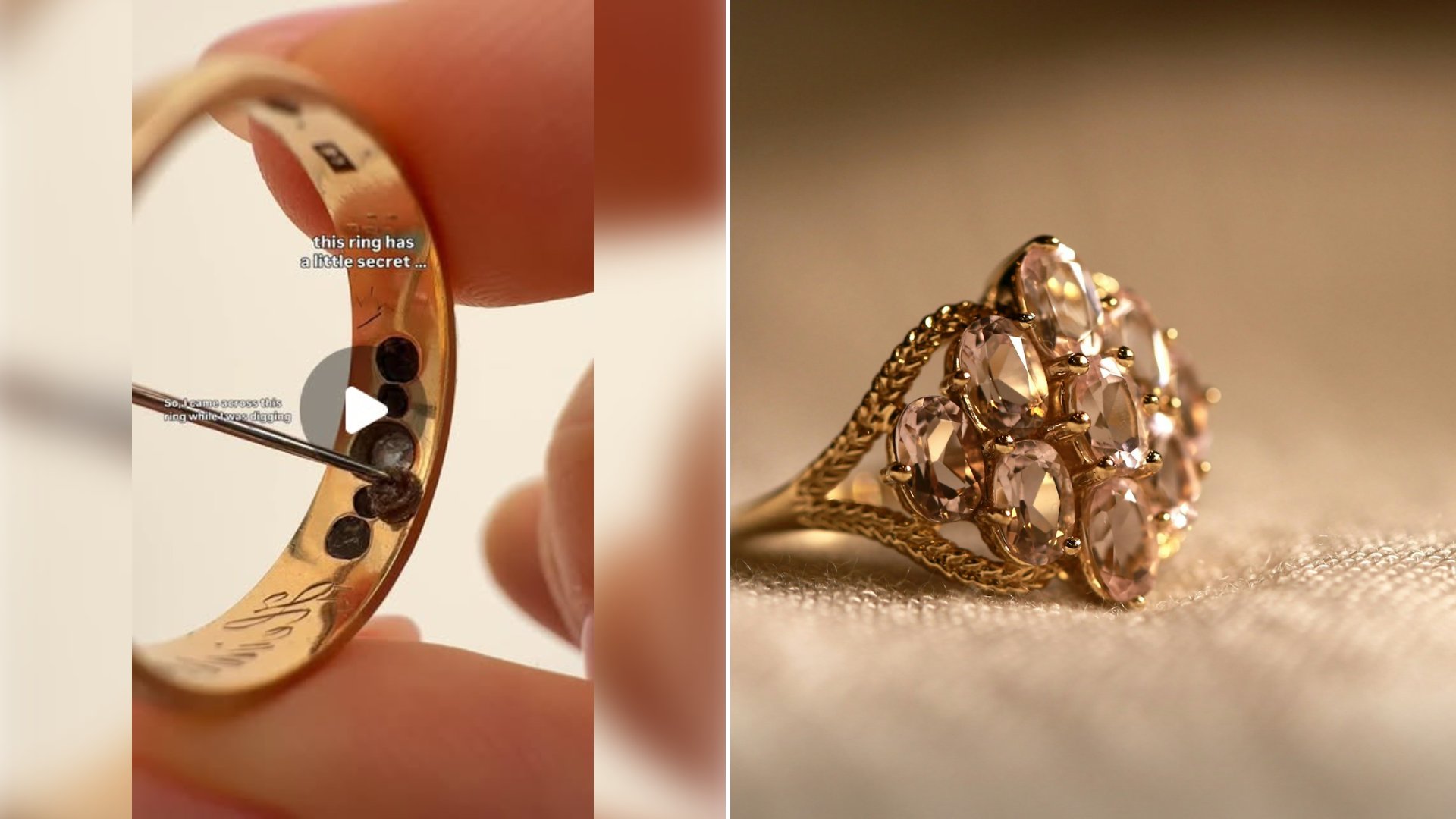
Restorer @holaamor.estudios pulls an antique ring out of a pile of forgotten pieces, and it is not pretty to start. Years of grime have settled into the setting and along the band, dulling the piece to the point where it is hard to tell what it actually looked like new. What follows is a slow, deliberate cleaning process, the kind that favors patience over speed, and it is clear from the first few seconds that this is not going to be a quick polish and done.
As the grime lifts away, fine detail starts to emerge along the band that was completely invisible under the buildup, including what looks like old engraving work. That moment is really the turning point of the video, because it is also where the restorer has to make a choice. The ring does not fit a modern finger the way it was likely sized generations ago, and the easy fix would be to resize the band and move on. Instead, the restoration leans toward preserving what is there rather than altering it, a decision that says a lot about how a careful restorer thinks about a piece like this.
Resizing a ring sounds simple, and for a plain modern band it usually is. Antique pieces are a different story. Most resizing methods involve cutting the band, removing or adding a small section of metal, and re-soldering it closed, which works fine on a smooth, unadorned ring. The moment a band carries engraving, filigree, or any kind of pattern that runs continuously around its circumference, cutting into it risks breaking that pattern permanently or distorting it once the metal is reshaped. Engraved detail that survived a century of wear can be erased in minutes by a resizing job that does not account for it, which is exactly the kind of mistake experienced restorers try to avoid.
There is also a real difference between restoring a piece and altering its history. Jewelry conservators generally draw a sharp line between cleaning off grime and corrosion, which simply reveals what was already there, and resizing or re-cutting metal, which permanently changes the object. A thorough cleaning restores visibility without erasing anything original, while a structural change like resizing can never be fully undone once it happens. That distinction is part of why a restorer faced with a piece like this one tends to lean toward the least invasive option available, especially when there is any engraving or detail work that an aggressive resize could damage.
Pieces that turn up in a forgotten pile like this one often arrive with no paperwork and no clear story attached, which makes a careful, non-destructive approach even more important. Without documentation, a restorer has no way to know in advance whether a ring is a mass-produced piece with no particular history or something with real age and craftsmanship behind it. Treating every unknown piece with the same caution, cleaning gently and avoiding permanent changes until more is understood about it, protects against the worst outcome: discovering after the fact that a quick fix destroyed something that mattered.
That caution is really the heart of why this kind of restoration video resonates. It is not just about making something sparkle again. It is about a restorer choosing to respect a piece that cannot speak for itself, erring on the side of preservation instead of convenience. Whatever this particular ring’s full story turns out to be, the choice to protect its detail rather than grind it away for a better fit says something simple and worth repeating: not every old object should be made to fit modern convenience, and sometimes the right move is just to clean it carefully and leave the rest alone.
More from Vinyl and Velvet
- Jeweler Says She Took One Look at a Customer’s Family Gold Presidential Style Watch, Knew It Was Not Authentic and Suggested He Keep It and Wear It Anyway
- Carole Radziwill Says She Inherited Jackie Kennedy Onassis’s Cartier Watch, Sold It at Christie’s to Break a Widowhood Curse, and Watched Kim Kardashian Place the Winning Bid
- Depop Reseller Sorts Through a Jar Packed Solid With Tangled Vintage Jewelry Piece by Piece, and Commenters Spot a Pendant Necklace They Say Deserves a Real Appraisal

Leave a Reply