

Sixty-three percent of interior designers sourced a pre-1920s antique for a client project this year, up from 56 percent just two years earlier — and that jump is landing at the exact moment the 1970s, the decade the design world spent the better part of a decade rehabilitating, is measurably losing ground. Both numbers come from the same place: 1stDibs’ ninth annual trade survey, which polled 468 design professionals in July and August of 2025. Put together, they describe something more specific than “vintage is popular” — they describe designers actively rotating out of one historical lane and into a much older one.
The Numbers Behind the Shift
The 1stDibs survey, conducted by the research firm Surveys & Forecasts among members of the platform’s Trade 1st Program, found that vintage and antique pieces now make up 36 percent of everything designers source for clients on average — the highest share since 2021 — and 85 percent of respondents said they’d sourced at least one piece originally made between the 1920s and the 2000s. Inside that broad “vintage” bucket, the real story is about which decades are gaining and which are fading. Pre-1920s antiques climbed from 56 percent of designers using them in 2024 to 63 percent heading into 2026, while 1970s-specific pieces — the shag-and-chrome, Milo Baughman, wicker-peacock-chair aesthetic that dominated design media for the past several years — declined in the same window.

Why the 1970s Is Cooling Off
None of this means the 1970s is disappearing from anyone’s Pinterest board. It means the era has moved from “discovery” to “default” — the point in any trend cycle where a look has been so thoroughly absorbed into mass-market furniture lines and big-box reproductions that sourcing an original piece stops feeling like a find. “Designers are embracing the future by beginning to adopt AI tools for efficiency while also looking back to vintage and antique furniture for inspiration and quality craftsmanship,” said Anthony Barzilay Freund, 1stDibs’ editorial director, of the broader pattern this year’s survey captured — designers pushing forward on tools while pushing backward on eras, chasing whatever hasn’t been strip-mined yet.
What “Pre-1920s and 1920s-1950s” Actually Looks Like in a Room
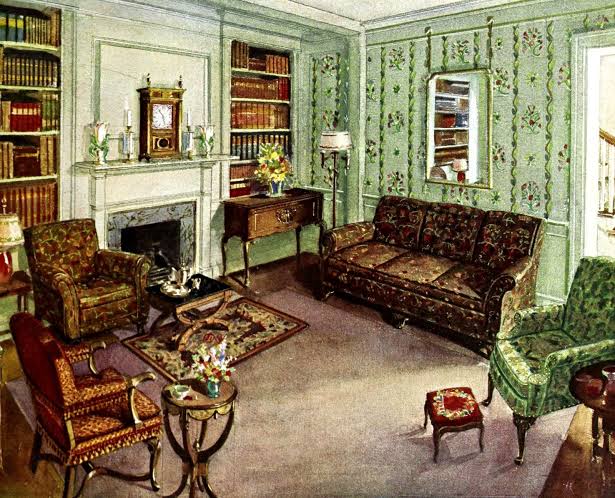
The eras gaining ground aren’t a single look so much as three overlapping ones. Pre-1920s antiques bring in genuinely old-world materials — carved wood casework, hand-blown glass, brass hardware worn to a soft patina that no distressing technique fully replicates. The 1920s and ’30s contribute Art Deco’s confident geometry: stepped forms, sunburst motifs, lacquer and exotic veneers, the aesthetic of a world that had just discovered electric light and wanted furniture that looked like it knew it. By the 1940s and into the ’50s, the line softens into early mid-century modern — tapered legs, organic curves, the first generation of designers building for smaller postwar homes rather than grand prewar ones. None of these three eras share the 1970s’ saturated earth tones or oversized scale; they’re leaner, more finished-looking, easier to drop into a room that already has one foot in the present.
Styling Notes for Working These Eras In
Mixing an actual pre-1920s or Deco-era piece into a contemporary room works best as a single anchor rather than a full period set — one carved cabinet, one sunburst mirror, one pair of tapered-leg chairs, surrounded by simpler modern pieces so the antique reads as intentional rather than accidental. Because these are often solid-wood or hand-finished pieces, they also tend to outlast trend cycles in a way particleboard reproductions don’t, which is part of the practical case designers make for sourcing them even at a premium. A single well-chosen antique also does something a full 1970s-themed room can’t: it signals craftsmanship and history rather than a decade, which is exactly the kind of piece that reads as “collected over time” instead of “shopped in one afternoon.”
The Pattern Underneath the Numbers
What this survey is really tracking isn’t nostalgia for a specific decade — it’s designers treating “vintage” as a moving target that gets recalibrated every time a previous favorite goes mainstream. The 1970s had its run because it was the deepest well nobody had fully tapped a decade ago; now that it’s everywhere from HomeGoods to Instagram reels, the eras that still feel undiscovered are the ones that came before it. That’s less a rejection of the ’70s than a preview of what happens to every retro era eventually — right up until the next one gets rediscovered behind it.

Leave a Reply