


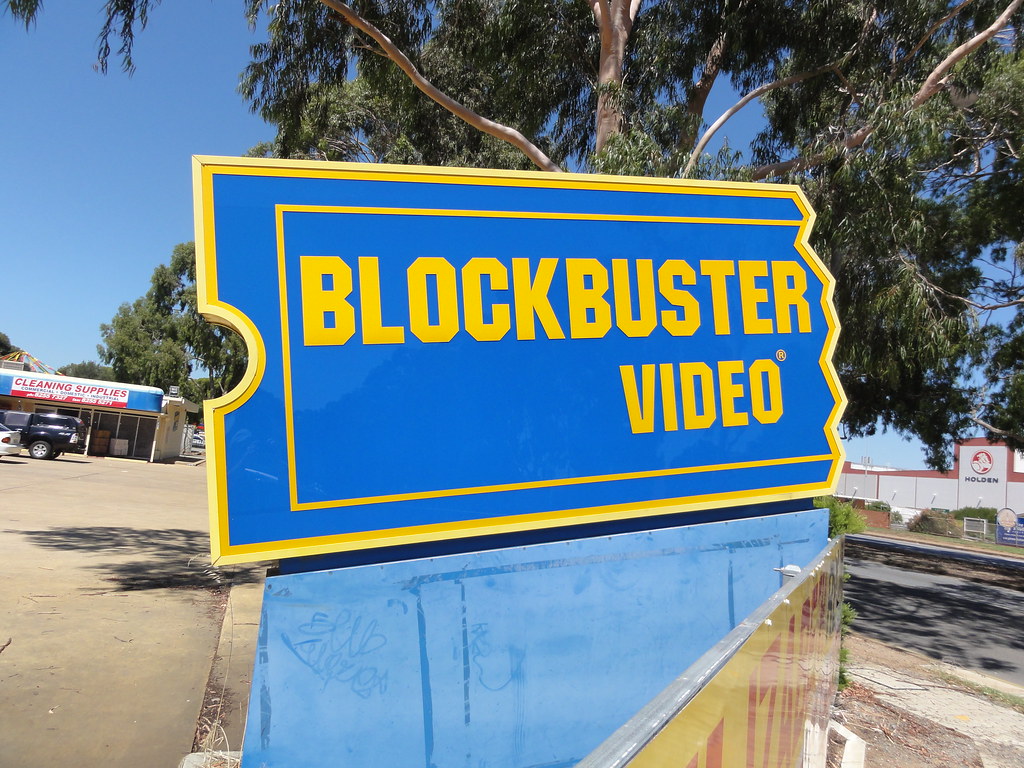
At its 2004 peak, Blockbuster operated 9,094 stores around the world, a number NBC News rounds to roughly 9,000. Today it’s one. A strip-mall storefront on Northeast Revere Avenue in Bend, Oregon, is the last Blockbuster Video left standing anywhere on the planet, and general manager Sandi Harding has been running it since 2004 — the same year the chain hit its high-water mark. The store didn’t get preserved behind glass. It kept renting actual discs to actual paying members long after everyone assumed the format was dead, and that gap between “extinct” and “open Sunday through Thursday until 8 p.m.” is why people still drive hours out of their way to see it.
From Nine Thousand Stores to One
Blockbuster’s collapse followed the shape most people vaguely remember but rarely see laid out: the chain filed for bankruptcy in 2010, and the last corporate-owned locations shut their doors a few years later, with the brand’s remaining assets passing to Dish Network and the surviving stores continuing on as independently owned licensees rather than company outposts, according to Roadtrippers. The dying wasn’t instant, and it wasn’t even really finished for a while — a scattered handful of holdouts kept the lights on in different corners of the world well into the following decade. The last store outside the United States, in Perth, Australia, closed on March 31, 2019. Domestically, a couple of Alaska locations outlasted almost everyone else before finally closing, which is what left Bend as the sole survivor, per NBC News. There was no single closing-day headline for Blockbuster the way there was for a beloved department store. It just kept losing outposts until only one address was left standing.
The Strip Mall That Started as Pacific Video
The Bend store’s roots actually predate the Blockbuster name on its sign. The location began life as a regional chain called Pacific Video in 1990 and only converted to Blockbuster branding in 2000, according to Roadtrippers. That earlier history is part of why the store never fully behaved like a corporate franchise even when the corporation still existed — it operates today under a license from Dish Network, owned by Ken and Debbie Tisher, who renew that agreement annually. Day-to-day, it runs on a staff of about a dozen people, only four of them full-time, stocking new releases largely through a specialty distributor called Vobile Inc., with the rest of the inventory picked up manually off retail shelves. Employees still hand-build the new-release board and laminate membership cards, the same unglamorous back-office work that used to happen in nine thousand identical strip malls and now happens in exactly one.
How a Video Store Becomes a Tourist Attraction
None of that operational detail is what put the store on people’s travel itineraries, though. Ellen DeGeneres filmed a segment inside it, and two Netflix productions leaned on its reputation: a 2020 documentary called “The Last Blockbuster,” made by local filmmakers Zeke Kamm and Taylor Morden, and a workplace sitcom titled simply “Blockbuster,” which premiered in November 2022 and borrowed the store’s central premise for its whole plot, per Roadtrippers. Visitors buy branded stickers, caps, t-shirts and hoodies, along with crocheted accessories Harding makes herself, treating the checkout counter more like a gift shop register than a rental desk.
The clearest sign of how far the novelty travels came in 2020, when Harding listed the store itself on Airbnb. For three one-night stays that September, open only to residents of the store’s home county, guests could book an overnight “stay” for four dollars a night, complete with a nineteen-nineties-themed living-room setup, a futon, vintage blankets and an unlimited movie marathon pulled from the shelves, according to Airbnb’s own announcement. Airbnb made a donation to the Humane Society of Central Oregon tied to the listing, and the store even ran a phone line nicknamed the “Callgorithm,” where staff gave out personal movie recommendations to anyone who called in.
Why the Last One Never Became a Museum
What keeps the Bend store interesting isn’t that it survived by accident. It survived by refusing to become a relic while everything around it turned into one. Most “last of its kind” landmarks get roped off and explained by a plaque; this one still has membership cards, a new-release wall, and a staff that argues about what to put in the window. The nostalgia is real, but it’s incidental — the actual product is still a video store doing video-store things, which turns out to be the rarer and more compelling exhibit.

Leave a Reply