


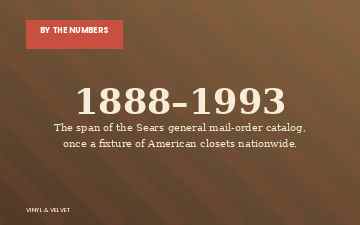
For 105 years, the Sears catalog sat in millions of American homes as something close to a national wishlist. From its first mailer in 1888 to its final general edition in 1993, the “Big Book” outlasted world wars, the Great Depression, the rise of television, and the birth of the shopping mall — reshaping how the country bought everything from watches to entire houses along the way, as chronicled by outlets including Smithsonian Magazine and History.com.
From a Watch Flyer to a National Institution
The catalog’s roots trace to Richard Warren Sears, a railroad station agent in Minnesota who began selling watches by mail in the mid-1880s after a shipment of unwanted stock landed in his lap. Sears’s early mailers were simple and narrow, focused almost entirely on watches and jewelry, but the format proved so effective that he partnered with watchmaker Alvah Roebuck in the early 1890s to expand into a broader catalog under the newly formed Sears, Roebuck and Co. By the late 1890s, the catalog had grown from a single-product flyer into a sprawling volume covering clothing, tools, furniture and household goods.
The Catalog That Sold Everything, Including Houses
What made the Sears catalog remarkable wasn’t just its longevity but its sheer breadth. At its peak, a single edition could run well over a thousand pages, covering categories as varied as sewing machines, bicycles, musical instruments, farm equipment and medical supplies. For rural Americans in particular — often located far from department stores — the catalog functioned as a lifeline to the same consumer goods available in major cities, delivered directly by mail regardless of how remote the address.
Perhaps the catalog’s most surprising chapter is its mail-order home business. Beginning in the early 20th century and continuing for roughly three decades, Sears sold complete house kits by mail, shipping precut lumber and building materials by rail for buyers to assemble on their own land, with architectural plans included in the purchase. Tens of thousands of these Sears houses were built across the country, and many remain standing and lived in today — a physical legacy of a catalog otherwise remembered mostly for clothes and household goods.
A Mirror of American Life
Because the catalog ran continuously for over a century, its pages effectively function as a decade-by-decade record of American consumer taste, technology and design. Fashion historians and archivists have used old Sears catalogs to date and authenticate vintage clothing, since the catalog documented mainstream styles with far more consistency than most surviving advertising from the same eras. A catalog page from the 1920s shows flapper-influenced dresses and early ready-to-wear tailoring; one from the 1970s shows bold prints and flared silhouettes; each edition effectively freezes a specific moment of American style in place.
Why the Big Book Finally Closed
By the early 1990s, the general merchandise catalog’s business case had eroded. Discount retailers and big-box stores offered many of the same goods with more immediate gratification than mail order could match, and the catalog’s massive size made it increasingly expensive to print and distribute relative to its returns. Sears discontinued the general catalog in 1993, closing a chapter that had run essentially uninterrupted since 1888 — 105 years during which the company had gone from selling surplus watches out of a train depot to defining, then losing, the dominant format of American mail-order shopping.
What Vintage Shoppers Can Still Learn From It
Old Sears catalogs remain one of the most practical research tools available to vintage clothing collectors precisely because they were mainstream rather than aspirational. High-fashion magazines from any given decade tend to document what a narrow, wealthy slice of the population wore on runways and red carpets; the Sears catalog documented what ordinary Americans of every income level actually bought and wore day to day. That makes it an unusually reliable reference for dating a garment’s silhouette, fabric, or construction detail to a specific year, since the catalog’s product photography and copy were updated on a predictable, seasonal schedule for over a century.
Digitized archives of many historical Sears catalogs are now available through library and museum collections, letting researchers and hobbyists alike flip through decades of American consumer history without needing access to an original physical copy. For anyone trying to pin down exactly when a particular cut of jeans, style of dress, or type of kitchen appliance was considered current, a Sears catalog from the right year is often a faster and more reliable answer than a general style guide.
The catalog’s absence hasn’t erased its influence. Surviving editions remain prized by collectors, historians and vintage-fashion researchers alike, offering a level of documented, dated detail about everyday American style that few other archives from the same period can match. More than a century after that first watch flyer went out, the Big Book’s real legacy may be less about what it sold and more about how thoroughly it recorded what an entire country wanted to wear, build and buy.

Leave a Reply