

The reel from @houseoflittlewomen opens on a sheet of hardboard curved away from a stairwell wall and a line of text across the hallway: “Making the most amazing discovery.” Her caption, posted October 4, 2026, says she is “still shocked that all of this was hiding behind hardboard” and that a hallway project is coming, so she “had to start with the most amazing discoveries.”
What follows in the 58 second video is a careful strip of the staircase. She wears a white tee, striped jeans and a yellow flower clip in her hair, and she works along the stairs one panel at a time, folding the hardboard back as it comes away.
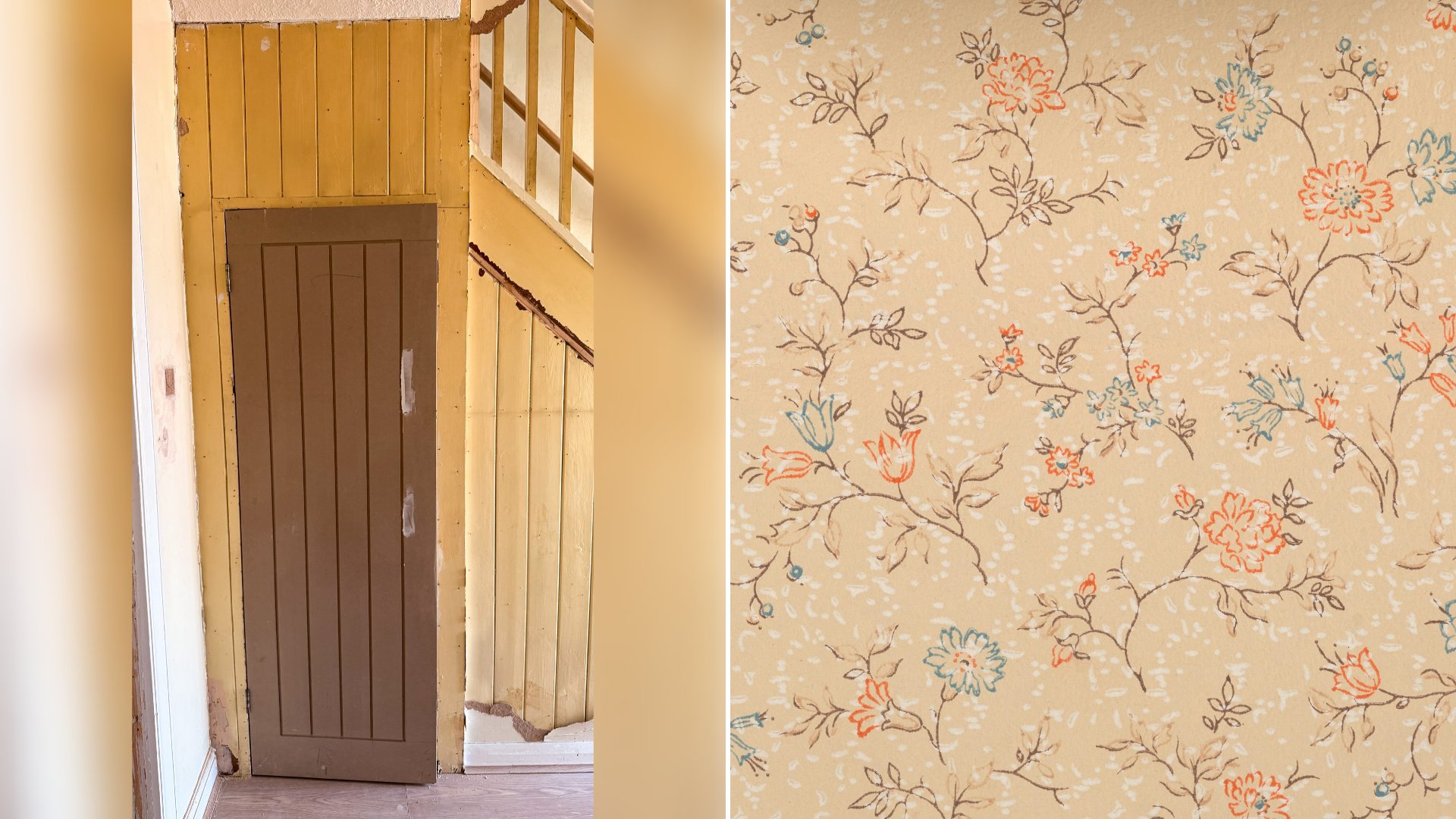
Underneath the first sheet is vertical timber panelling painted a warm ochre, running down the slope of the stairs with a smaller hardboard panel and a metal handle set into it. She presses a hand to the wall and the on screen text says she is “tapping to see if spindles are there.” They are. Lifting the long sloped sheet above the panelling exposes a row of upright stair spindles, and the text reads: “Every single one is still here.”
The order of the strip is worth following if you plan to try it. In the first seconds the title text builds across the frame while she holds a hammer in one hand and peels the first sheet back from the vertical boards. Higher up the stair, a long sloped sheet still covers the wall below the handrail line. Around the 14 second mark she prises that sheet away from the top, and through the gap the first upright spindles show. A text card asks “Are you ready?” and she bends the sheet into a wide curve and lifts it clear. As it swings past the camera the whole row of spindles comes into view, and she stands beside them with a hand on the wood, glancing at the camera while the next text cards appear.
The reel is specific about what she thinks she has found. Her text says “These are the original 1930s stair bannisters that have been hidden since probably the 60s or 70s when this hardboard was put up,” and then, “and they’re all here. This is so exciting!” The decade of the hiding is her estimate, flagged with “probably,” and the video shows no document that dates the staircase or the hardboard.
The second half of the video moves to the other side of the staircase. Her text says, “Let’s take the other side off,” and later, “Then I found the rest of the panelling.” A second person in a striped top and grey dungarees helps lift away a tall sheet of board from a doorway frame, which exposes more of the same timber boards and a view through to a small room with a window, where a drill sits on a floor scattered with debris. Back at the foot of the stairs, someone in a patterned knit jumper uses a hammer on the handled panel and swings it open like a door. It is a cupboard under the stairs, and inside it are bags and soft items in blue, yellow and red. The final text card reads: “Come back to see how I restore it!” The restoration itself is not in this video.
Her 1930s date fits the period when this kind of house was being built in large numbers. Historic England’s listing guide on modern houses says suburban development in the interwar years took place “on a massive scale,” and that the semi detached house came to characterise interwar suburbia. That context explains why one hallway can hold a complete staircase of the era behind later boards.
The most useful point for anyone about to copy her is about the board itself. The UK Health and Safety Executive says it is difficult to tell asbestos insulating board apart from non asbestos equivalents by looking at it, that most work removing asbestos insulating board is higher risk and should be done by a licensed contractor, and that if you think you have found asbestos you must stop work. Boards fitted over old panelling in the 1960s or 70s are the kind of job where that check is worth making before a crowbar goes in. Nothing in the reel suggests her boards were anything other than hardboard, and she calls them that.

Leave a Reply