

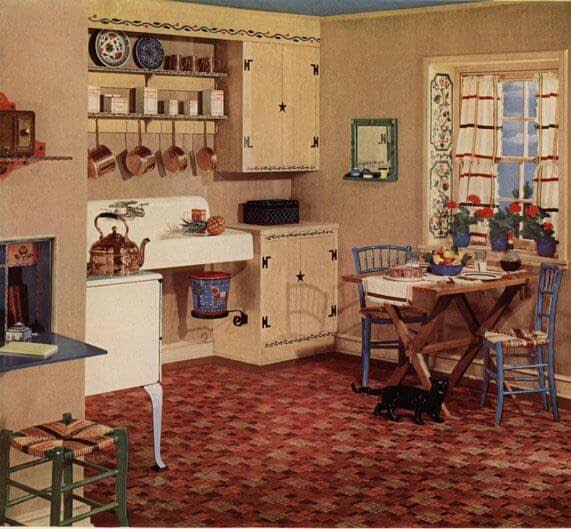
Armstrong’s Pattern #5352 stayed in continuous production for 68 straight years, from 1932 to 2000, making it arguably the best-selling resilient flooring pattern of the entire 20th century. It had a name, a specific designer, and a nickname among the factory workers who made it. That’s not typical for a floor most people never thought to look down and identify.
A Material Invented by Accident
Linoleum itself has an origin story that predates the kitchens most people associate it with by nearly a century. According to the Hagley Museum and Library’s history of the material, Englishman Frederick Walton discovered the core process in 1855 when he noticed linseed oil had solidified into a flexible film inside an unsealed container, and he patented the resulting material — a mix of linseed oil, flax, cork, and pigment pressed onto a canvas backing — starting in 1860. The name caught on so completely that British courts ruled in 1878 that “linoleum” had become generic terminology, making it one of the first product names in history to lose trademark protection purely through overwhelming popularity.
Armstrong Turned Flooring Into a Design Catalog
American manufacturing scaled the material dramatically once Armstrong Cork Company entered linoleum production in Lancaster, Pennsylvania, in 1908. Smithsonian Design Museum research into the company’s output notes that by 1918, just a decade later, Armstrong was marketing roughly 380 distinct designs — mosaics, tile-effect patterns, parquet imitations, faux marble and granite finishes, and carpet-style prints — essentially treating floor covering the way a wallpaper company would treat a print catalog. Each pattern had its own name, its own catalog number, and its own dedicated sales pitch.
The Pattern Nicknamed “The Christmas Pattern”
No single pattern illustrates how personal this design work actually was better than Armstrong’s #5352. According to design history reporting on the pattern’s origins, it was created in the early 1930s by an Armstrong designer, credited as Mr. McClurg, as an interlocking, zig-zagging brick motif originally sold in red. Its genius was almost invisible by design: the pattern had no single dominant detail for the eye to latch onto, which let it recede into the background of a kitchen rather than announce itself. It sold so well during the Great Depression that Armstrong employees nicknamed it “The Christmas Pattern,” because its revenue reportedly helped keep factories running and funded employee holiday bonuses in years when that wasn’t guaranteed. The same reporting credits Hazel Dell Brown, director of Armstrong’s Bureau of Interior Decoration, with building the marketing and room-styling systems that made patterns like #5352 into household names — she personally received tens of thousands of letters from homemakers responding to her design guidance. Pattern #5352 stayed in continuous production from 1932 to 2000, cycling through color updates that tracked the decades — including versions in avocado and harvest gold to match 1970s kitchens.
Named Patterns Are Coming Back on Purpose
The clearest sign that collectors and homeowners are now seeking out specific named patterns rather than generic “vintage flooring” is that Armstrong itself brought #5352 back. After two decades off the market, the company reintroduced the pattern in four new colorways — a business decision that only makes sense if there’s a real, identifiable audience specifically requesting that pattern by name rather than just wanting a generically retro look. Archival research demand tells a similar story: the Hagley Museum’s own trade catalog collection, spanning 1924 to 1952, is regularly consulted by researchers and enthusiasts trying to identify a specific vintage floral or geometric linoleum pattern spotted in an old photograph or artwork, rather than settling for an approximate match.
Why the Pattern Name Matters Now
What’s shifted is the level of specificity collectors are willing to chase. A decade ago, wanting “vintage kitchen flooring” meant browsing whatever turned up. Now, thanks to design writers digging through old catalogs and manufacturers reissuing specific numbers, people restoring midcentury kitchens can search for Armstrong #5352 by name the same way a furniture collector searches for a specific Eames model number. The linoleum under your grandmother’s kitchen table was never actually anonymous — it had a designer, a catalog number, and sometimes a nickname all along. It just took decades for anyone outside the flooring industry to start asking what it was called.

Leave a Reply