

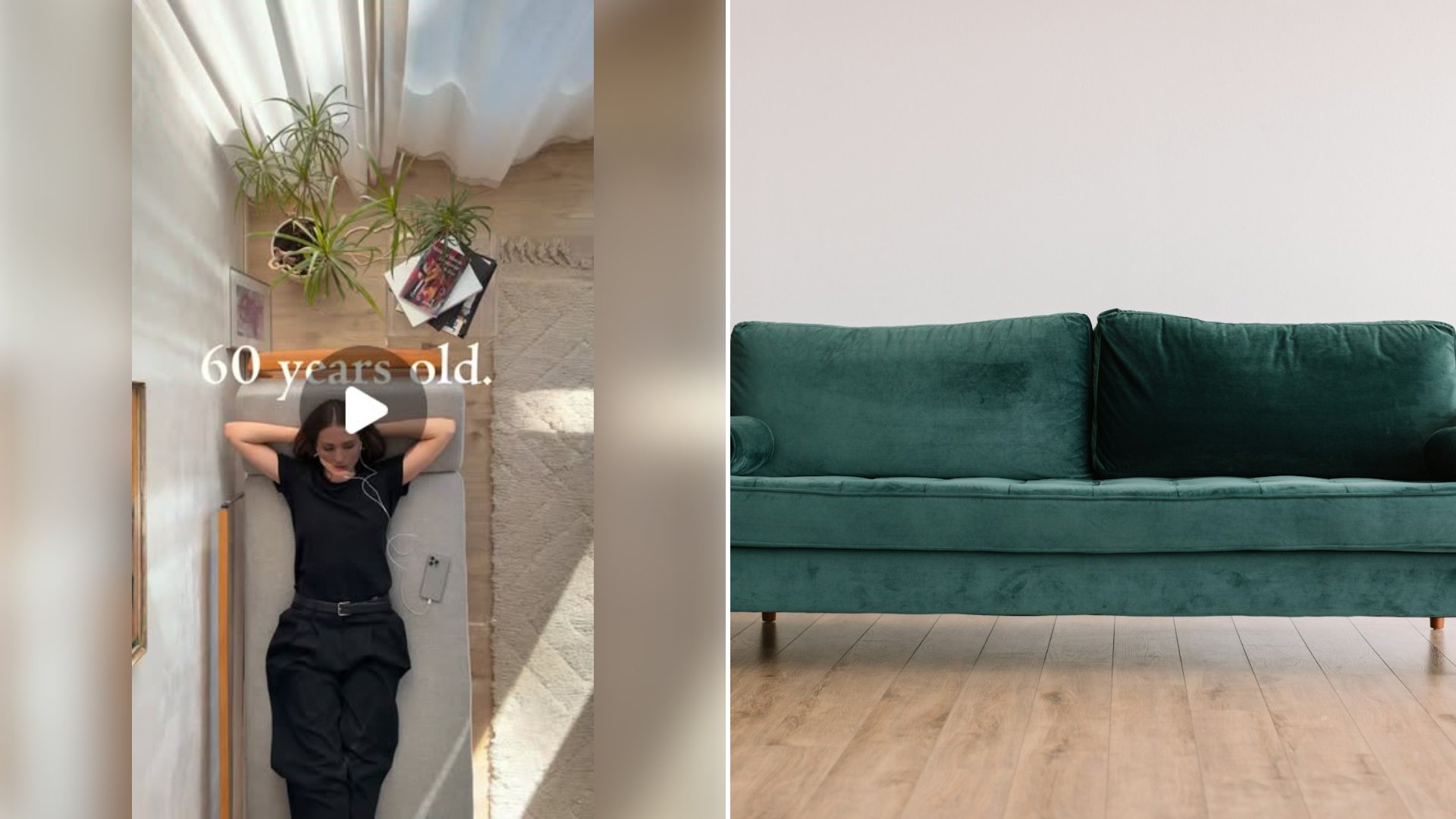
In a video from @mid_century_friends, a woman walks over to a sofa that looks like a fairly standard mid-century piece until she starts folding it. A few quick motions later, the back cushion drops, the frame shifts, and what was a full sofa becomes a flat daybed. Then she reverses it, popping the piece right back into couch form in seconds. It’s the kind of mechanism that modern furniture rarely bothers with anymore, built entirely out of wood, springs, and hinges rather than anything electronic, and sixty years after it was made, it still works exactly the way it was designed to.
What makes the clip from @mid_century_friends land is the contrast between before and after. The frame itself had clearly survived decades of use, but the fabric hadn’t, so the piece went through a full reupholstery before it ever made it on camera. The new upholstery is fitted tightly to the original lines of the piece, with none of the boxy padding or oversized arms that dominate a lot of furniture built today. Once it’s dressed and demonstrated in both positions, it genuinely looks like something out of a furniture showroom rather than someone’s basement find.
Convertible daybed sofas like this one were a staple of mid-century furniture design, especially from the 1950s through the early 1970s, when smaller postwar homes and apartments created real demand for furniture that could do double duty. A sofa that folded flat into a bed meant a den could become a guest room overnight without needing a dedicated bedroom for it. Manufacturers across the country built versions of this idea, usually relying on simple drop-arm or fold-out mechanisms rather than anything motorized, which is a big part of why so many of these pieces are still mechanically functional today. There’s simply less to break on a design built around wood joints, coil springs, and a hinge rather than electronics or foam that degrades over time.
That durability is the real story behind why pieces like this keep resurfacing online. A lot of furniture made in the last fifteen or twenty years is built around particle board frames, stapled upholstery, and foam cushions that start breaking down within a few years of regular use. A solid wood frame from the 1960s, by comparison, was usually built with proper joinery and designed to be reupholstered more than once over its lifetime, which is exactly what happened here. Reupholstery isn’t cheap, but it’s a fraction of the cost of replacing a comparable piece of new furniture outright, and it lets a frame that’s already proven it can last six decades keep going instead of ending up in a landfill.
There’s also a practical argument buried in the demonstration itself. A convertible sofa like this one solves a problem that a lot of smaller homes still have right now: not enough square footage for a guest room, a home office, and a living room all at once. Buying new furniture that does exactly this kind of double duty, done well, often costs significantly more than a vintage daybed sofa in need of reupholstery, and new pieces are far less likely to still be functional in another sixty years. It’s a reminder that functional design doesn’t go out of style just because it’s old, it just needs someone willing to put in the work to bring it back.
More from Vinyl and Velvet
- Two Women Shopping at Parma Flip Open the Glass Lids on a Dark Wood Drinks Cart and Find Glasses, Decanters and a Cocktail Shaker Waiting Inside
- Minnesota Antique Refrigeration Specialist Shows a Teal Fridge Swinging Open Hands Free When a Foot Presses a Chrome Pedal, Revealing Copper Toned Shelves Inside
- Creator Who Tags It Dumpster Diving Finds a Dirty Yellow Chair, Searches It and Sees Used Hosu Listings From $2,200 to $4,000, Then Deep Cleans It and Lounges in It

Leave a Reply