

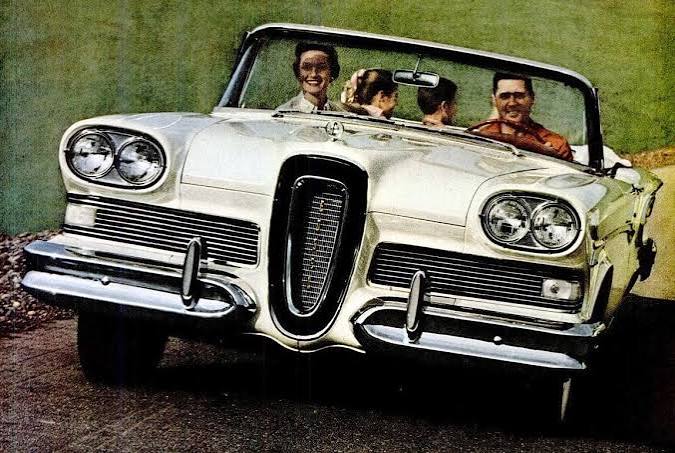
Sixty-nine years ago today, Ford invited America to meet a car it had spent three years and roughly $250 million developing — about $2.72 billion in today’s dollars, according to details compiled on the car’s Wikipedia entry. Company insiders called September 4, 1957 “E Day.” Within three years, the car built for that day would become the textbook example business schools still use to teach how a product launch goes wrong.
A name nobody in the family wanted
The car was named for Edsel Ford, who ran Ford Motor Company from 1919 until his death in 1943 at age 49 — and his own three sons objected to using their father’s name on the project, according to Britannica’s entry on the car. Ford’s marketing team went looking for alternatives anyway, hiring the advertising firm Foote, Cone & Belding, which reportedly generated more than 6,000 possible names. The company also informally invited poet Marianne Moore to pitch ideas, and her suggestions — “Utopian Turtletop” and “Mongoose Civique” among them — were never seriously in the running but became one of the odder footnotes in American car history, per Wikipedia’s account. Ford ended up going with the family name its own family didn’t want.
A grille that became a punchline before the car even sold
The car’s most infamous feature was its vertical front grille, originally designed as a slender element before Ford’s engineers widened it for cooling requirements, according to Hagerty’s breakdown of what went wrong. The public was not gentle about the result. Critics and buyers nicknamed it a “horse collar,” an “Oldsmobile sucking a lemon,” and, less charitably, a “toilet seat.” A car’s grille isn’t usually load-bearing for an entire brand’s reputation, but this one effectively became the Edsel’s whole personality before anyone had driven one.
The math problem nobody solved before launch
Design jokes aside, the deeper failure was structural. Ford positioned the Edsel across four separate series meant to bridge the gap between mainstream Fords and upscale Mercurys — except that gap barely existed. The price difference between Ford’s most expensive model and Mercury’s cheapest was only $136, according to Hagerty’s reporting, leaving almost no real room for an entirely new mid-tier brand to differentiate itself. Buyers looked at the sticker price, shrugged, and bought a Ford or a Mercury they already understood.
Timing made it worse. A recession hit the U.S. economy just weeks after the September launch, and consumer appetite swung hard toward smaller, cheaper cars — the exact moment Volkswagen’s Beetle started gaining serious traction in the American market, per Hagerty’s account. Meanwhile, entire established luxury marques like Packard, Hudson and Nash were folding under the same economic pressure. Ford had launched a brand-new mid-priced car into the one economic climate where “mid-priced and unnecessary” was a death sentence.
Quality problems Ford should have caught first
Even buyers willing to overlook the styling and the pricing ran into real mechanical headaches. Early Edsels shipped with faulty welds, leaky trunks and power-steering failures, and the car’s showpiece feature — a push-button “Teletouch” transmission built into the steering wheel hub — turned out to be genuinely dangerous, with control wiring routed uncomfortably close to the exhaust system, according to Hagerty’s reporting. Ford had reportedly skipped meaningful test marketing with actual consumers before rolling the car out nationally, which meant problems that should have surfaced in development instead surfaced in customers’ driveways.
The numbers that ended it
Ford sold roughly 116,000 Edsels across the 1958 through 1960 model years — about a third of what executives had projected. Sales dropped another 29% in 1959 alone, and Ford discontinued the line in November 1959, midway through its third model year. Resale values collapsed so completely that Ford ended up issuing $300 to $400 rebate vouchers just to placate owners stuck with cars nobody wanted to buy back, according to Hagerty’s account. The company’s exclusive network of 1,187 Edsel dealers largely abandoned the brand as sales cratered, leaving Ford with an entire distribution system built for a product that no longer existed.
None of that means the Edsel was a bad car, mechanically speaking, once the early defects got sorted out — it means Ford built an entire brand around assumptions it never actually tested against real buyers. Nearly seventy years later, “Edsel” is still shorthand in boardrooms for exactly that mistake: spending a fortune building the thing everyone internally agreed on, and skipping the step where you ask if anyone outside the building actually wants it.

Leave a Reply