

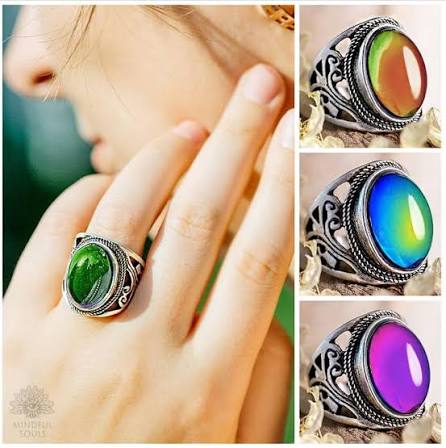
Two men have spent decades getting credit for the same invention, and neither of them ever filed a single patent to settle the argument. The mood ring went from a jeweler’s idea to roughly $15 million in sales by December 1975, according to recorded sales figures — some contemporary estimates cited by HISTORY put the total closer to $20 million by year’s end — all within about ten months of the first rings hitting stores. That kind of speed usually locks in a clear origin story. The mood ring’s origin story never got locked in at all, and the reason is almost embarrassingly simple: nobody protected it.
Two Competing Claims
Jewelry designer Marvin Wernick said he developed the underlying technique after watching a doctor use thermochromic tape, refining it into pendants and rings by January 1975 and putting them on sale that February, per Wikipedia’s account of the invention’s timeline. Meanwhile, New York businessman Josh Reynolds — working with Maris Ambats — introduced color-changing rings into American department stores that same year and became, in the public’s memory, the name most associated with the product. HISTORY reports that Reynolds traced his own inspiration to stress on Wall Street and an interest in biofeedback therapy, a completely different origin story than Wernick’s doctor’s-office observation. Both accounts can be true at once, since neither man had exclusive legal claim to the idea — which is exactly the problem.
The Real Science Underneath the Fad
The liquid crystal technology that made the rings change color did not originate with either man. As Lawrence Livermore National Laboratory’s own account details, scientist Robert Parker had spent years at the Lab studying how liquid crystals respond to heat before launching his own company, Robert Parker Research, in 1972. The encapsulation method that kept the crystals stable in a wearable format — protecting them from oxidation inside a gelatin base — traced back to research originally developed by National Cash Register scientists. In other words, the actual hard science behind the mood ring’s party trick came out of legitimate materials research, while the consumer product built on top of it became a free-for-all the moment it hit stores.
Why Nobody Patented It
Patents exist specifically to stop this kind of chaos, and the mood ring is a textbook example of what happens without one. Because neither Reynolds nor Wernick filed for a patent, any jeweler with access to liquid crystal material could legally start producing near-identical rings the moment demand appeared. Retail proof of just how fast that happened: HISTORY reports a single Alexander’s department store location in Monmouth, New Jersey, ordered roughly 25,000 rings within three weeks of the fall 1975 launch. Silver-plated versions initially sold for as much as $45, according to HISTORY’s reporting — a real price for a real accessory, not a novelty toy. Once cheap knockoffs flooded shelves, that price collapsed toward pocket change within a matter of months — a swing from luxury accessory to bargain-bin novelty in less time than it takes most fashion trends to even peak.
The Crash Was as Fast as the Rise
The same lack of protection that let the fad explode also gutted it. With no patent barrier, quality control disappeared, and the thermotropic crystals in cheaper versions degraded within a year or two, turning “mood rings” into stones that just sat there doing nothing. Reynolds himself filed for bankruptcy in 1977, a stunning collapse for someone whose name had been attached to a genuine cultural phenomenon just two years earlier. The product that made millions in under a year could not survive the same open market that had made it a phenomenon in the first place. Vintage examples that survived intact, with original packaging or working crystals, are now the rare exception rather than the rule — a strange reversal for an item that once sold in the tens of thousands from a single store counter.
What the Mood Ring Actually Teaches
Half a century later, the mood ring’s murky origin story is not really a mystery to solve — it is a case study in what happens when a genuinely clever piece of consumer science gets released into the world with no legal fence around it. Wernick, Reynolds and Ambats all have a real claim to some piece of the invention, and none of them ever had the paperwork to make that claim exclusive. The rings themselves were supposed to reveal what was happening inside you. What their tangled history actually reveals is what happens to an idea nobody bothered to own.

Leave a Reply