

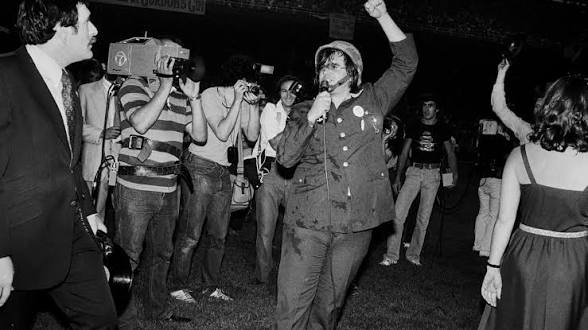
Comiskey Park was built to hold 44,492 people. On July 12, 1979, the official count was 47,795, with an unknown number more slipping past ticket-takers who’d stopped checking. The White Sox had booked a doubleheader against the Detroit Tigers and a between-games publicity stunt meant to move a few thousand extra tickets.
Instead they got a field-storming, a riot police response, and a game the team lost without a single additional pitch being thrown, all because a crate of vinyl records blew up in center field.
A Promotion Built on Spite
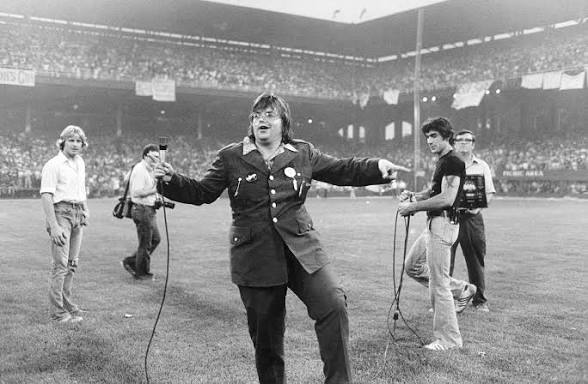
The idea came from Steve Dahl, a rock DJ who’d been fired from Chicago’s disco-format station WDAI-FM on Christmas Eve of 1978 and landed at rival WLUP-FM with a grudge and an audience. Mike Veeck, the White Sox’s director of promotions and son of team owner Bill Veeck, paired Dahl’s on-air anti-disco crusade with a ballpark gimmick: 98 cents admission, matching WLUP’s 97.9 frequency, for anyone who brought a disco record to be destroyed between games, as detailed in the Society for American Baseball Research’s account of the game. Organizers reportedly expected around 20,000 people and staffed security for as many as 35,000. What showed up was closer to double that low estimate, and the mismatch between crowd size and crowd control is where the night started to go wrong before a single record had exploded.
The Detonation, and What Came After
Detroit won the first game 4-1. Between games, Dahl detonated the collected records in a crate out past center field, the spectacle the whole promotion had been built around. Per SABR’s documented account, an estimated 7,000 fans then climbed out of the stands and onto the field itself. The damage was specific and thorough: the pitching rubber was torn up, sections of the outfield and infield dirt were dug out, the bases were taken as souvenirs, the batting cage was overturned, and records that hadn’t made it into the detonation pile got flung around the field. Chicago police in riot gear eventually cleared the crowd, and 37 people were arrested in the process, according to SABR’s game record.
An Unplayable Field, and an Unusual Ruling
The damage to the diamond wasn’t cosmetic. Home plate had been uprooted and reset in roughly the right spot, but not precisely enough to satisfy Detroit’s coaching staff, and Tigers manager Sparky Anderson refused to send his team back onto a field he considered unsafe and improperly restored. American League President Lee MacPhail initially tried to split the difference, ordering the second game postponed and rescheduled for that Sunday rather than canceled outright. Anderson’s objection held, though, and MacPhail reversed course, officially ruling the second game a forfeit, with the White Sox charged a 9-0 loss, a sequence of events documented in SABR’s official game log. Forfeits are rare enough in Major League Baseball that most seasons pass without one; Disco Demolition Night produced one because a Major League playing surface had, briefly, become unplayable by fans rather than weather.
Why It Outlived the Disco Backlash It Was Part Of
Disco Demolition Night is remembered today less as a baseball story than as a cultural flashpoint, one frequently cited, per Britannica’s entry on the event, as a symbolic marker in disco’s rapid commercial decline at the end of the 1970s. That reading has always been contested, since disco’s chart collapse had more to do with oversaturation and record-label overcorrection than with one Chicago promotion, no matter how chaotic. What’s not contested is the mechanics of the night itself: a shock-jock’s grudge, a franchise’s promotional gamble, a crowd that outnumbered the venue’s security plan, and a league office forced into a ruling it almost never has to make.
Baseball has run plenty of between-inning giveaways and gimmick nights since, bobbleheads, fireworks, novelty jerseys, but very few promotions departments have tried anything involving controlled detonation of fan-supplied materials in the years since 1979. The lesson the sport actually took from Comiskey Park wasn’t about disco at all. It was about crowd math, and about what happens when a stunt built for 20,000 people draws twice that many and nobody adjusts the plan in response.
Mike Veeck’s career survived the mess, eventually building a reputation in minor-league baseball for promotions that stayed just this side of chaos without ever repeating the specific mistake of putting an active detonation between two halves of a scheduled doubleheader. Steve Dahl kept broadcasting on Chicago radio for years afterward, and the phrase most associated with his anti-disco campaign outlived both the movement it targeted and the format war that produced it. Old Comiskey Park itself hosted its final game on September 30, 1990, per the Chicago History Museum’s own account, which also notes that the forfeit remains one of only five in Major League Baseball since the 1960s expansion era. Nearly half a century later, the box score from July 12, 1979, still reads the way American League records rarely do: White Sox, forfeit.

Leave a Reply