

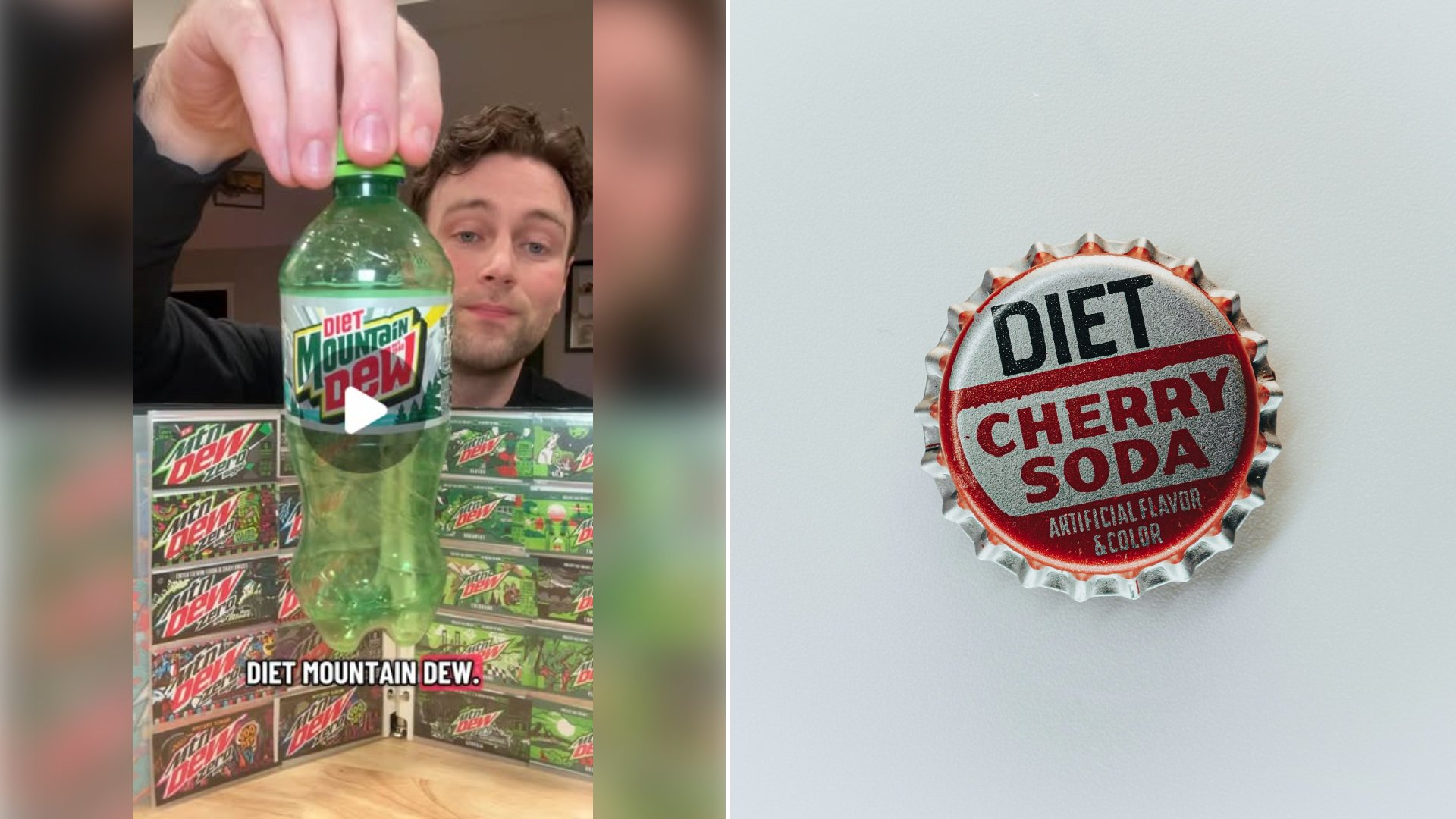
A collector who posts under the handle @e.finsanity recently shared a video that sounds almost too small to matter until it’s actually playing in front of you: a man carefully opening a binder, sliding a brand new Diet Mountain Dew label into a plastic sleeve, and talking through why this particular piece earns a spot in his collection. There’s no dramatic reveal and no eye-popping price tag attached to it, just someone who has clearly spent years building something most people would never think to start, and the quiet satisfaction in his voice is what makes the clip work.
Throughout the video, @e.finsanity pages through a binder organized by flavor and era, each label removed in one clean piece rather than torn or wrinkled. That detail matters more than it sounds like it should, because peeling a label off a bottle without destroying it is its own small skill, usually involving a soak, a steady hand, and a lot of patience. He walks through where a few of the rarer labels came from, how long certain variations stuck around on shelves before getting pulled, and why a seemingly ordinary Diet Mountain Dew label earns a spot next to labels that are decades older.
Label and packaging collecting sits inside a much older hobby called ephemera collecting, the practice of preserving printed materials that were never designed to last, things like matchbooks, postcards, ticket stubs, and product labels. Beverage labels specifically have been collected since at least the early twentieth century, when soda and beer bottling was mostly regional and local brands produced short runs that disappeared the moment a company changed ownership or a recipe got reformulated. Mountain Dew itself has that kind of tangled regional history. It was developed in Tennessee in the 1940s by brothers Barney and Ally Hartman as a mixer for whiskey, carried a cartoon hillbilly mascot on its early packaging, and wasn’t picked up by Pepsi until 1964. Every redesign along the way, and there have been dozens, created a label that only existed on store shelves for a limited window before being replaced.
That turnover is exactly what makes a hobby like this work. Labels don’t become rare because they’re beautiful or expensive to produce; they become rare because almost nobody saves them. A can or bottle gets recycled within days of being emptied, and the label goes with it. A collector who manages to preserve a clean, intact label from a short-lived flavor or a regional test release is often holding something far scarcer than the drink itself ever was, simply because they were the one person in a given town who thought to keep it instead of throwing it away. Price guides for vintage soda memorabilia routinely show flat, undamaged labels commanding more than the bottles they once wrapped, precisely because so few survived the trip from store shelf to recycling bin.
What keeps a video like this from feeling like a punchline is how little performance there is in it. He’s not selling anything, he’s not hyping a six-figure find, and he’s not pretending the hobby is cooler than it is. He’s just a guy with a system, a binder, and a genuine reason for every page. That kind of sincerity is rare online, and it’s probably why a video about peeling a soda label resonates with people who have never thought about Mountain Dew packaging in their life. Everyone has their own version of this binder, whether it’s ticket stubs, bottle caps, or old concert flyers tucked in a drawer, and watching someone else take theirs this seriously is a quiet reminder that the specific thing being collected almost never matters as much as the care behind collecting it.
More from Vinyl and Velvet
- Barbie Collector Says She Quit Dolls at 16 for Being Too Cool, Then Dug Out Her Childhood Barbies When Covid Hit and Now Films a Room Packed Wall to Wall With Them
- Convention Attendee Brings His Childhood Pokemon Binder to a Dealer Booth Just to See If He Has Anything Good, and Walks Away Minutes Later With a Blind Cash Offer of 21,000 Dollars
- Family Clears Out Their 97 Year Old Uncle Jimmy’s New Jersey Attic After His Death and Finds Six Autographed 1930s Babe Ruth Cards Among Decades of Carefully Kept Baseball Memorabilia

Leave a Reply