

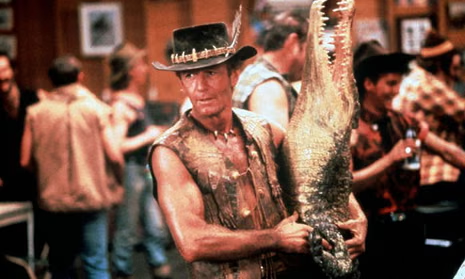
Crocodile Dundee cost about $8.8 million to make. By the time its worldwide box office run finished, it had pulled in roughly $328 million — more than 37 times its original budget, according to The Numbers’ box office database. That’s not a modest hit stretching further than expected. That’s one of the widest gaps between production cost and box office return that any film released that decade managed to pull off, and it happened with a leading man nobody in America had heard of before that September.
A Modest Budget for an Enormous Bet
Paul Hogan starred as Michael “Crocodile” Dundee, the bushman at the center of the film, and co-wrote the story himself, according to Wikipedia’s account of the production. The film premiered in Australia on April 24, 1986, months before it reached American theaters, giving distributors real evidence of its appeal before they had to gamble on a wide U.S. release. It opened stateside on September 26, 1986, riding on that Australian box office momentum rather than a traditional star-driven marketing push, since almost nobody in the U.S. audience knew who Hogan was going in.
The Numbers Behind the Sleeper Hit
The film’s opening weekend brought in $8,038,855 — a real number, but only 4.6% of its eventual total gross, according to The Numbers. That ratio is the tell. A movie whose opening weekend accounts for such a small slice of its total earnings isn’t a film that spiked and faded; it’s a film that built momentum steadily, week after week, on word of mouth rather than opening-weekend hype. It went on to earn $174,803,506 domestically and another $153,399,675 internationally, landing at a combined worldwide gross of $328,203,181.
Nine Weeks at Number One
Crocodile Dundee didn’t just open well — it held the top spot at the U.S. box office for nine straight weeks, according to Wikipedia, an unusually long run for any film, let alone one led by a first-time American movie star. By the end of its run, it ranked as the second-highest-grossing film released in the U.S. in 1986, and it stood as the highest-grossing non-American film in U.S. box office history up to that point. In Australia, the numbers were even more lopsided: it became the highest-grossing film of all time in the country, and remains the highest-grossing Australian film ever produced worldwide.
Not Everyone at Home Was Thrilled
The film’s runaway success abroad wasn’t universally celebrated back in Australia. Wikipedia notes that some Australian critics pushed back on the film’s portrayal of Australians as broadly “ocker” — a working-class, unrefined caricature that played well for international audiences precisely because it was a caricature, even as it flattened a much more varied national identity into a single marketable type. The tension is a familiar one for any regional export that becomes a global hit: the version of a place or a culture that travels best internationally is rarely the most accurate one.
The Park Nobody Had Visited Yet
Part of the film’s box office story is really a tourism story. Much of Crocodile Dundee was shot in Kakadu National Park, which at the time barely registered as a destination even domestically. “In ’86, Australians hadn’t even been to Kakadu, let alone Americans,” Peter Hook of Kakadu Tourism has said, describing a park that had essentially no hotel infrastructure and only sealed roads on its main routes, according to Kakadu Tourism’s own retrospective. The film turned that remote, undeveloped landscape into a place American audiences suddenly wanted to see for themselves — a marketing effect no studio could have engineered on purpose. Tourism Australia’s own managing director, John O’Sullivan, has put the industry’s debt to the film plainly, per the same retrospective: “the tourism industry in Australia owes Paul Hogan a hell of a lot of gratitude.”
A Return Nobody Expected From a Movie This Cheap
Two sequels followed, riding the goodwill of the original, though neither came close to replicating its numbers. What actually made Crocodile Dundee remarkable wasn’t the sequels or even the box office total on its own — it was the ratio. A film that cost under $9 million to produce didn’t just turn a profit; it became one of the era’s clearest proof points that a story built on a distinct, specific voice can outperform films with budgets many multiples larger, provided the story actually travels.

Leave a Reply