

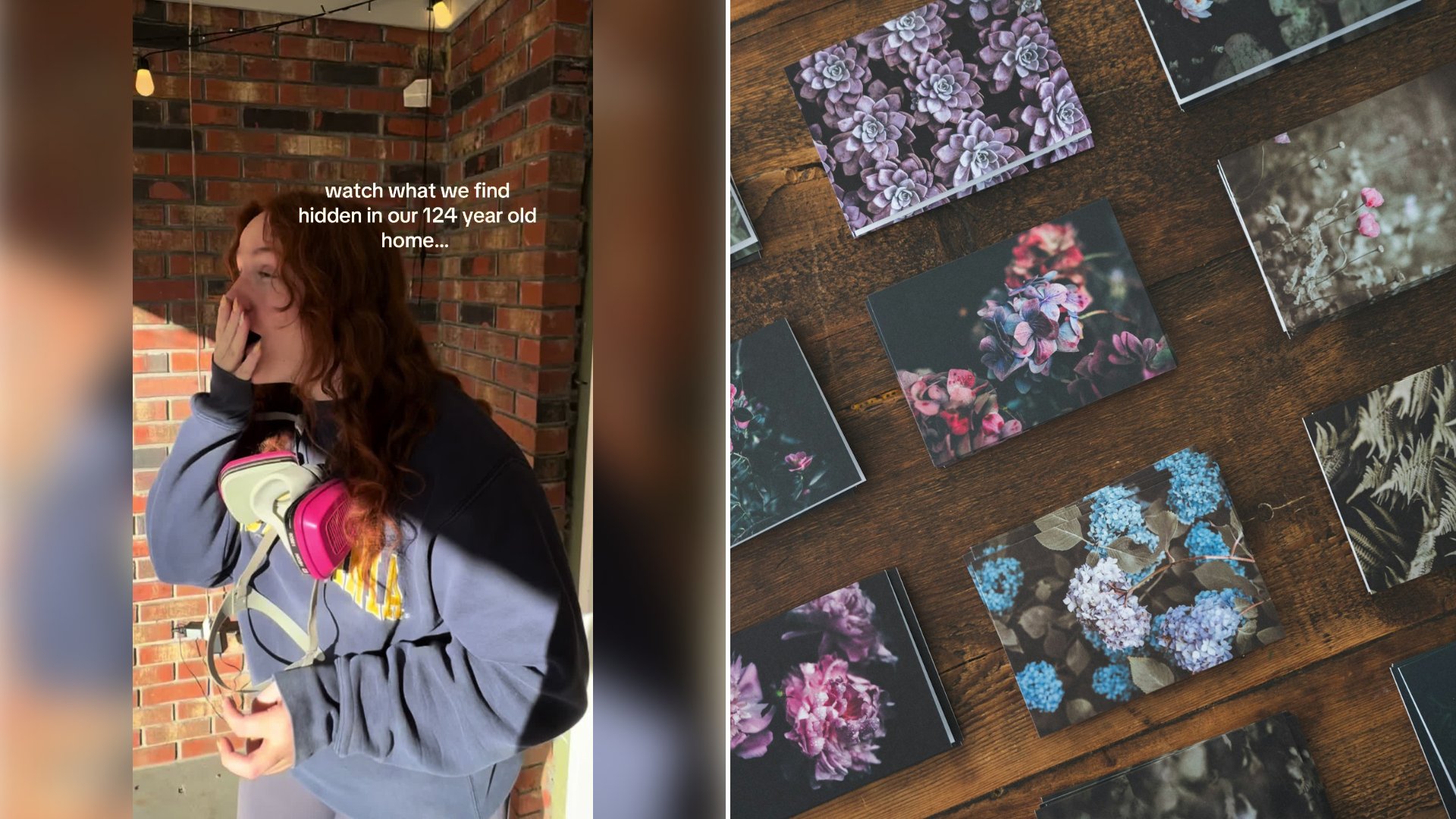
Every renovation has a moment that changes the day. For the creator behind @jennaxhall, that moment came during work on the old house she is restoring, when something flat and thin turned up. It looked like a piece of paper at first, and then someone realized it might be a picture. The post about it has been played about 17.2 million times, which tells you how many people wanted to know what was on it.
@jennaxhall
A first home that is not livable yet
According to the captions on her page, she is restoring what she calls a gorgeous 124 year old home, and she jokes that their first home is not perfect, or livable. Her bio describes a 23 year old who shares thrifting, vlogs, renovating and everyday life. The renovation series shows the house in the middle of its messy middle chapter, with ceilings coming down and fixtures coming out, and a voice she calls Bryant is heard helping out in several posts.
The speech in the posts is hard to make out in places, because the automatic subtitles are garbled, so the details below stick to what is clear and say plainly when something is her guess.
The moment of discovery
In the main post, the voices say it looks like there is another piece of paper or a picture over to one side. Someone says it is something and asks to hold on. The suggestion is to take it outside and hold it up to the sun to see it better. Once it is in daylight, a voice says it is a family photo. Then comes the line that gives the story its heart, which is that there are kids in it. Someone asks whether you can see better now, and the answer is a stunned oh my gosh, that is crazy.
Her caption asks the question that every renovator eventually faces, which is what to do with it now. She adds her own theory that the photo had to have belonged to the original family in 1900. That date is her guess, and nothing in the post confirms it. It is a reasonable instinct for a house that is more than a century old, but the real age of a photograph can only be settled by looking at its materials, its format and any markings on it. The post also does not say exactly where in the house the photo was tucked away, so this story leaves that detail open.
Other discoveries from the same renovation
The photo is not the only surprise the series has uncovered. In a separate post, she is ripping down the rest of a ceiling, hoping the shiplap continues all the way through. Instead, she spots something and asks what it is, and the answer is original wallpaper hidden above. In another, she describes attempting to remove a mantel because the room is going to become a bathroom, and she says she would not want to take a bath in it. While at it, she goes searching for a quarter that the original owner supposedly dropped behind it, a bit of house lore she does not claim to have proof of. Along the way, someone asks whether some items are matches and then says they are sparklers.
Another post is labeled as a reveal at the end, and the speech mentions a document with a date of about 1920 and the word attorney. The subtitles are unclear here, so the details are uncertain, and the same is true of a remark that the paper is falling apart and about a hundred years old. Someone is heard saying to let Bryant get it, which sounds like a good rule for anything that might crumble. Other posts in the series mention a letter reveal and a look at the bathroom, though the audio is unclear.
What should you do with a photo found in an old house?
The question in her caption deserves a real answer, because it comes up in many old houses. Here is a practical path for anyone who finds a loose photograph or paper tucked into a wall.
First, stop and protect it. Old photographs and papers are fragile, and heat, sunlight and moisture all do damage. If it has to be moved, slide it onto a clean piece of stiff paper or card instead of picking it up by a corner, and wash and dry your hands first, since skin oils can mark the surface. Taking a photo outside to see it in the sun, as the people in the post did, is understandable in the excitement of the moment, but long exposure to bright light can fade an old image, so short is better.
Second, document where it was found. Take pictures of the spot, note the room and the wall, and write down the date. Where an item turns up can hint at how it got there, whether it slipped through a gap, was tucked away on purpose or was left behind when a wall was patched.
Third, store it properly. Archival sleeves or folders made for photographs, kept in a cool, dry, dark place, are far better than a kitchen drawer or an ordinary album with sticky pages. Do not tape, laminate or glue it, and avoid framing it with ordinary mat board until you know what you have, since materials that are not acid free can stain over time.
Fourth, try to learn about it. The photo format, the clothing and the setting can help narrow a date. A local historical society, a library with a local history room or a photograph conservator can often help. County records, old city directories and census information can sometimes link a house to the families who lived there, which could give names to the faces. Any identification should be treated as a theory until something solid backs it up.
Fifth, decide what the photo is for. Some owners scan it and share the scan with local history groups while keeping the original safe. Others frame a high quality copy for the wall and store the original in a box. If a descendant of a past owner comes forward, returning a copy or the original is a kind gesture, and it can bring the story full circle.
Why a few seconds of discovery can mean so much
It is easy to see why a picture of children can stop a work crew in their tracks. Unlike a bottle, a coin or a scrap of newspaper, a photograph of a person invites questions about who they were and why the picture ended up where it did. Nobody in the post claims to know the answers, and the creator is careful to phrase it as a question. That honesty is part of why the post drew so much attention.
For her, the renovation is still going, with plenty more rooms to open and plenty more decisions ahead. What she does with the photo is up to her, and the many people who followed the story are free to suggest ideas. Whatever she decides, the picture has already done something valuable, because it has turned a house in need of repair into a place with a past that someone wants to protect.

Leave a Reply