

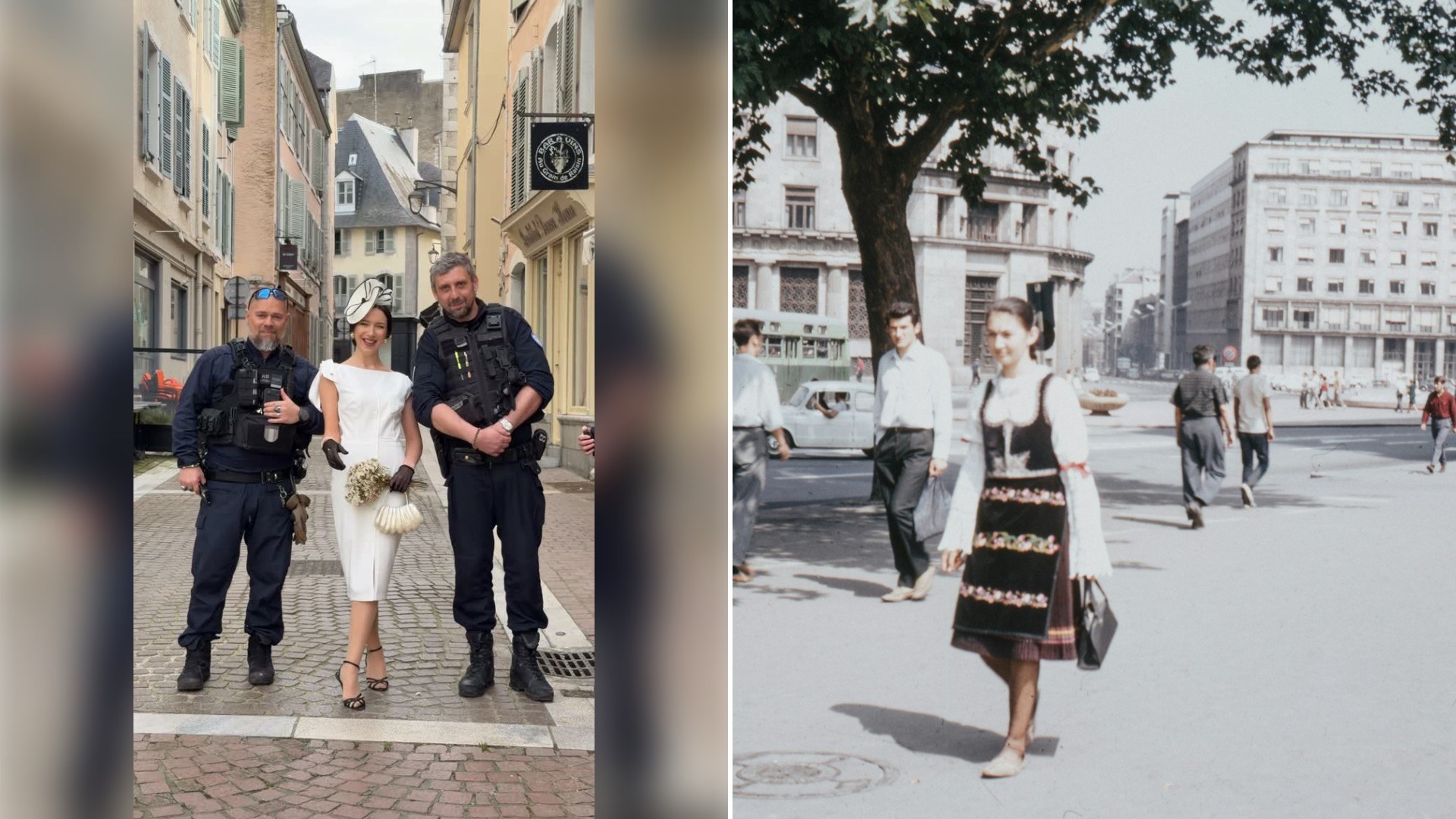
Vintage-inspired fashion content usually settles for a general impression of an era, but @barinovael aims for something far more precise, intercutting genuine archival black-and-white and color film clips of 1950s street style directly with her own recreation of the same looks and movements in a modern city setting. The goal isn’t a loose homage; it is a shot-for-shot match, attempting to replicate a specific historical aesthetic down to posture and gesture rather than simply the clothing itself.
That level of precision is what separates this video from a typical vintage-inspired outfit post. Watching the archival footage and the modern recreation side by side reveals just how closely the styling, movement, and even walking pace have been studied and reproduced, resulting in a comparison that feels uncannily exact rather than merely evocative.
Working directly from archival footage, rather than from photographs or general references, adds a layer of research most nostalgic fashion content skips entirely, since film captures movement and behavior that a still photo simply cannot. Nineteen-fifties street style specifically continues to influence modern vintage fashion communities, prized for its structured silhouettes and clearly defined visual codes that remain relatively easy to identify even decades later.
Projects built around matching real historical footage this closely also elevate vintage fashion content beyond simple styling inspiration into something closer to a genuine historical study, treating the era’s fashion as source material worth studying carefully rather than just borrowing loosely from.
The distinction between vintage-inspired and vintage-accurate matters enormously within serious fashion history circles, and this video plants itself firmly on the accurate side of that line. A vintage-inspired look borrows general silhouettes and color palettes loosely associated with a decade, often blending elements from several different years or even different decades into a single cohesive but historically imprecise outfit. A vintage-accurate recreation, by contrast, demands real research into exactly what a specific year or even a specific season looked like, down to details as granular as hemlines, hairstyles, and the particular way fabric moved on period-appropriate cuts, all of which requires genuine study rather than a general aesthetic instinct.
Archival film footage in particular offers something photographs cannot: it captures gait, gesture, and the small unconscious mannerisms of how people carried themselves in a given era, details that vanish entirely in a still image but read as immediately, subtly wrong when a modern recreation gets them incorrect. A stiff, modern walk paired with an otherwise perfect period outfit can undercut the entire illusion instantly, which is exactly why intercutting real footage directly against a recreation is such a demanding, high-risk creative choice; there is nowhere to hide an inaccuracy when the comparison sits right there on screen for viewers to judge for themselves.
The 1950s specifically remain one of the most heavily referenced decades in ongoing vintage fashion revival cycles, prized for a combination of clean structural silhouettes, distinct separation between formal and casual dress codes, and a level of visual consistency that makes the era instantly recognizable even to viewers with no particular fashion history background. That recognizability is part of what makes a project like this one so satisfying to watch, since even a casual viewer with only a loose mental image of fifties style can appreciate just how closely the recreation lines up with the genuine archival source.
There is also something worth noting about the sheer technical difficulty of sourcing usable archival street style footage in the first place, as opposed to photographs, which are far more widely digitized and searchable. Genuine period film capturing ordinary people going about their day, rather than staged studio photography or promotional material, tends to be comparatively rare and scattered across archives, historical societies, and newsreel collections, meaning simply finding the right clip to recreate is its own significant research task before any actual styling work even begins.
Vintage fashion communities online have increasingly rewarded exactly this kind of rigor, moving past simple outfit inspiration posts toward more historically engaged content that treats period style as something worth researching properly rather than just borrowing the surface aesthetic from. A creator willing to put in the archival legwork this project clearly required tends to earn a different, more dedicated kind of respect from that audience than one producing a looser, more generalized vintage-inspired look.
The modern city backdrop chosen for the recreation also plays a subtle but important role in how convincing the comparison ultimately feels. Rather than filming against a heavily art-directed, obviously staged period set, placing the recreation in an ordinary contemporary street setting makes the accuracy of the outfit and mannerisms carry the entire illusion, with nothing in the surrounding environment doing any of that work for her. That choice raises the difficulty considerably, since any inaccuracy in the styling has to stand entirely on its own against a backdrop that offers no vintage cues of its own to lean on.
There is also a quieter, more personal appeal running underneath the technical achievement here, the simple pleasure of watching someone care enough about a specific slice of history to study it this closely and then physically step into it themselves. Fashion history projects like this one function as a kind of embodied research, treating the past not as a distant reference to admire from behind glass but as something a person today can actually put on, move through, and briefly, convincingly inhabit.
For fans of vintage style, a project like this one raises the bar for what a recreation video can be, showing that with enough research and attention to archival detail, a modern creator can get remarkably close to genuinely stepping into a specific moment in fashion history.

Leave a Reply