

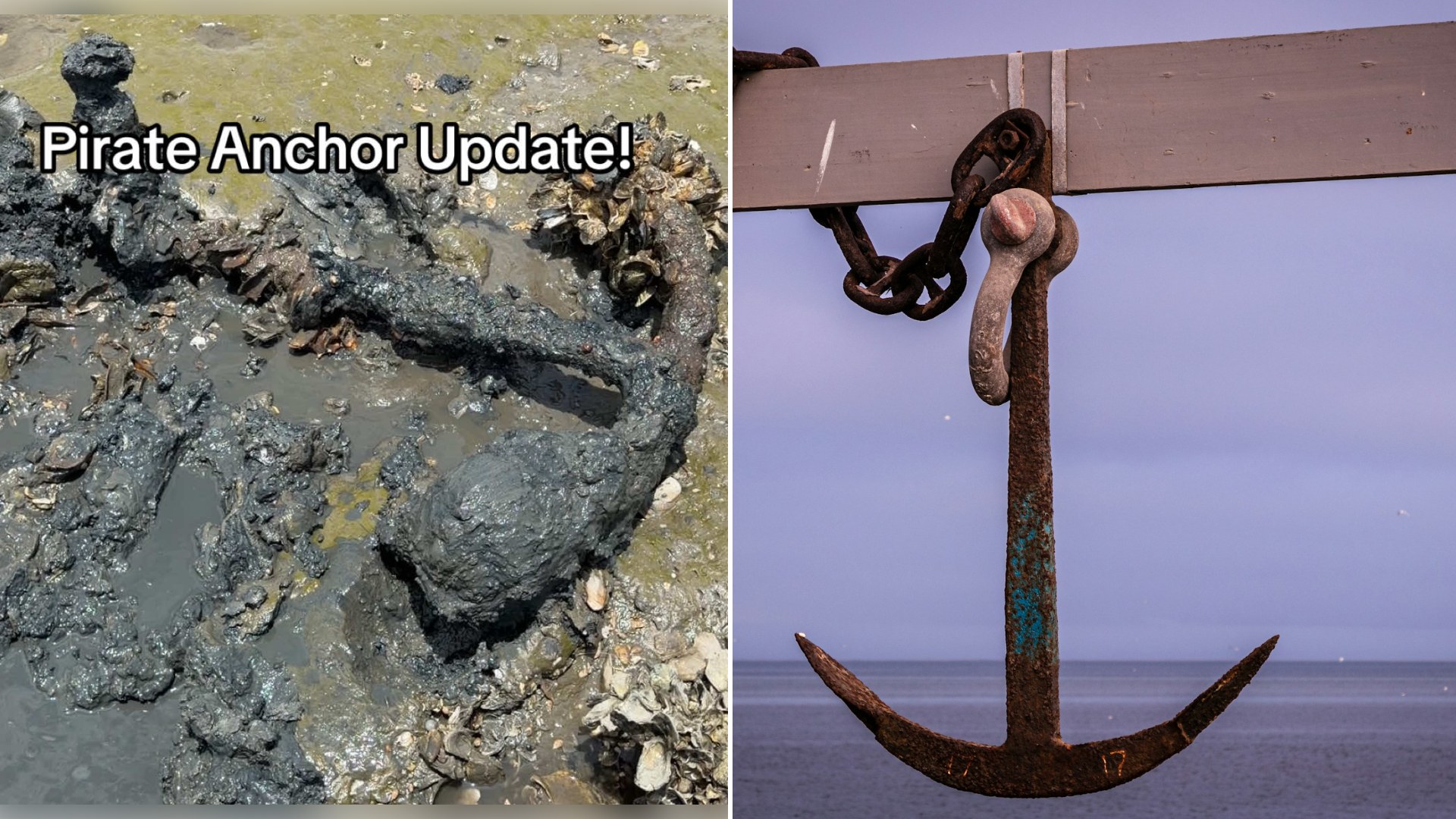
Metal restoration content tends to reward patience — the kind of slow, unglamorous process where progress is measured in small, visible changes rather than dramatic before-and-after reveals. A creator who posts as @sergei_merkelov on TikTok has been documenting exactly that kind of long-term project, giving viewers a progress update on the restoration of an anchor he describes as roughly 300 years old, scraping away layers of “rusticles” and outlining his next step: electrolysis.
The creator’s hashtags — #pirate, #history, #anchor, #explore, and #restoration — place the piece firmly in the world of maritime salvage and historical metalwork, a niche that has built a steady following on TikTok among viewers drawn to the process of bringing corroded, unrecognizable objects back into something resembling their original form. “Rusticles,” the term the creator uses for the corrosion he’s scraping off, is a real phenomenon in underwater archaeology — the icicle-like formations of rust and marine growth that build up on iron objects submerged for long periods, most famously documented on the wreck of the Titanic. Their presence on this anchor is consistent with an object that spent a significant stretch of time underwater before recovery.
It’s worth being careful, though, about how firmly to state the anchor’s age. While the project is described as centering on a roughly 300-year-old anchor, the video itself — a progress update focused on the physical process of removing rust formations — doesn’t independently document or prove that age or the anchor’s broader provenance. Dating an object like this precisely typically requires expert analysis of its construction technique, metallurgy, and any identifying marks, none of which are part of a routine restoration-progress clip. What the video does show clearly is the anchor’s current state, encrusted with the kind of heavy corrosion that suggests genuine age and prolonged submersion, whatever its exact origin turns out to be.
The next phase the creator outlines — electrolysis — is a well-established technique among serious metal restorers for removing rust from iron artifacts without further damaging the underlying metal. The process runs a low electrical current through the corroded object while it’s submerged in a conductive solution, gradually loosening rust and mineral deposits that would be difficult or destructive to remove by scraping alone. It’s a slow method, often taking days or weeks depending on the size and condition of the piece, which fits the overall tone of the video: not a quick fix, but one stage in what is clearly a long, methodical restoration.
That pacing is part of what makes this kind of content compelling to a certain audience. Rather than a single satisfying reveal, viewers get an ongoing series of incremental updates — a little more rust scraped away, a new technique introduced, a status check on a project that will clearly take a considerable amount of time to finish. For anyone interested in maritime history or hands-on metalwork, watching a heavily corroded anchor slowly shed its rusticles and inch toward its original form offers a rare, close-up look at a restoration process that most people never get to see in person.
The Slow Work of Restoring Old Metal
Restoring heavily corroded metal objects, whether a small tool or something as large as an anchor, is fundamentally a project in patience. Electrolysis is widely regarded by conservators as one of the gentler methods available for stripping rust from iron, precisely because it lifts corrosion without the abrasive scraping that can gouge or thin out original metal. For anyone attempting a similar project, it’s worth researching the specific setup carefully, since the process involves an electrical current and a chemical solution that both require proper safety precautions. It’s also worth having realistic expectations about timeline: genuine historical ironwork, especially anything recovered from a marine environment, can take weeks or months to properly stabilize and treat, and rushing the process risks doing more damage than the corrosion itself. For pieces with potential historical value, consulting a professional conservator before undertaking DIY restoration is generally the safer, more responsible route.

Leave a Reply