

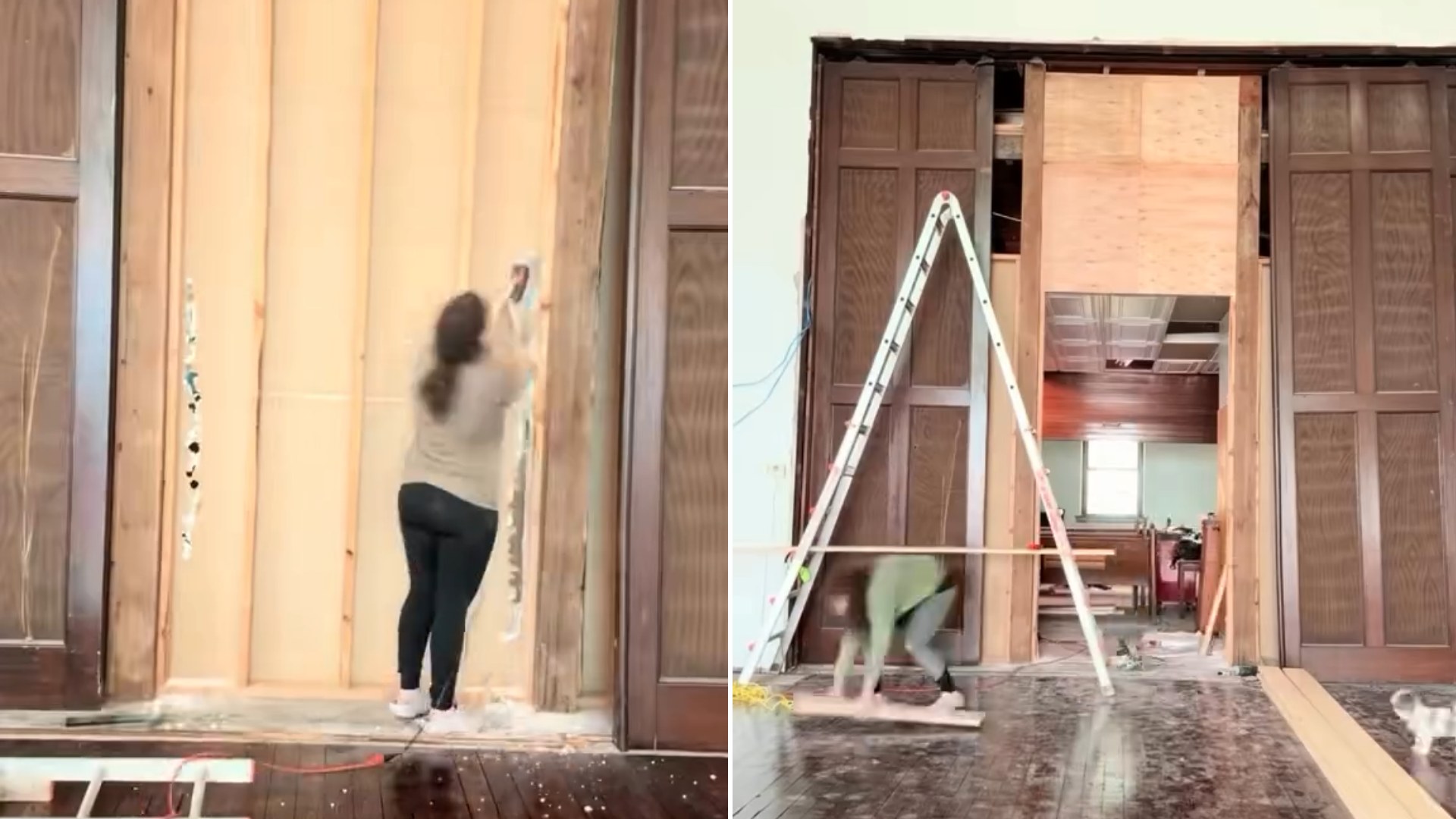
Fifteen feet. That’s the height of the pocket doors a couple found hiding behind drywall at their new wedding venue, discovered only because, as their caption puts it, they finally “listened to the town locals.” The reveal video shows them hammering straight through a wall to expose doors that had been sealed away since the 1970s, and it’s pulled in nearly 122,000 views, 60 times the account’s usual reach, from an audience that apparently can’t get enough of walls hiding something better than drywall on the other side.
Doors Built to Impress, Not Just Divide Rooms
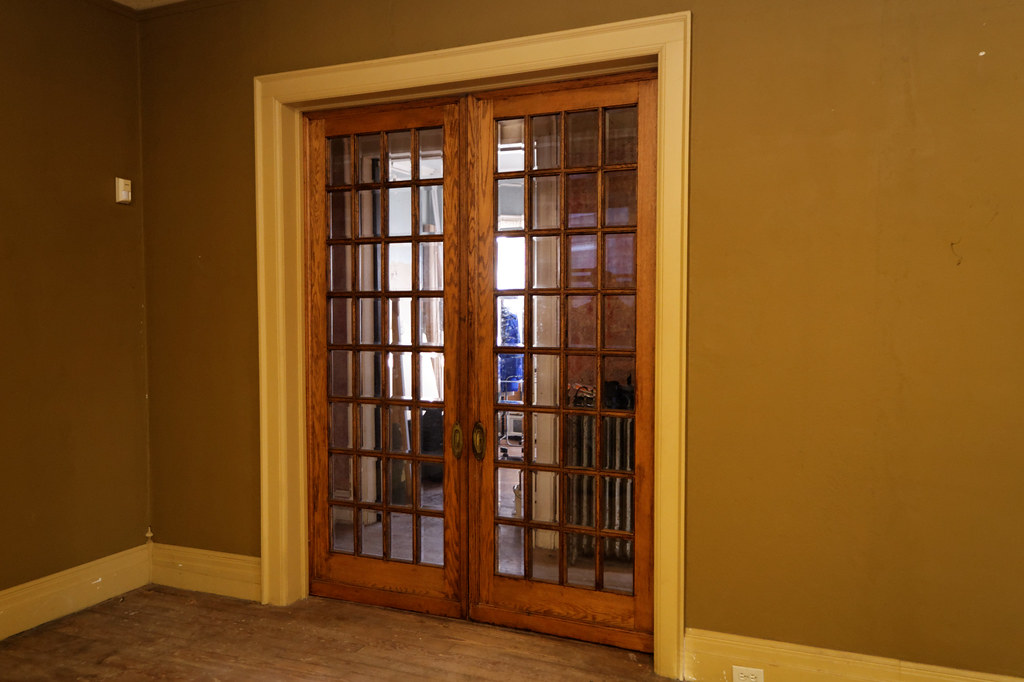
Pocket doors like these weren’t just a practical space-saving trick when they first went into grand homes. They were most popular from the 1850s through the early 1900s, showing up in Queen Anne Victorians, Italianate villas, and Colonial Revival homes, according to The Craftsman Blog. Homeowners liked them because they let a house function two ways at once, opened wide for entertaining, then slid shut for privacy, without a swinging door eating up floor space either way or bumping into furniture arranged for company. The doors themselves were often built from premium wood with ornate detailing, sometimes with elaborate carving or inlay work meant to be admired up close, which tracks with the kind of craftsmanship a 15-foot pair like this one would have needed to fill an opening that size and still glide smoothly on its original hardware.
Why So Many Got Walled Over
If pocket doors were such a showpiece, the obvious question is why anyone would bury a pair this dramatic behind plain drywall in the first place. Part of the answer is that the reputation of pocket doors declined over the twentieth century, as cheaper hollow-core doors, plastic hardware, and flimsier tracks replaced solid original craftsmanship in newer construction, per The Craftsman Blog. Once a set of doors stopped gliding the way they were designed to, homeowners of a later era often had little patience for troubleshooting century-old hardware. A later owner likely decided it was easier to close off a set of doors that no longer worked smoothly, or simply didn’t match a more modern renovation, than to maintain them properly or call in a specialist. Fifty years later, a couple with a sledgehammer and a tip from the neighbors proved that decision wrong in the most satisfying way possible.
Trusting the People Who’ve Lived There Longest
There’s a small but telling detail buried in that caption about listening to the town locals. Longtime neighbors and lifelong residents often know more about an old building’s history than a deed or a listing ever will, the kind of institutional memory that gets passed down at diners and hardware stores rather than filed anywhere official. A new owner dismissing that local knowledge as gossip is an easy, common mistake, one this couple apparently avoided just in time to find something worth fifteen feet of drywall demolition. It’s a reminder that the best clues about an old house’s secrets rarely come from paperwork at all.
What the Venue Gets Back
For a wedding venue specifically, a detail like this is worth more than a curiosity. Original architectural features have become a selling point in their own right for event spaces, the kind of backdrop couples actively search for instead of something a planner has to dress up with rented decor. Every old house has a version of this bet buried somewhere in its walls, some detail a previous owner decided wasn’t worth the trouble to keep visible. You just don’t usually get to watch the moment someone wins that argument back on camera, let alone at fifteen feet tall and wide enough to frame an entire wedding party walking through. Restoration work like this rarely happens overnight either. Cleaning, re-hanging, and re-hardware-ing a pair of doors this size, after decades sealed inside a wall, typically takes real time and real money, which makes the payoff land even harder for anyone who has ever priced out custom millwork for a project of their own. Matching new hardware to century-old track systems is its own small treasure hunt, one plenty of preservation-minded renovators would happily take on if it meant getting a detail like this one back instead of settling for a modern replacement.

Leave a Reply