

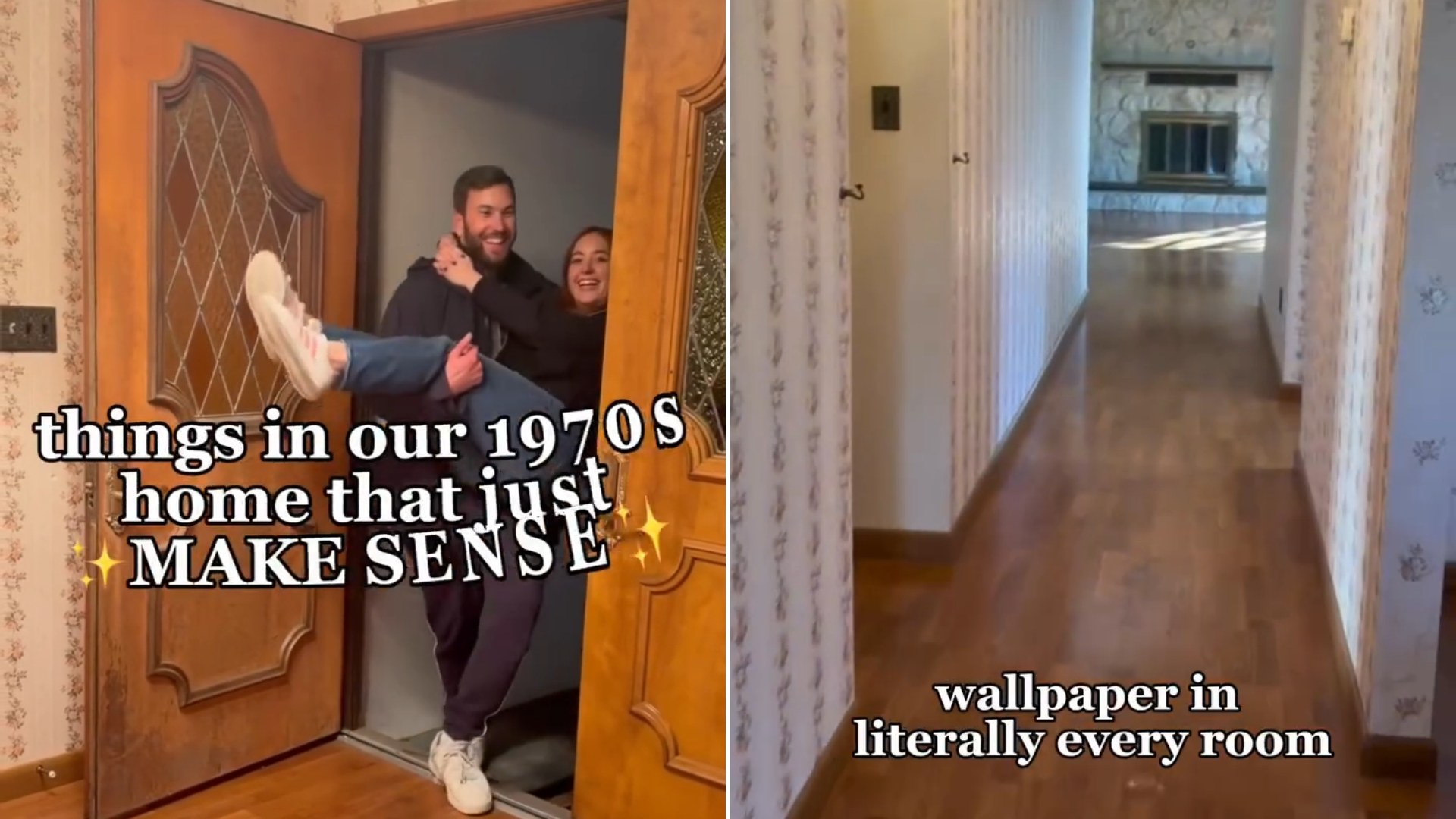
Every homeowner who buys an untouched 1970s house eventually hears the same well-meaning renovation advice from friends, contractors, and total strangers in the comments: rip it all out. One couple decided to answer that advice with a running list instead of a demolition crew, and the response has turned their unrenovated original interior into one of the more talked-about home accounts on the platform right now.
The List That Started With “It Just Makes Sense”
The Instagram Reel behind the buzz comes from home duo @kaylieandmatt, who titled the video “things in our 1970s home that just MAKE SENSE,” according to @kaylieandmatt’s own Instagram Reel. The caption doubles down with a line that reads more like a mission statement than a joke: “It’s called character.. look it up. We LOVE all of the quirky charming qualities of our 1970s home.” It is the kind of caption that turns a simple home tour into a small manifesto, and the numbers behind it suggest a lot of people agreed with the sentiment.
A Reach That Says the Video Struck a Nerve
The reel pulled in 625.4K views against a channel median of 3.4K, a jump of more than 184 times normal reach for an account with 3,400 followers. That kind of spike rarely happens by accident. It tends to happen when a video says out loud something a specific audience has been waiting to hear, and “please stop telling me to gut my original house” turns out to be exactly that sentiment for a large slice of the home-renovation corner of Instagram right now.
Why 1970s Built-Ins Keep Getting a Bad Reputation
The decade gets an unfair rap in renovation circles. Sunken conversation pits, built-in wet bars, floor-to-ceiling wood paneling, and custom shelving units were not cheap afterthoughts when they went into houses like this one — they were often the most deliberately planned, most expensive parts of the original build. A sunken living room required structural framing most contractors today would rather avoid than replicate from scratch. Paneling that has survived five decades without warping or delaminating was milled from real wood, not the thin veneer-over-particleboard version sold under the same name in big-box stores now. None of that history shows up in a real estate listing photo, which is exactly why so many of these features get torn out by buyers who never lived with them long enough to understand what they were actually looking at.
The Case for Character Over a Blank Slate
What makes this particular reel land isn’t a dramatic renovation reveal — there isn’t one, and that is the point. The caption frames every quirky detail as a feature instead of a flaw, and viewers responding in the hundreds of thousands seem to agree that a house does not need to look like a fresh magazine spread to be worth living in. In a renovation landscape dominated by all-white kitchens and matching gray flooring, a couple standing firm on keeping their original built-ins reads less like a passing trend and more like a small, deliberate act of preservation.
Reading the Comments Instead of the Contractor’s Quote
Videos like this one tend to pull two very different crowds into the same comment section. One side is made up of people who grew up in houses exactly like this and recognize every built-in on sight, ready to defend a sunken pit or a paneled den the way other people defend a childhood home. The other side is renovation-forward viewers convinced that any surface older than a decade belongs in a dumpster. Watching those two camps argue underneath a single 30-second video is its own kind of entertainment, and it is a big part of why a reel from a relatively small account with 3,400 followers ended up traveling so far past its usual audience.
What This Means for Anyone Sitting on an Original 1970s House
The lesson traveling with this video is a simple one: before a single sledgehammer swings, it is worth asking whether a feature is genuinely dated or just unfamiliar. Original built-ins carry real information about how a house was designed to be used — where people gathered, where a bar cart lived, where a family sat down together without a screen dictating the layout of the room. Ripping that out is permanent, and it is not reversible once the lumber hits a dumpster. Keeping it, at least long enough to actually live with it through a season or two, costs nothing but patience. Judging by the reaction under this particular Reel, a growing number of viewers are starting to agree that “character” really is worth looking up before it gets thrown out with the demo debris.

Leave a Reply